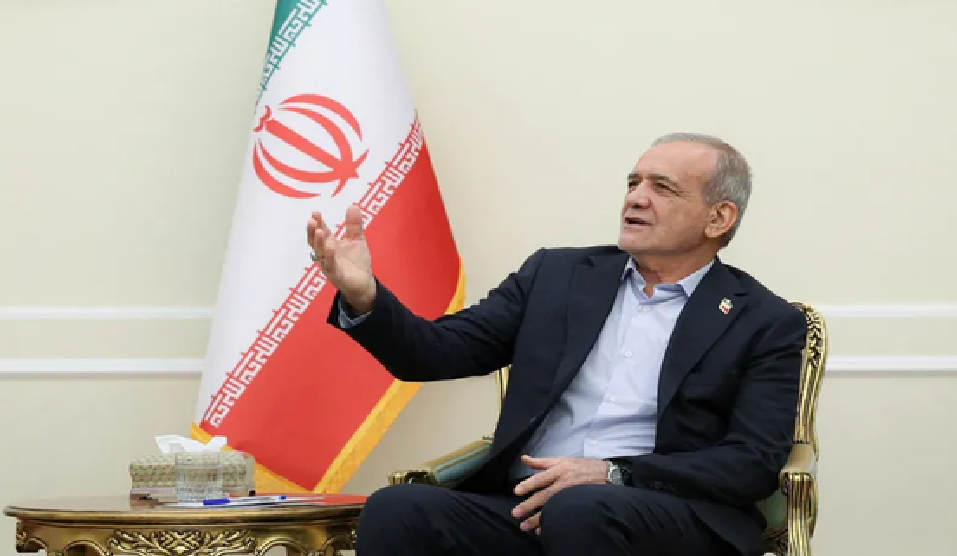
Iran's President, Masoud Pezeshkian "Peace, Not Surrender."
DeepSeek research response:
10 citations
- LNG Trade Through Hormuz Extends Rebound Despite Shipping Risks — gCaptain, Oct. 5, 2026. Link
Description: gCaptain’s syndicated Bloomberg report on the September–October LNG rebound.
Summary: At least three LNG shipments exited Hormuz after late September, and September outbound traffic was the highest since the war began. The article said flows remained more than 75% below pre-war levels and that shipping risks were still acute. On Oct. 4, UKMTO reported a tanker hit by an unknown projectile inside Hormuz. - Qatar Brings Empty LNG Ships Into Gulf in Potential Export Boost — gCaptain, Oct. 7, 2026. Link
Description: gCaptain/Bloomberg report on Qatar positioning empty LNG tonnage for a possible export increase.
Summary: At least 12 QatarEnergy-linked ballast LNG carriers were waiting in the Persian Gulf, with capacity of about 1.1 million tons. The report cautioned there was no guarantee they would sail through Hormuz because Iranian attacks had intensified. It said LNG traffic had risen in September but remained about 75% below February pre-war levels. - Qatar LNG Cargo Makes Rare Red Sea Journey to Get Gas to Europe — gCaptain, Oct. 19, 2026. Link
Description: gCaptain/Bloomberg report showing the workarounds still needed for Qatari LNG.
Summary: A Qatari LNG cargo loaded in August was sailing north through the Red Sea toward Poland, a rare routing because of Houthi risk. The tanker’s security team exchanged gunfire with a skiff in the Gulf of Aden. The article said European gas prices were the highest in almost four years and inventories at the lowest seasonal level in over a decade. - Iran Prolongs Talks in Stalemate to Influence US Midterms — gCaptain, Oct. 20, 2026. Link
Description: gCaptain/Reuters report on Tehran’s negotiating strategy and the strait’s status.
Summary: Iranian officials said Tehran was deliberately prolonging talks to weaken Trump before the Nov. 3 midterms. The article described Hormuz as effectively closed by Iran since the war began and traffic as a trickle. It said there was little chance of a breakthrough before the elections. - Long Road Ahead for LNG Recovery, Study Finds — Industrial Info Resources, Oct. 22, 2026. Link
Description: Summary of an Oxford Institute for Energy Studies (OIES) LNG scenario report.
Summary: OIES estimated about 80% of previously available Qatari and UAE LNG remained sidelined by security risks. It concluded there was “no real breakthrough on reopening the Strait of Hormuz for the full year” and that flows would remain heavily restricted. Its base case now assumes a return to normal only by April 2027, with infrastructure damage constraining supply for years. - A new world order emerges in LNG shipping — Splash247, Oct. 21, 2026. Link
Description: Shipping-market analysis using Vortexa and Kpler LNG transit/loading data.
Summary: Vortexa recorded only five confirmed LNG carrier transits of Hormuz in the latest week, versus a four-week average of 12, and only two were laden outbound. Kpler found 13 Qatari LNG loadings Oct. 1–13 but only four with active AIS. Edison had received force majeure notices covering 35 Qatari cargoes through early December, while damage removed 12.8 million tonnes per annum of Ras Laffan capacity. - Strait of Hormuz traffic plunges once again amid new wave of Houthi attacks — Anadolu Agency, Oct. 13, 2026, updated Oct. 14. Link
Description: Operational count of transits and attacks in the second week of October.
Summary: At least 14 attack, attempted-strike, or obstruction incidents were recorded in and around Hormuz Oct. 5–12, including six ships attacked on Monday alone. Commercial transits fell to six on Monday from 32 on Oct. 8, the lowest since July 22. Middle East crude, petroleum, and LNG exports plunged, with the weekly crude average at 17 million barrels per day versus about 23.3 million pre-war. - Across the Globe — Council on Foreign Relations, Oct. 9, 2026. Link
Description: CFR newsletter summarizing the U.S. blockade and failed U.S.–Iran talks.
Summary: A U.S. blockade on traffic to and from Iranian ports in Hormuz took effect at 10 a.m. ET on Oct. 9. U.S.–Iran talks in Islamabad failed after more than 20 hours, with Hormuz shipping and frozen assets among the sticking points. The ceasefire was described as holding, but no reopening deal was reached. - Iran says US approves 7-day plan, Hormuz Strait may be fully reopened — Lao Động, citing IRNA, Oct. 21, 2026. Link
Description: Translation of Iranian Foreign Minister Abbas Araghchi’s Oct. 21 interview with Iraq’s Al-Ekhbariya.
Summary: Araghchi said the U.S. had accepted the conditions of Iran’s seven-day plan but wanted to add clauses. He said Hormuz could be fully reopened on Friday if those conditions were met. He also warned that the strait would not fully open without an agreement. - Hormuz LNG Flows Still Down More Than 75% Despite Rebound — TankTerminals/Oil Price, Oct. 6, 2026. Link
Description: LNG-flow assessment for late September and early October.
Summary: At least three LNG carriers transited Hormuz after late September, extending a rebound. September’s 21 cargoes were the highest monthly total since the war began but only about 25% of pre-war volumes. UKMTO reported an attack on a tanker, the eighth incident in a week, while Asian and European gas prices hit their highest since the 2022–23 crisis.
Current read as of Oct. 22, 2026
The resolution condition is not met today. The Strait is partially navigable for LNG, but gCaptain’s own latest LNG-specific reporting describes flows as more than 75% below pre-war levels with acute attack risk—plainly “severely restricted,” not “de facto unimpeded.”
Latest available data
| Indicator | Latest value | Date/source |
|---|---|---|
| Confirmed LNG transits through Hormuz | 5 in latest week; 4-week average 12; only 2 laden outbound | Splash247, Oct. 21 |
| Qatari LNG loadings, Oct. 1–13 | 13 loadings; only 4 with active AIS | Splash247/Kpler, Oct. 21 |
| September LNG cargoes exiting Hormuz | ~21, about 25% of pre-war volume | TankTerminals, Oct. 6 |
| Qatari/UAE LNG sidelined | ~80% of previously available supply | OIES via Industrial Info, Oct. 22 |
| Overall commercial transits | 6 on Monday vs. 32 on Oct. 8 | Anadolu, Oct. 13 |
| Pre-war LNG baseline | ~3 LNG cargoes/day; ~20% of global LNG | gCaptain/TankTerminals |
| Qatar liquefaction damage | 12.8 Mtpa removed; repairs potentially years | Splash247, Oct. 21 |
| European gas context | Prices highest in almost 4 years; storage lowest seasonal in over a decade | gCaptain, Oct. 19 |
Bottom line: As of Oct. 22, 2026, gCaptain is reporting a fragile, partial LNG rebound—not de facto unimpeded traffic. A Yes by year-end would require a rapid security and insurance normalization that neither gCaptain’s current reporting nor the OIES base case presently supports.
=== Forecast Result ===
Baseline Conditions as of Late October 2026
- Traffic and Volume Deficit: Commercial transits remain depressed. Splash247 and TankTerminals data indicate confirmed LNG transits are running at ~5 per week (with only ~2 laden outbound), compared to a pre-war baseline of ~21 per week. Overall Qatari and UAE LNG exports remain roughly 75% to 80% below normal levels.
- Security Environment: October has seen some of the heaviest shipping attack volumes of the conflict, with UKMTO and Kuehne+Nagel recording dozens of incidents targeting tankers, bulk carriers, and gas carriers.
- Operational Obstacles: An active U.S. naval blockade on Iranian ports took effect on October 9, commercial insurers have kept war-risk premiums prohibitive or canceled coverage, and vessel operators are forced to coordinate escort or operate dark. Additionally, 12.8 Mtpa of Qatari liquefaction capacity at Ras Laffan has suffered physical damage, with force majeure notices active into early December.
- Analyst Consensus: The Oxford Institute for Energy Studies (OIES) baseline outlook (October 22, 2026) projects that flows will remain heavily restricted throughout 2026, establishing April 2027 as the earliest base case for return to normal maritime flows.
Data sufficiency: Sufficient
Probability: 8%
End
About The Author