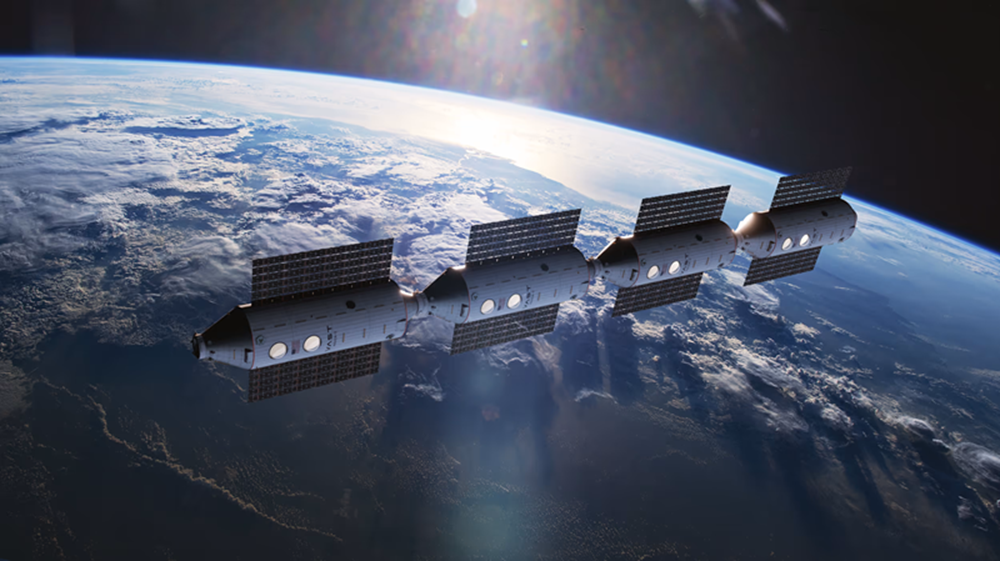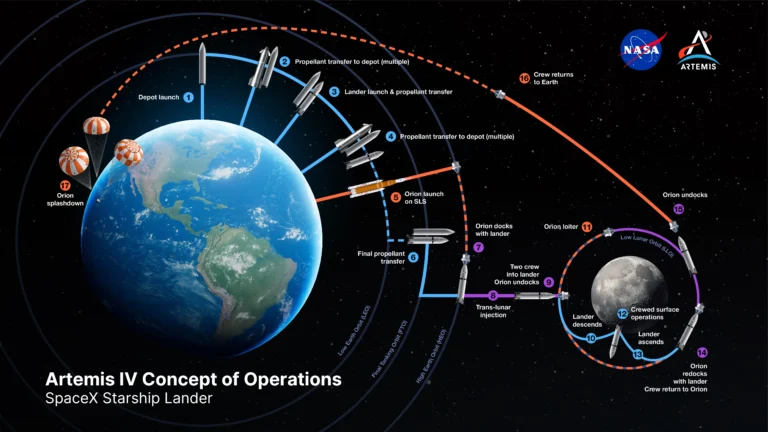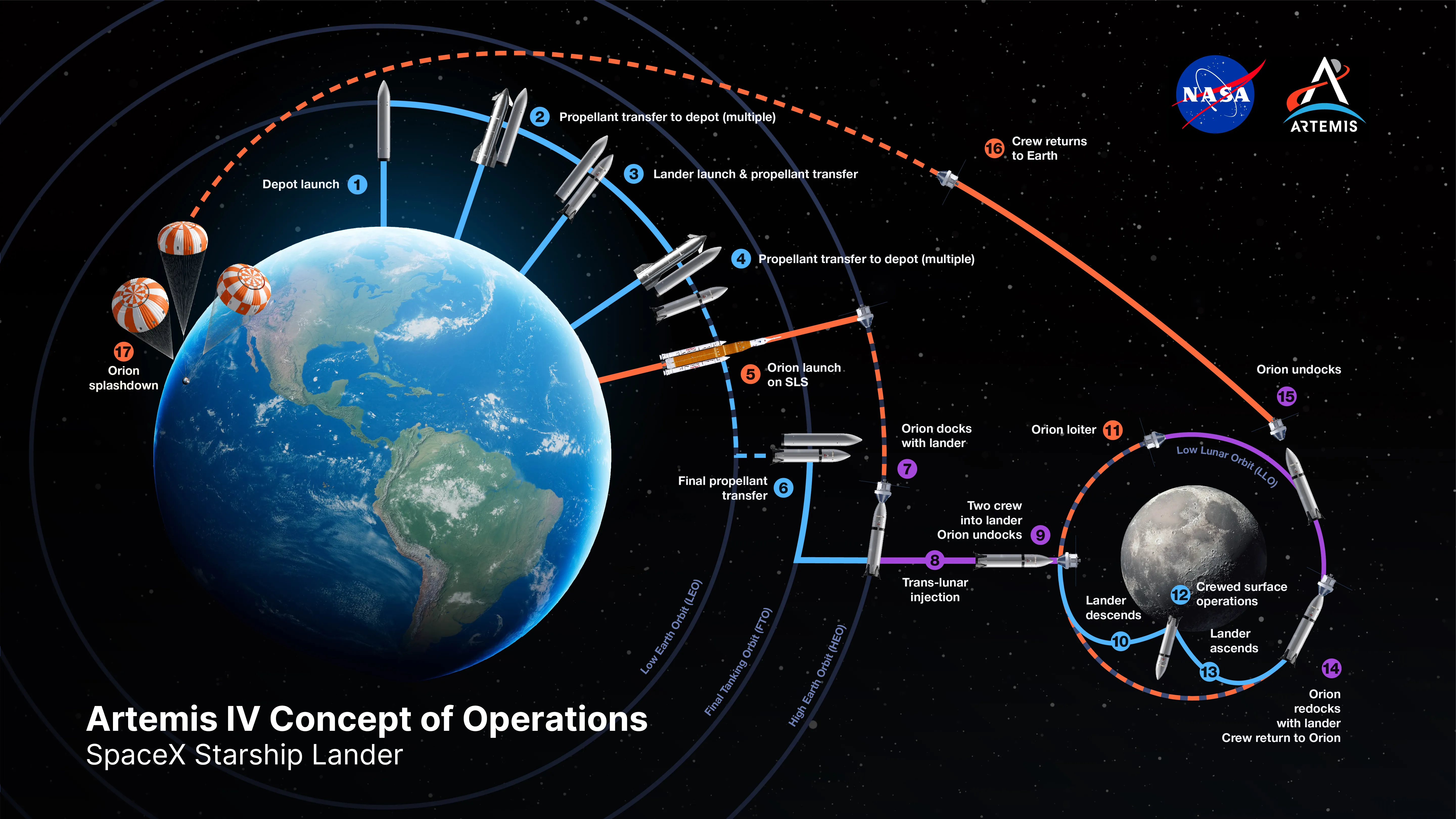
Image: SpaceX continues to plan for an in-space propellant aggregation approach to transfer super cold, or cryogenic, liquid propellant in space. The company will launch multiple versions of Starship to low Earth orbit prior to the launch of the Starship Human Landing System (HLS) from Florida. Similar to a gas station on Earth, the series of propellant “tanker” Starships in low Earth orbit will transfer propellant to the waiting “depot” Starship. The depot Starship will ultimately fuel the Starship lander for its journey to the Moon.
DeepSeek research response:
- Moon to Mars | NASA’s Artemis Program — NASA, official resolution source. Undated; accessed Oct. 26, 2026.
Description: NASA’s official Artemis mission-of-record page.
Summary: The page states that Artemis III is “Launching in 2027” and will send NASA astronauts Randy Bresnik, Frank Rubio, Andre Douglas, and ESA astronaut Luca Parmitano on a low-Earth-orbit demonstration mission. It says the crew will test rendezvous and docking with test versions of commercial human landing systems developed by Blue Origin and SpaceX. The page separately states that NASA’s first crewed Moon landing under Artemis will be Artemis IV in 2028. - NASA’s Artemis III Mission to Test Future Moon Lander Operations — NASA. Oct. 22, 2026.
Description: Detailed NASA mission profile released after the latest Artemis program review.
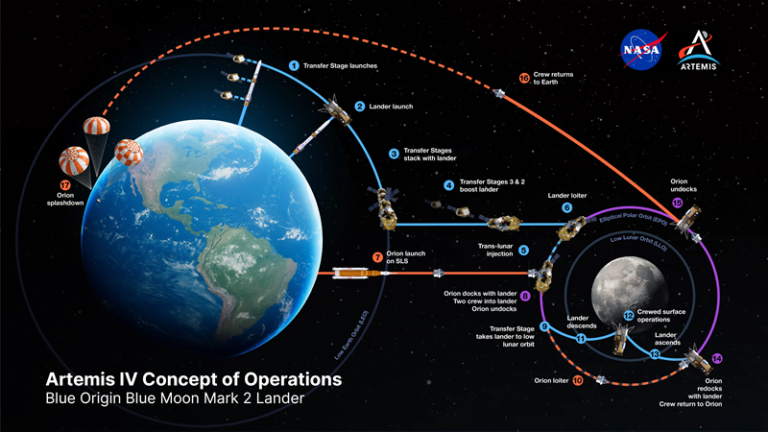
Summary: NASA describes a planned 14-day, 2027 mission using three rockets: Blue Origin’s New Glenn with a Blue Moon Mark 2 test article, NASA’s SLS with Orion and four astronauts, and SpaceX’s Starship Version 3 test article. Orion is to dock first with Blue Moon around flight day three, spend about two days with the crew inside, then later dock with Starship for up to two hours without crew ingress. NASA frames the flight as risk reduction for a crewed lunar landing in 2028, not as a lunar landing itself. - NASA Completes Artemis III Booster Stacking, Shares Status Update — NASA. Oct. 13, 2026.
Description: Official SLS, Orion, and crew-training progress update.
Summary: NASA says teams completed stacking the twin five-segment solid rocket boosters for the Artemis III “short stack” on Sept. 30 and installed all four RS-25 engines on the core stage. The core stage is to be mated to the boosters in the coming weeks, after which the short stack will roll to Launch Pad 39B for a tanking test “in the coming months.” The update also says the mission-specific spacer and adapters remain on track to ship to Kennedy early next year, but it does not provide a launch date. - NASA is Full Steam Ahead on Artemis III, IV and V — SpacePolicyOnline. Oct. 23, 2026.
Description: Independent report on NASA’s Oct. 23 Artemis briefing.
Summary: NASA officials reaffirmed a mid-2027 Artemis III launch and 2028 landings on Artemis IV and V, while acknowledging that the schedule had been “90 days broken” in a September workforce note. The article details the three-launch sequence: Blue Moon MK2 first, Orion/SLS second, and Starship on day six, with Orion docking with Blue Moon on day three and Starship for only about two hours. It flags slow human-lander and spacesuit progress and says SpaceX’s first in-space cryogenic propellant transfer is expected in early 2027, with an uncrewed lunar landing test in late 2027. - NASA eyeing year-end tanking test and summer 2027 launch for Artemis III — Aerospace America. Oct. 23, 2026.
Description: Trade-press account of NASA’s Oct. 23 update, including a displayed schedule chart.
Summary: NASA Administrator Jared Isaacman said SLS booster/core-stage integration was proceeding toward a year-end tanking test and a summer 2027 Artemis III launch, and a chart shown at the briefing indicated a May-to-September 2027 window. Artemis program manager Jeremy Parsons said both lander test articles were “progressing really well,” but Blue Origin was rebuilding its New Glenn pad after a May explosion, with pad operations targeted for November and return to flight soon after. SpaceX was analyzing its most recent Starship flight and targeting another in November while building the passive docking system for the Artemis III test article. - NASA lays out a packed 14-day schedule for Artemis III — Scientific American. Oct. 23, 2026.
Description: Independent schedule and risk analysis of the revised Artemis III mission.
Summary: Scientific American reports that Artemis III is expected in summer 2027, with a 14-day nominal mission that could stretch to 17 days. It describes Blue Moon launching first, Orion docking three days later for two days of tests, and Starship launching on day six for a roughly two-hour docking. It highlights that New Glenn has not flown since a spectacular May explosion, that SpaceX has had multiple Starship failures despite reaching orbit, and that neither lander has yet flown with crew. - ‘The most complicated launch campaign ever’: NASA lays out mad dash to test lunar landers — CNN. Oct. 23, 2026.
Description: CNN synthesis of mission complexity and contractor readiness.
Summary: CNN reports that Artemis III will require three heavy-lift launches and multiple dockings in a roughly 14-day mission, which NASA calls likely the most complicated launch campaign ever undertaken. It says neither lander has flown with crew or docked with a crewed spacecraft, and that the landers—not Orion or SLS—are currently driving the schedule. It notes Blue Origin’s New Glenn explosion destroyed its Florida launch site and that SpaceX’s Starship had only recently completed its first orbital test flight.eporting technical and programmatic risks “likely to delay their schedules,” and that 25 of 36 major projects had felt the effects of a nearly 22% cut in NASA’s civil-servant workforce. The report also notes that the FY2027 budget request proposed a further cut of more than 20%, adding uncertainty to NASA’s ability to execute the revised Artemis plan.
| Mission | NASA’s current official position | Key detail |
|---|---|---|
| Artemis II | Launched April 2026 | Crewed lunar flyby completed; SLS/Orion have now flown with crew |
| Artemis III | Launching in 2027 | 14-day LEO demo; four astronauts; rendezvous/docking with Blue Moon MK2 and Starship test articles |
| Artemis IV | 2028 | First crewed Artemis Moon landing under current plan |
| Artemis V | 2028 | Lunar surface mission; NASA envisions roughly one mission per year afterward |
Net assessment of the news flow: the latest authoritative updates are modestly positive for a 2027 flight—NASA has reaffirmed the plan, SLS hardware is moving, and the mission design is less demanding than a lunar landing. But the schedule remains fragile because the two commercial landers and New Glenn are not yet flight-proven for this mission, no exact launch date exists, and the three-launch campaign has multiple single-point schedule risks. The key near-term signals are the year-end 2026.
Extracted resolution criteria links:
[‘https://www.nasa.gov/humans-in-space/artemis/‘
=== Forecast Result ===
=== Reasoning ===
Looking at this forecast, I need to weigh several interlocking factors:
Positive signals for 2027 completion:
- NASA has publicly reaffirmed the Artemis III 2027 timeline as recently as Oct 23, 2026, with specific crew assignments and detailed mission architecture
- SLS/Orion hardware (the most mature piece) is progressing well: boosters stacked, RS-25 engines installed, tanking test targeted for year-end 2026
- The mission architecture has built-in flexibility (Blue Moon can loiter 30 days; three separate launches rather than one tightly coupled stack)
- There’s substantial schedule buffer: even a “summer 2027” target slipping by 3-6 months would still land before the Dec 31, 2027 resolution deadline (mission is only 14-17 days)
- SpaceX reached orbit with Starship for the first time (Sept 2026), showing progress, and SpaceX historically iterates quickly
Major risk factors:
- This is explicitly called “the most complicated launch campaign ever” by NASA officials themselves — three rockets, three spacecraft, multiple novel docking geometries
- Blue Origin’s New Glenn suffered a catastrophic pad explosion in May 2026; Blue Moon (any version) has never flown; the MK1 uncrewed demo is itself not yet complete
- Starship V3 (the specific variant needed) still requires docking-system integration, propellant-transfer demonstration, and reliable orbital operations — Starship’s historical reliability record has been uneven
- NASA’s own Administrator described the schedule as “90 days broken,” and GAO flagged technical/programmatic risks “likely to delay” Artemis schedules
- No exact launch date has been set; only a broad May–September 2027 window
- Historical base rates for NASA mega-programs (SLS/Orion development itself slipped years; similar commercial crew/lander programs have experienced significant schedule slips)
Key uncertain assumption — resolution scope: The background text says “one or both” providers, while NASA’s current official mission page frames it as testing both landers. If strict interpretation requires both landers’ successful demonstrations, probability drops significantly (given Blue Origin’s compounding risks: New Glenn RTF → Blue Moon MK1 → Blue Moon MK2, all before Dec 2027). If a looser interpretation applies (success with just one lander counts), the probability rises substantially, since SpaceX’s Starship path alone has reasonably good odds of readiness in that timeframe.
Weighing a blended probability across these interpretations, accounting for NASA’s historical tendency toward schedule slips on first-of-kind complex missions, the maturity gap in lander hardware (neither lander has flown anything close to the required demonstration), and reasonable schedule buffer within the 2027 calendar year, I arrive at a moderate-to-below-even probability.
Data sufficiency: Sufficient
Probability: 37%
End
About The Author