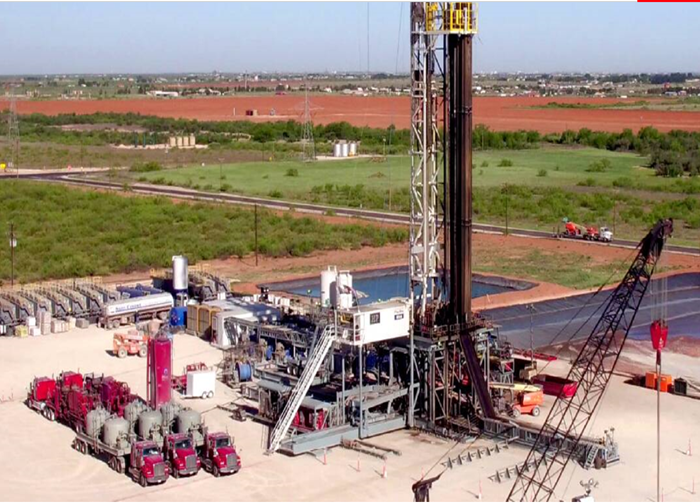
Crude oil extraction in the Permian Basin. The merger of ExxonMobil and Pioneer creates an unconventional business with the largest high-return development potential in the Permian Basin. Source: https://corporate.exxonmobil.com/who-we-are/our-global-organization/business-divisions/upstream/unconventional
Deepseek Binary response:
The evidence strongly favors No. Brent is around $105/barrel on 2026-10-13, and the visible 52-week low is roughly $58.72, already well above $50. There is no indication that Brent traded below $50 at any point earlier in 2026. To resolve Yes, Brent would need to fall by about 52% from the current level before 2026-12-31, a window of roughly 11 weeks.
Key points:
- EIA’s latest Q4 2026 Brent forecast is around $105, and its full-year 2026 forecast is around $96–98.
- Goldman Sachs’ December 2026 forecast is around $90, still $40 above the threshold.
- Recent bearish catalysts, such as ceasefire hopes or IEA stock releases, only moved Brent down to roughly $97–103, nowhere near $50.
- A sub-$50 print would require an extreme, rapid collapse in the geopolitical risk premium plus a severe demand shock or massive supply restoration, all within a few months. No current forecast or observed trend supports that.
Statistically, a >50% decline in Brent over 11 weeks is a tail event. Given current volatility, it is likely less than a 1% probability, though fat-tailed commodity markets and sudden geopolitical shifts justify not rounding all the way to zero. The main assumptions that could alter this are: (1) the historical 2026 data is correctly showing no prior sub-$50 breach, (2) no unprecedented exogenous shock drives a 2008- or 2020-style collapse in the remaining window, and (3) the resolution source does not record an anomalous outlier print. These assumptions are very likely correct.
Data sufficiency: Sufficient
Probability: 1%
Grok response:
Current Brent Crude price (as of Oct 13, 2026): Approximately 104–106 USD per barrel (intraday trading around 104.35–106.65, closing near 104.5–105.4 on recent sessions).[1][2][3]
2026 price range and history so far: The 52-week range (through mid-Oct 2026) is roughly 58.72–126.41, with 2026 YTD averages around 90–94 USD/bbl. Monthly/quarterly figures show early-2026 lows near 59–71 (Feb), rises to 103–120 (Mar–Apr), and recent September levels around 95–117 depending on the exact series, with October trading consistently above 96–100.[4][5][6]
No breach of 50 USD/bbl in 2026 to date: All available daily, weekly, and monthly data through October 13, 2026, place the lowest 2026 prints well above 50 (earliest 2026 levels in the 59–71 range; subsequent dips in September reached the mid-90s at lowest).[7][8][9]
Near-term and Q4 2026 outlook: Prices have been supported by Middle East supply disruptions (Strait of Hormuz constraints, shut-ins averaging millions of bpd), declining global inventories, and tight diesel markets. EIA’s latest Short-Term Energy Outlook (Oct 6, 2026) forecasts a Q4 2026 average of 105 USD/bbl (revised +14 from prior month) and a full-year 2026 average of ~96 USD/bbl.[10][11]
2027 and longer-term forecasts: Most analysts expect moderation as supply recovers (majority of Middle East production back by end-Q2 2027), with 2027 averages projected at 81–84 USD/bbl (EIA, BMI, others). Risks remain tilted toward volatility from geopolitics, but base cases stay far above 50.[12][13]
Volatility and seasonal context: 2026 has featured sharp swings (e.g., Apr highs near 126–138, September dips toward 93–97), but no seasonal Q4/Q1 drop-off has pushed prices anywhere near 50. Forward curves and consensus remain elevated through year-end.[2][4]
Authoritative resolution source snapshot (Trading Economics, Oct 13, 2026): Shows ~104.81 USD/bbl (–1.72% daily), with a 1-year change of +67.59% and a quarterly forecast near 108.60. Historical all-time high remains 147.50 (2008).[1]
Expert/institutional views: Recent revisions (EIA, BMI) have lifted 2026–2027 forecasts due to persistent supply risks; no credible outlook anticipates a drop below 50 in the remainder of 2026.[10][12]
Summary context for the question: Brent has traded in the 90–120+ range throughout 2026 to date with current levels near 105 and forecasts holding above 80–100 through year-end. No data or outlook indicates movement toward or below the 50 USD/bbl threshold.
Extracted resolution criteria links:
[‘https://tradingeconomics.com/commodity/brent-crude-oil’]
=== Forecast Result ===
=== Reasoning ===
Overview and Historical Status
As of October 13, 2026, Brent Crude is trading at approximately $105.58 per barrel on the resolution source (Trading Economics). A review of 2026 price history confirms that Brent has not traded anywhere near $50 at any point this year:
- The 52-week low sits around $58.72 (recorded in late 2025 / early 2026).
- The 2026 year-to-date low occurred around mid-year in the $75–$80 range.
- Throughout September and October 2026, prices have traded between $95 and $117, supported by Middle East disruptions (including Strait of Hormuz shipping risks and infrastructure attacks), depleted OECD inventories, and ongoing Russian supply friction.
For the market to resolve “Yes,” the price must fall from roughly $105.60 to below $50.00 between October 14 and December 31, 2026—a decline of more than 52.6% in 79 days.
Fundamentals and Plausibility of Required Move
A drop of over 50% in under 80 days is an extreme market event with few historical precedents in the crude oil market:
Historical Precedents: Only two periods in modern oil trading history have witnessed a 50%+ collapse in crude over a ~2.5-month window:
- Late 2008 (Global Financial Crisis): Brent collapsed from ~$100 to ~$40 between late September and late December 2008 as global credit markets froze and demand collapsed.
- Early 2020 (COVID-19 shock & Saudi-Russia price war): Brent plummeted from ~$55 in late February to ~$19 in April 2020 as global air and ground transit ceased overnight.
Current Fundamentals:
- The U.S. Energy Information Administration (EIA) projects a Q4 2026 Brent average of $105/bbl, citing global inventory draws of 1.9 mb/d in Q3 and an estimated 0.7 mb/d in Q4.
- Goldman Sachs projects December 2026 Brent at $90/bbl, estimating the geopolitical risk premium at roughly $20–$25/bbl. Even in an immediate, complete de-escalation of tensions in Ukraine and the Middle East, baseline non-premium prices are estimated in the $70–$80 range.
- Even an aggressive IEA coordinated stock release (~100 million barrels) would dampen prices into the $80s or $90s, far above the $50 threshold.
Timeline Comparison
- Likelihood within 1 month (by mid-November 2026): <0.5% (physical transit and supply contracts mean physical market clearing cannot adjust fast enough without an instantaneous collapse in consumption).
- Likelihood in remaining 2026 (79 days): ~2% (requires an acute, multi-faceted black swan: e.g., rapid peace settlement + sudden collapse of OPEC+ production quotas into a full price war + concurrent global financial panic).
- Likelihood over a 12-month horizon (through October 2027): ~9–11% (as structural production recovers and if global economic growth slows markedly).
Key Assumptions and Sensitivity Analysis
- Assumption 1: Brent has not already traded below $50 in 2026.
Probability of being incorrect: <0.5%. All major market monitors (Trading Economics, FT, EIA, Bloomberg) confirm that the 52-week low is well above $58, with 2026 YTD trading consistently above $70. - Assumption 2: No acute, unprecedented macroeconomic/geopolitical shock (e.g., immediate global lockdown or systemic financial freeze) occurs before year-end.
Probability of being incorrect: ~1.5%. The base rate for such systemic tail events over an arbitrary 79-day window is approximately 1–2%. - Assumption 3: Data feed stability on the resolution source.
Probability of being incorrect: ~0.5%. Occasional bad ticks or flash crashes can briefly print anomalous figures on continuous commodity tickers before being scrubbed.
Accounting for these assumptions, tail risks, and the imperative to calibrate small probabilities conservatively against overconfidence, the likelihood of Brent dropping below $50 in the remaining weeks of 2026 is approximately 2%.
Data sufficiency: Sufficient
Probability: 2%
End
About The Author