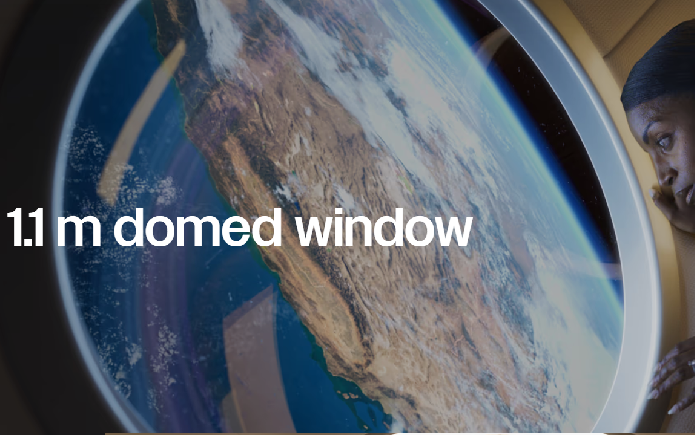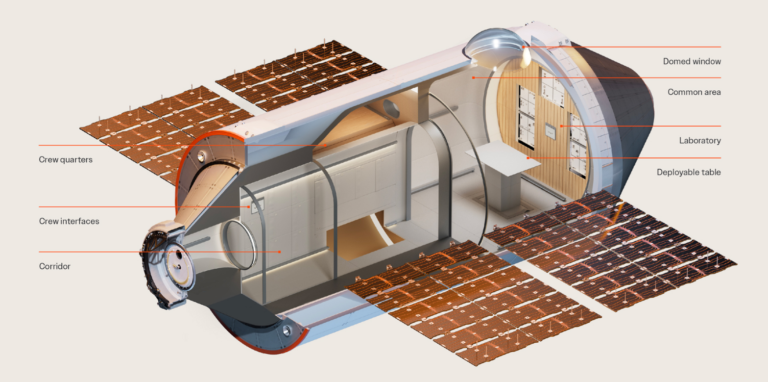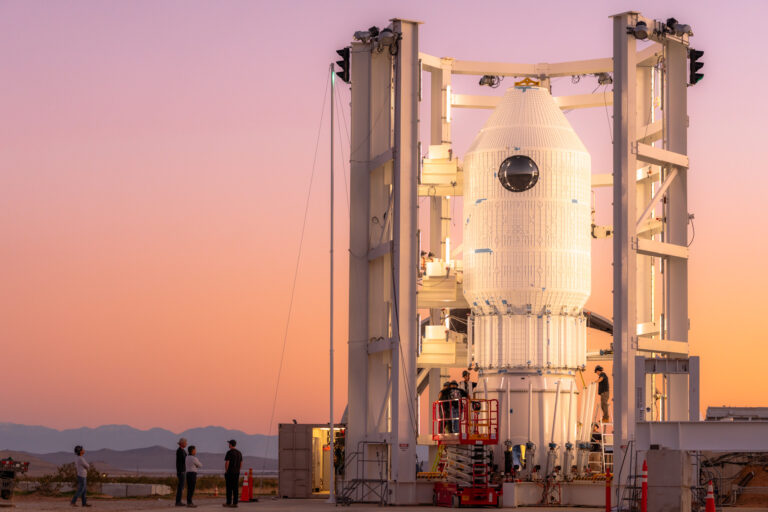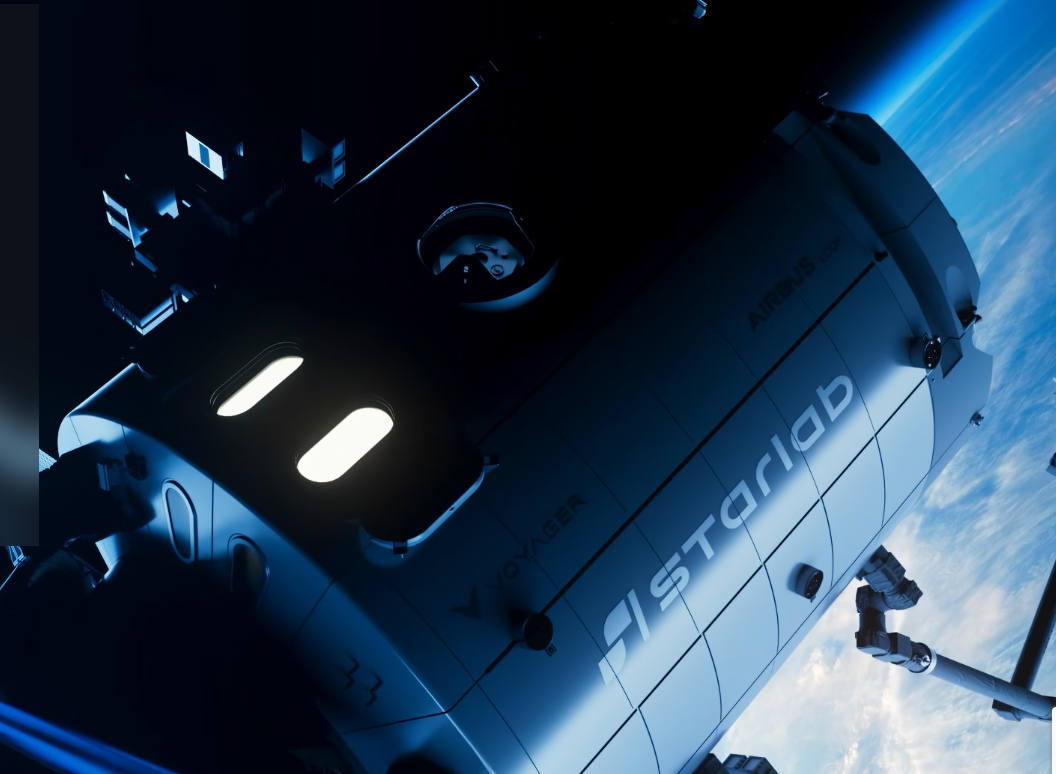
Starlab plans: 17m tall; Width 7.7m wide; Crew Capacity:4 continuous, 8 during handover; Docking & Robotics: Three docking ports; MDA SKYMAKER™ robotic arm; Bishop science airlock; Power & Propulsion: Continuous power generation, thermal control, and station propulsion Source: https://starlab-space.com/
Grok response:
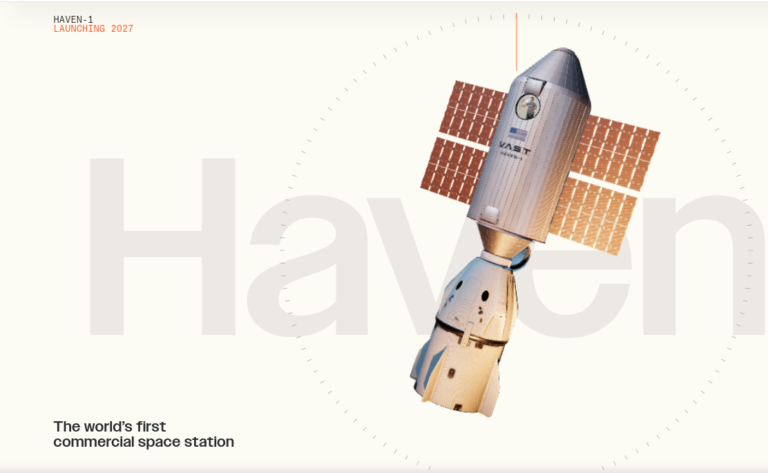
Haven-1 by Vast is the leading candidate for the first new crewed space habitat visit, with an uncrewed launch targeted for Q1 2027 and potential crewed docking shortly thereafter (as early as weeks later). Other projects like Starlab, Orbital Reef, and any Starship-derived stations remain on later timelines (2028+). No other independent new habitats show credible plans for human visits before the end of 2027.[1][2]
1. Vast Advances Haven‑1 Into Integration Phase (vastspace.com, Jan 20, 2026)
Company announcement on Haven-1 integration progress and schedule update. Summarizes shift to Q1 2027 launch readiness after NASA testing, with Falcon 9 contract and focus on environmental tests through late 2026.[1]
2. Vast Delays Haven-1 Launch to 2027 (payloadspace.com, Jan 20, 2026)
Reports delay from 2026 target; notes uncrewed launch no earlier than Q1 2027, with first crew possibly weeks later but potentially much longer. References Ars Technica interview on timelines.[2]
3. Haven-1 (Wikipedia, updated ~Jul 2026)
Encyclopedia entry on Vast’s commercial station: NET Q1 2027 Falcon 9 launch, plans for crewed missions (four astronauts, ~30 days cited in some descriptions). Notes January 2026 assembly start and prior mid-2026 slip.[3]
4. Haven-1 (vastspace.com, current as of Aug 2026)
Official project page: Targets 2027 launch for three-year orbital life supporting multiple 14-day crewed missions (four crew each) via SpaceX Dragon. Details habitat features and private funding.[4]
5. The first commercial space station, Haven-1, is now undergoing assembly for launch (arstechnica.com, Jan 20, 2026)
Detailed interview with Vast CEO on integration, testing at NASA facilities, and Q1 2027 launch shift from mid-2026. Confirms uncrewed initial launch and flexible post-launch crew timeline.[5]
6. Orbital Reef Space Station Advances to Design Phase (blueorigin.com, Aug 22, 2022, with later context)
Older milestone on SDR completion; original 2027 operational goal referenced but not updated here. Later sources indicate slippage.[6]
7. Commercial Space Stations 2026: Vast, Axiom, Starlab (orbitalradar.com, Jul 26, 2026)
Timeline overview: Orbital Reef listed at ~2028+ with Blue Origin/Sierra Space; notes program lags and design-phase status.[7]
8. Private Starlab space station moves into ‘full-scale development’ ahead of 2028 launch (space.com, ~2026)
Update on Voyager/Airbus Starlab: Shift to detailed design/hardware phase (CDR ~2026), single-launch on Starship targeted for 2028 (some sources note 2029 operational).[8]
9. Starlab (space station) (Wikipedia, updated ~2026)
Entry details: Launch now planned 2029 on Starship Cargo (shifted from earlier 2028 estimates); single-launch fully outfitted design for four crew.[9]
10. Axiom Space plans and timelines (various 2024-2026 sources, e.g., space.com Dec 2024; Wikipedia ~2026)
Axiom’s first module (PPTM) targeted ~2027 to attach to ISS; free-flying Axiom Station possible as early as 2028. Modules initially extend ISS rather than forming independent new habitat.[10][11]
As of August 2026, Haven-1 shows the clearest near-term path with integration underway and a firm Q1 2027 launch window. Crewed visits could occur in 2027 if docking proceeds as envisioned, though exact crew timing remains flexible per Vast statements. Starlab and Orbital Reef timelines have slipped beyond 2027, and Starship-based or Axiom free-flying options do not appear viable for independent new habitats before the deadline. No other projects indicate faster progress in recent reporting.[2][8]
This context is drawn from company announcements, industry analyses, and Wikipedia summaries updated through mid-2026; actual outcomes depend on testing, regulatory, and technical milestones in the coming months.
Extracted resolution criteria links:
[‘https://voyagertechnologies.com/starlab/,’, ‘https://www.space.com/nasa-considering-spacex-starship-space-station‘, ‘https://www.blueorigin.com/destinations,’]
=== Forecast Result ===
Reasoning
Situation Assessment
Today is August 5, 2026. The resolution window is ~17 months (to December 31, 2027).
Only one credible near-term candidate: Haven-1 (Vast)
- Orbital Reef, Starlab: explicitly 2028+ per all recent research
- Axiom Space modules attach to ISS (excluded by resolution criteria)
- Starship-based habitat: speculative/far off
Haven-1 Timeline Analysis
Key data points from research (January 2026 and later):
- Already slipped from mid-2026 to Q1 2027 (one confirmed slip)
- Integration underway as of January 2026
- Launch NET Q1 2027 (Falcon 9)
- After uncrewed launch, crewed visit is “weeks later, potentially much longer”
- Station mockup touring (Space Center Houston as of July 2026), no orbital operations yet
Key Assumptions and Their Failure Probabilities
Assumption 1: Haven-1 launches in Q1-Q2 2027 (no further significant slips)
- Already slipped once; commercial space programs frequently slip again
- Environmental/integration testing still ongoing through late 2026
- Probability this assumption fails (slips to Q3+ 2027 or later): ~45%
Assumption 2: Crewed visit follows within 2027 after launch
- Post-launch checkout could take months before crewing
- Vast acknowledged timing uncertainty post-launch
- Probability this assumption fails: ~25% (conditional on timely launch)
Assumption 3: No technical showstopper discovered during final integration
- Testing at NASA facilities is ongoing; novel issues possible
- Probability this fails: ~10%
Monte Carlo-Style Estimate
| Launch timing | P(launch) | P(crew in 2027 | launch) | Contribution |
|---|---|---|---|
| Q1 2027 | 25% | 75% | 18.8% |
| Q2 2027 | 20% | 65% | 13.0% |
| Q3 2027 | 20% | 40% | 8.0% |
| Q4 2027 | 15% | 10% | 1.5% |
| 2028+ | 20% | 0% | 0% |
Haven-1 contribution: ~41%
Other programs contribution: ~2% (Orbital Reef, Starlab, Axiom all 2028+)
Calibration Adjustments
- Historical base rate in forecasting competitions: ~35% positive resolution
- I have a known bias toward overconfidence; compensating downward
- Space schedules have a structural tendency to slip, especially for first-of-kind commercial stations
- The mockup-at-Space-Center-Houston context (July 2026) suggests outreach/marketing phase, not imminent launch readiness
Adjusting from ~43% to account for overconfidence correction and historical base rates: approximately 38-40%.
Probability: 38%
End
About The Author