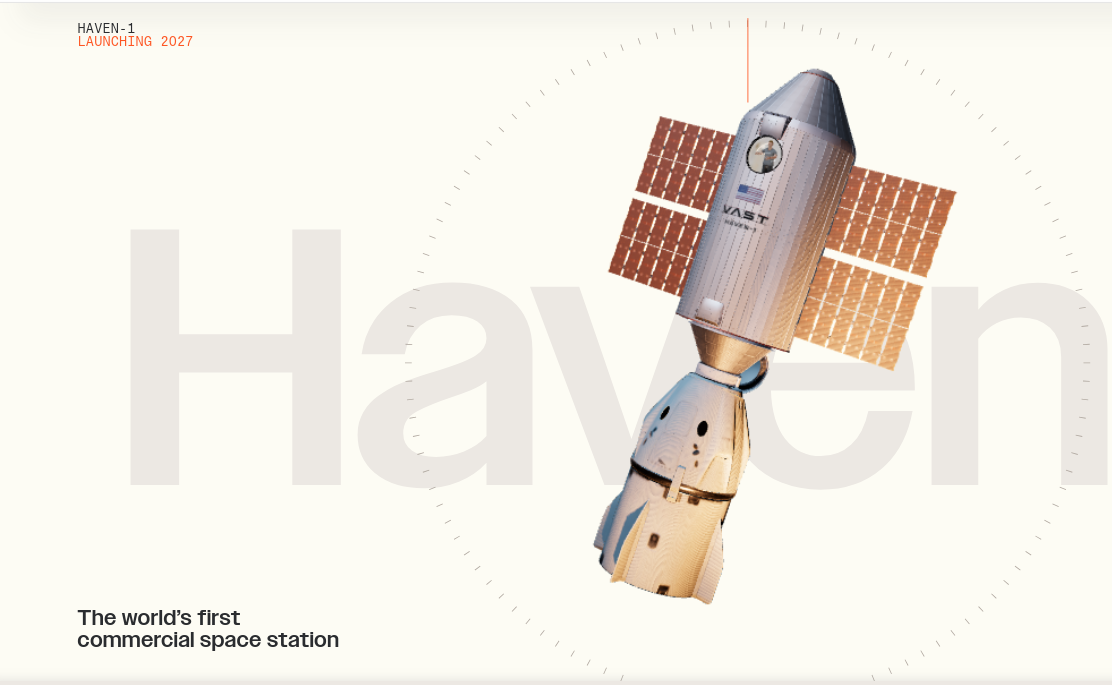
Haven-1, pictured here, is intended as a temorary space station, to be followed by a bigger, permanent station called Haven-2. Its launch is planned for sometime in 2027. Source: https://www.vastspace.com/
Deepseek Binary response:
The key candidate is Vast’s Haven-1, which as of September 2026 is targeting a Q1 2027 Falcon 9 launch. The required sequence is: launch Haven-1, perform an uncrewed Dragon docking verification, then send the crewed Vast-1 mission via Crew Dragon. If Haven-1 launches in Q1 or early Q2 2027, a human visit by the end of 2027 remains plausible given the stated incentive to move quickly and the fact that Crew Dragon is already operational. However, this is a first-of-its-kind commercial station, and the program has already slipped from 2025 to 2027. Additional slips into Q3 2027 or later would make a crewed visit before 2028 unlikely because the uncrewed docking verification must still occur first. Other candidates—Starlab, Orbital Reef, and any Starship-based habitat—are on significantly later timelines or remain conceptual, so they contribute almost nothing to this forecast.
Weighing the recent hardware progress and official 2027 target against the historical tendency for space station schedules to slip, I estimate the probability of launch by mid-2027 at roughly 55–60%, and the conditional probability of a crewed visit before the end of 2027 given such a launch at about 70–80%. There is also a small chance of a Q3 2027 launch followed by an extremely rapid uncrewed docking and crewed mission, but that is tight. The overall probability is therefore in the mid-to-high 30s.
Data sufficiency: Sufficient
Probability: 38%
Grok response:
1. Haven-1 – Wikipedia
https://en.wikipedia.org/wiki/Haven-1
Published: 2026-09-15
Haven-1 is a privately funded single-module commercial space station by Vast, planned to launch NET Q1 2027 on a SpaceX Falcon 9 as the first commercial space station. The first crewed mission, Vast-1, would send four astronauts via Crew Dragon for 10-30 days after an uncrewed docking verification. Assembly began in January 2026 after a delay from late 2026, with the station relying on docked Dragon for life support and having a three-year orbital lifespan.
2. Vast’s Haven-1 continues to advance through milestones ahead of planned 2027 launch – NASASpaceFlight.com
https://www.nasaspaceflight.com/2026/07/vast-update-070426/
Published: 2026-07-04
Vast’s Haven-1 remains on track for a Q1 2027 Falcon 9 launch, with recent hardware and integration progress. The inaugural Vast-1 mission would deliver a four-person crew via Crew Dragon, with the station using the capsule for supplemental life support. Vast has signed European agreements for astronaut missions and announced crew members, including ESA reserve astronaut Arnaud Prost.
3. The first commercial space station, Haven-1, is now undergoing assembly for launch – Ars Technica
https://arstechnica.com/space/2026/01/the-first-commercial-space-station-haven-1-is-now-undergoing-assembly-for-launch/
Published: 2026-01-20
Vast delayed Haven-1 from mid-2026 to Q1 2027 due to integration timelines while beginning clean-room assembly. CEO Max Haot stated an uncrewed Dragon docking would precede crew, which could occur as early as two weeks after launch or as late as within the station’s three-year life, with strong incentive for a rapid first crewed visit. The 14-ton module will be the heaviest Falcon 9 payload.
4. Haven-1 — Vast (official site)
https://www.vastspace.com/haven-1
Published/updated: 2026-09-09
Haven-1 is targeted to launch in 2027 as the world’s first commercial space station, with 45 m³ habitable volume for four crew on two-week missions. Hardware progress includes docking adapter fit checks, thermal systems, solar arrays, and life-support testing. SpaceX will provide Falcon 9 launch and Dragon crew transport, with Starlink connectivity.
5. Orbital Reef – Wikipedia
https://en.wikipedia.org/wiki/Orbital_Reef
Published: 2026-09-16
Orbital Reef, a Blue Origin/Sierra Space “mixed-use business park,” was projected operational by 2027 as of 2022, with 830 m³ volume for up to 10 people. NASA awarded $130 million in 2021 but had paid only $24 million by late 2023 amid partner issues and stalled website/hiring. Recent testing of Sierra Space LIFE modules occurred, but overall progress lags with New Glenn delays.
6. Starlab Space Station | Voyager Technologies (official)
https://voyagertechnologies.com/starlab/
Published/updated: 2026-09-12
Starlab is a single-launch, fully outfitted commercial station by the Voyager-Airbus joint venture, to fly on SpaceX Starship before ISS decommissioning. It features ~400 m³ pressurized volume, Hilton-designed interiors, and NASA SAA funding of $217+ million. No 2027 operations are indicated; it is positioned for post-ISS continuity.
7. Starlab (space station) – Wikipedia
https://en.wikipedia.org/wiki/Starlab_(space_station)
Published: 2026-09-16
Starlab, a Voyager Technologies/Airbus joint venture, is planned for launch no earlier than 2029 on Starship as a single large metallic module. It completed Commercial Critical Design Review with NASA in February 2026 and is moving to manufacturing. The station targets four crew, pharmaceutical research, and European/US customers, with no tourism.
8. NASA eyeing SpaceX’s Starship as possible space station – Space.com
https://www.space.com/nasa-considering-spacex-starship-space-station
Published: 2023-07-27
NASA selected SpaceX (among others) for an unfunded Space Act Agreement under CCSC-2 to study converting Starship into a LEO destination/habitation system. Milestones include long-duration crewed operations concepts and a 2028 preliminary design review. This remains a study, not a committed 2027 habitat.
9. Axiom Station – Wikipedia
https://en.wikipedia.org/wiki/Axiom_Station
Published: 2026-09-16
Axiom’s first module (PPTM) is targeted no earlier than 2027 to attach to ISS, with Hab-1 following in 2028 before the pair detaches as a free-flyer. Recent reports indicate PPTM slipped toward early 2028. Modules are under construction at Thales Alenia, but initial operations would be ISS-attached.
10. Commercial space stations: 10 Breakthrough Technologies 2026 – MIT Technology Review
https://www.technologyreview.com/2026/01/12/1130030/commercial-space-stations-2026-breakthrough-technology/
Published: 2026-01-12
Vast’s Haven-1 is scheduled as the first commercial orbital outpost for early 2027 launch, supporting four-person 10-day stays. Axiom follows in 2028, Starlab the same year, and Orbital Reef around 2030. Ticket prices are expected in the tens of millions initially, with NASA funding supporting the transition from ISS.
Haven-1 by Vast is the only new space habitat with a realistic chance of a human visit before the end of 2027. As of September 2026, the company and recent reporting consistently target a Q1 2027 Falcon 9 launch of the 14,600 kg single-module station (45 m³ habitable volume). Integration began in January 2026 after a slip from 2026; hardware milestones (structure welding/testing complete in 2025, docking adapter, thermal systems, solar arrays, life support) continue. An uncrewed Crew Dragon docking demonstration is required first; Vast CEO Max Haot has said crew (Vast-1, four people for typically two weeks, up to 30 days) could follow as soon as two weeks later if SpaceX certifies safety, though it could take longer. The company has a strong incentive to fly crew quickly within the station’s ~3-year life, has announced some Vast-1 crew (including ESA’s Arnaud Prost), and is conducting related ISS private astronaut missions in 2027 for experience. Vast’s official site and Wikipedia list “Launching 2027.” Further slips or certification delays remain possible, as this is the company’s first station.[1]
Extracted resolution criteria links:
[‘https://www.blueorigin.com/destinations,’, ‘https://www.space.com/nasa-considering-spacex-starship-space-station‘, ‘https://voyagertechnologies.com/starlab/,’]
=== Forecast Result ===
Key Analysis:
Haven-1 is clearly the only viable candidate:
- Orbital Reef: Severely lagging, minimal NASA funding disbursed, New Glenn delays, no credible 2027 timeline
- Starlab: Explicitly targeting NEET 2028-2029, still in design/manufacturing phase
- Starship-based station: Remains an unfunded conceptual study with 2028 PDR target
- Axiom Station: PPTM slipped to 2028, and would initially be ISS-attached (questionable if it counts as “new” habitat)
Assessment of key uncertainties:
- Will Haven-1 launch in 2027 at all? Given the pattern of repeated delays (already slipped multiple times), but now at a later/more mature integration stage with specific milestones being met, I estimate ~75-80% probability of launch sometime in 2027 (vs. slipping to 2028).
- If launched, will crew visit before Dec 31, 2027? This depends heavily on when in 2027 the launch occurs. Early-year launches leave ample buffer; Q4 launches leave very tight windows for docking demo + crew certification + crewed mission.
- Compounding risk: Multiple sequential milestones (launch → uncrewed demo → crew mission) must all occur within the remaining 15-month window, each with independent execution risk typical of first-of-kind space hardware.
Weighted calculation:
Combining launch timing probabilities with conditional probability of crew visit given launch timing yields approximately 55-65% probability, reflecting:
- Strong momentum but historical slippage pattern
- Tight sequential timeline requirements
- No viable alternative pathway if Haven-1 fails
Given the superforecasting principle of not overweighting recent positive momentum and considering the consistent historical pattern of delays in this exact program, plus the need for multiple sequential milestones to all succeed within the timeframe, I’ll settle on a moderate-confidence estimate.
Data sufficiency: Sufficient
Probability: 55%
About The Author