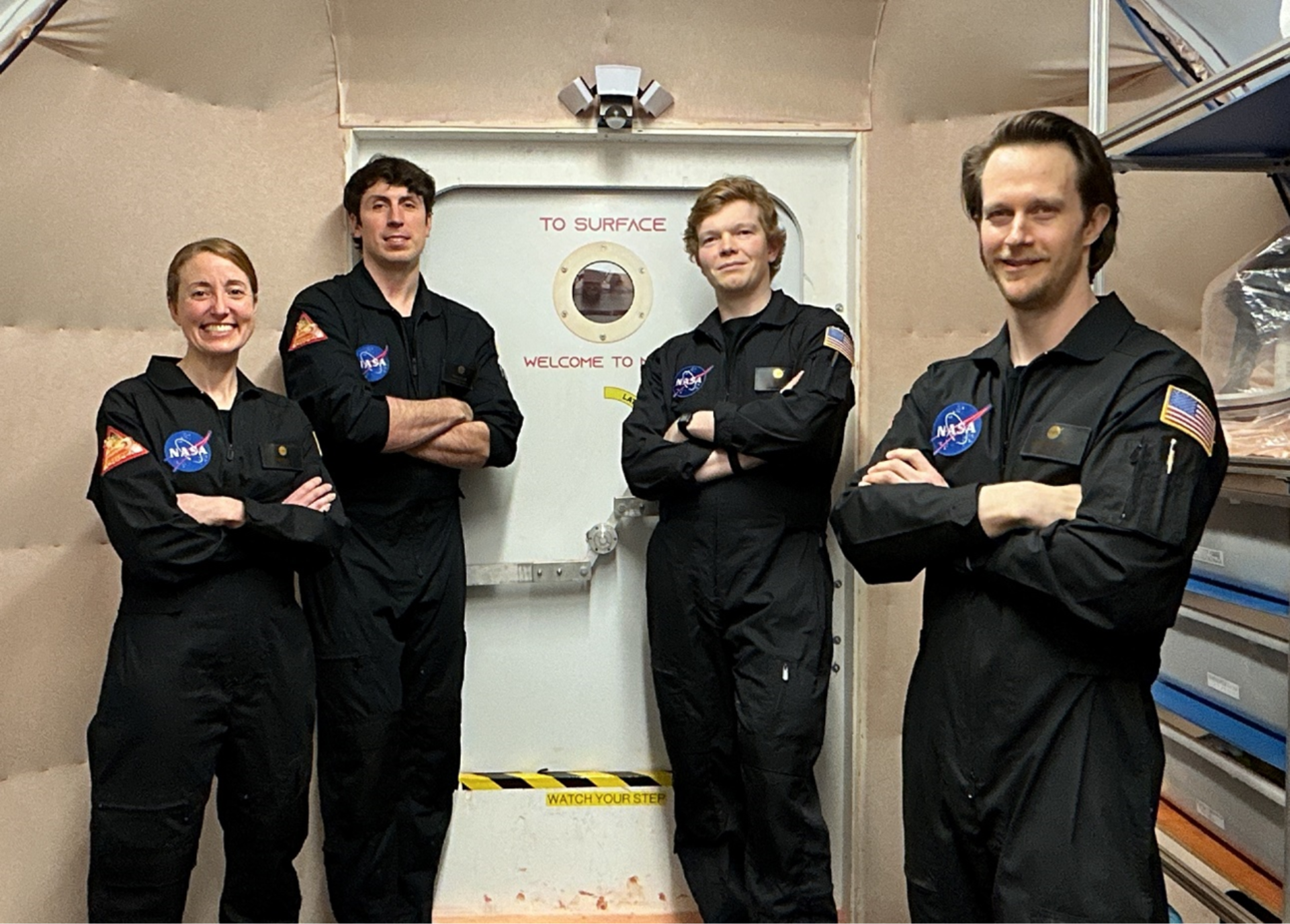
Members of NASA’s CHAPEA (Crew Health and Performance Exploration Analog) mission 2 pose for a group photo. (From left to right: Ellen Ellis, Ross Elder, James Spicer, and Matthew Montgomery) Credit: NASA Source: https://www.nasa.gov/hrp/nasa-seeks-volunteers-for-yearlong-simulated-mission-to-moon-mars/
Obtaining outside data.
Checking internet sources, using keywords: space habitat human 2027
News from various sources:
The content retrieved focuses on a NASA initiative to simulate space habitation on Earth as part of preparations for future human missions to the moon and Mars. Starting in August 2027, NASA is seeking volunteers to participate in a year-long simulation at the Johnson Space Center in Houston. This deep space mission simulation will mimic conditions expected on the moon and Mars, using two isolated habitats—a spacecraft and a base. Participants will engage in tasks such as conducting mock Mars walks and using a rover to explore beyond the main habitat. This effort is part of NASA’s Artemis program, which aims to gather data to inform the design of future human missions to the moon and Mars. Volunteers must meet specific criteria, including holding U.S. citizenship or a green card, being between 30 and 55 years old, having astronaut-like qualifications, and passing NASA’s physical and psychological assessments. This simulation joins a series of others aimed at preparing for the construction of a moon base by 2032.
Overall, while the simulation activities and participant criteria are important for understanding the seriousness and nature of the tests taking place, the overarching program goals and timelines directly impact the potential for new space habitats visited by humans by 2027.
Fact-checked summary:
NASA is conducting a space habitat simulation program starting in August 2027 at the Johnson Space Center in Houston, which is directly relevant to assessing the timeline for human space missions and habitation. This year-long simulation will employ isolated habitats, such as a spacecraft and a base, to study conditions similar to those anticipated during space missions. The simulation is part of NASA’s Artemis program, which is crucial to understanding future human missions to the moon and Mars by 2027. This program is integral to understanding potential developments and human visits to new space habitats by this time. Additionally, this simulation signals long-term goals that align with NASA’s broader objectives for the establishment of a moon base by 2032, suggesting possible new space habitats could be operational and visited before the end of 2027.
OpenAI gives a base rate of 0.6 (60%)
The question difficulty is rated 7 (0 to 10)
Historical weighted factors include:
Past successful completion of preparatory simulation programs, 0.25
Historical NASA program funding continuity, 0.2
Technical advancements in space technology, 0.3
International cooperation in space exploration, 0.15
Historical timelines for space mission readiness, 0.1
A Bayesian calculation could be performed as follows:
Using historical success factors, we estimate the likelihood of success for each factor. Successful historical completion of simulations contributes positively (0.25), funding continuity (0.2) is relatively stable, technical advancements continue positively (0.3), while international cooperation, though variable, remains neutral (0.15), and historical mission timelines add caution (0.1). Combining these, the Bayesian estimate remains aligned with the base rate of 0.6 due to the weight and likely fulfillment of necessary events.
Bayesian base rate: 0.6 (60%)
Sufficient news to provide a good forecast? 1 (0 or 1)
News is relevant, topical and unbiased? 1 (0 or 1)
Question classification: scenario_based_forecast
Expected time (days) until question close: 611
The following were considered in order to produce this base rate:
The base rate is influenced by the likelihood of NASA successfully completing similar preparatory programs in the past, expected consistency in funding, pace of technological development in space habitation, and historical timelines of mission development, which are generally over-optimistic.
Ideally, the news feed would contain the following sorts of information for a better forecast:
Detailed information about current global political support, specific technological challenges faced, and any private sector collaborations or advancements in space habitation would provide additional insight.
Some potential divergent considerations that might affect the base rate:
If there are unexpected breakthroughs in technology, the forecast could improve. Conversely, if there are significant budget cuts, technical setbacks, or shifts in political priorities, the timeline could be delayed, affecting the likelihood negatively.
The following chain of events are necessary for the question to resolve positively:
- Successful completion of the NASA space habitat simulation program starting in August 2027 that provides informative data on human habitation in space-like conditions (Likely).
- Continued funding and support for NASA’s Artemis program through 2027 (Highly Likely).
- Development of technologies for sustainable human habitation in space environments (Likely).
- Political and international support for human missions to new space habitats (More Likely Than Not).
- No major technical failures or setbacks in ongoing NASA programs relevant to space habitation (Likely).
Querying Claude (AI predicts: 0.08 – confidence: 5)
Querying OpenAI (AI predicts: 0.5 – confidence: 5)
Guide to Jeremy Lichtman’s Multi-AI Oracle Reports
Question Type: Binary
Median from LLMs: 0.29
Base rate: 0.6 (from OpenAI)
SD: 0.21
MAPD: 0
Confidence: 5
Conf Mode: Low
Mellers: 0.21
Reverse Mellers: 0.36
Theory of Mind: 0.4 (What did the LLMs think other LLMs predicted?)
Beta Distribution: 0.96
Close Type: B (B = cautious # closer to 50%; A/C = closer to extremes)
LLM responses: 2
Model value: 0.29 (29%)
The AIs concluded that it is highly unlikely for a new space habitat to be visited by humans before the end of 2027 due to several factors. Firstly, historical data suggests a track record of delays in the establishment of new crewed space habitats, with no successful standalone projects since the ISS in 2000. Current candidates, such as Axiom’s modules and NASA’s Artemis program, face significant delays and challenges, and many planned projects such as the Lunar Gateway or other commercial space stations aren’t expected to become operational until later in the decade. Furthermore, the distinction between actual space visits and ground-based simulations, like NASA’s planned simulation starting in August 2027, emphasizes the unlikelihood. Although unexpected developments or accelerations in technology or international efforts may alter this outlook, current trajectories and historical patterns suggest a very low probability of achieving a human visit to a new space habitat by the end of 2027.
Runtime: 60 seconds.
About The Author