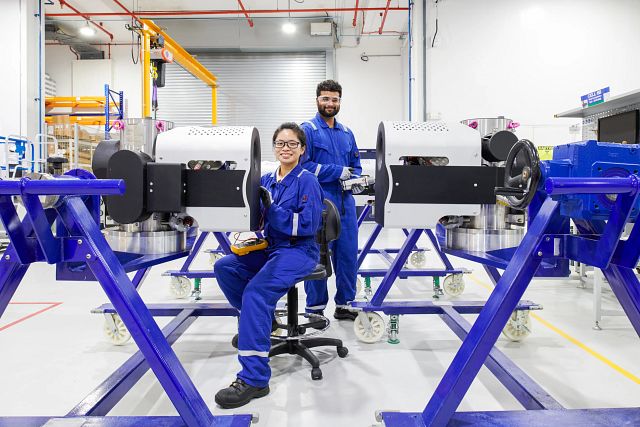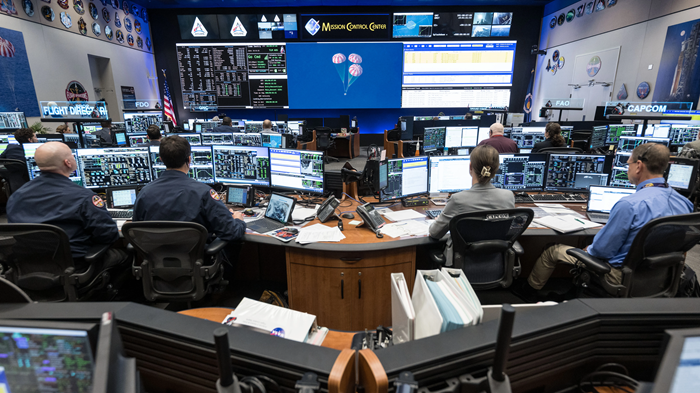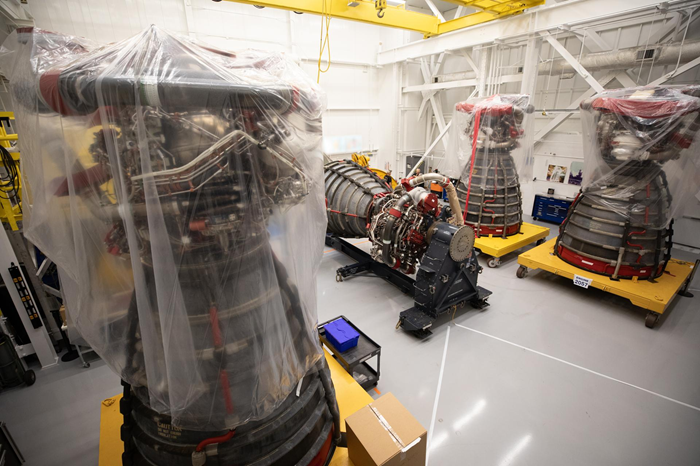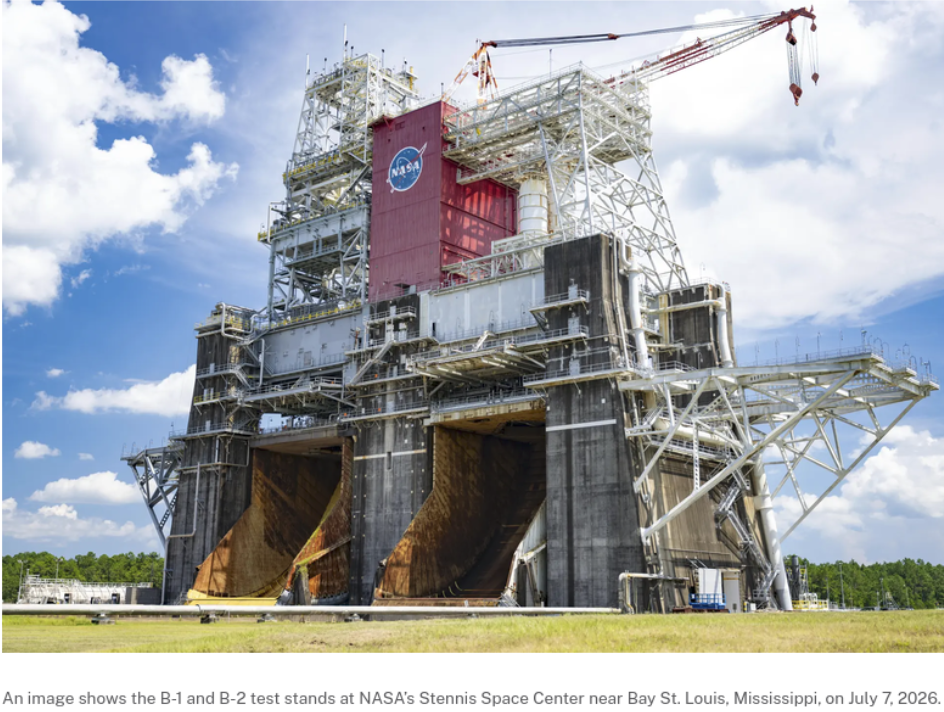
NASA to Support Blue Origin New Glenn Rocket Testing, Advance Artemis. The test stand features dual, vertical firing positions built in the 1960s to test Saturn V rocket stages that carried humans to the Moon during the Apollo Program.
Grok response:
10 Citations:
- NASA Marches Toward Artemis III Mission in 2027, Names Crew Members (NASA.gov news release, Jun 9, 2026)
Describes the Artemis III LEO demonstration as a crewed SLS/Orion launch in 2027 for rendezvous/docking tests with one or both commercial HLS test articles (SpaceX Starship and Blue Origin Blue Moon). Notes hardware integration and multi-launch coordination underway, with crew announced. Emphasizes tests of propulsion, communications, and interfaces essential for later lunar landings.[1] - Artemis III (NASA.gov mission page, updated ~Jun 2026)
Outlines Artemis III as a 2027 crewed LEO demonstration (4 crew, SLS/Orion) focused on critical systems validation for future landings, including docking with commercial lander test articles. Confirms launch target in 2027 and objectives to reduce risk ahead of Artemis IV. Provides overview of mission type and goals.[2] - ‘Full steam ahead’: NASA ramps up prep for Artemis III astronaut launch in 2027 (Space.com, Jul 15, 2026)
Reports NASA targeting mid-to-late 2027 for the LEO demo mission, with SLS hardware stacking and testing active at Kennedy Space Center. Notes Orion will rendezvous/dock with SpaceX and Blue Origin lander test articles in LEO. Describes ongoing positive momentum post-Artemis II.[3] - How NASA’s Artemis III Lander Test Will Pave Way for Moon Landings (NASA.gov, Jul 15, 2026)
Details the 2027 mission’s focus on practicing rendezvous and docking between Orion and HLS test articles from both providers in LEO. Explains separate launches of lander test articles on commercial rockets and ~2-day docked operations for systems checks. Highlights risk reduction for 2028 lunar landing.[4] - Moon to Mars | NASA’s Artemis Program (NASA.gov, page content as of Jul 2026)
States Artemis III is scheduled for 2027 as the new LEO demonstration testing one or both commercial landers; Artemis IV remains targeted for early 2028 lunar landing. Confirms the revised architecture post-Feb 2026 overhaul and unchanged early-2028 landing goal. Includes quick facts on prior missions like successful Artemis II.[5] - Artemis III (Wikipedia, updated ~Jul 2026)
Notes the Feb 27, 2026 NASA announcement redesignating Artemis III as a 2027 LEO crewed demo instead of a lunar landing, preserving assets for later missions. Describes complex objectives including three launches, Orion systems checks, and docking demos. Confirms NET 2027 launch on SLS.[6] - NASA to Support Blue Origin New Glenn Rocket Testing, Advance Artemis (NASA.gov, ~Jul 24, 2026)
Announces recent agreement for Blue Origin engine testing to support Artemis progress, including Artemis III docking demos. References the multi-launch 2027 mission with both providers’ test articles. Ties into broader acceleration of lander and rocket capabilities.[7] - Revised Artemis lunar lander plans take shape (SpaceNews, Jun 13, 2026)
Provides details on SpaceX and Blue Origin acceleration approaches for HLS, including test articles for the 2027 Artemis III LEO docking mission. Notes ongoing work on Starship V3 and Blue Moon Mark 2 variants. Highlights June 2026 crew announcement and integration planning.[8] - NASA will test SpaceX and Blue Origin Moon landers before the next lunar landing (ScienceDaily, Jul 23, 2026)
Summarizes plans for both companies’ test articles in the 2027 Artemis III mission, with SpaceX using Starship V3 and Blue Origin testing crew cabin elements. Notes data collection for future lunar operations and separate launch profiles. Reports active development as of mid-2026.[9] - NASA announces major overhaul of Artemis moon program (Spaceflight Now, Feb 27, 2026)
Covers the initial Feb 2026 announcement adding the 2027 LEO demo mission (now Artemis III) to test commercial landers before lunar landing attempts. Explains shift from prior timelines due to complexity and safety considerations. Sets stage for Artemis IV as first landing target in 2028.[10]
Rundown of relevant context (as of July 27, 2026):
NASA’s official Artemis program page and multiple July 2026 updates confirm the Artemis III LEO orbital demonstration mission is targeted for mid-to-late 2027. It will launch four crew on SLS/Orion for systems checkouts and the first rendezvous/docking tests with test articles of SpaceX’s Starship HLS and/or Blue Origin’s Blue Moon lander(s) in low Earth orbit.[5][3]
Artemis II completed successfully in April 2026 (lunar flyby), providing operational experience. Hardware progress includes SLS components being stacked and tested at Kennedy Space Center, with NASA describing efforts as “full steam ahead” in mid-July 2026 reporting. Both HLS providers are accelerating development specifically for the test articles, with recent NASA support for Blue Origin engine testing.[3][7]
The mission profile involves multiple launches (lander test article(s) on commercial rockets first, then SLS/Orion), ~2 days of docked operations for propulsion/comms/interface tests, and a ~2-week duration. No major new delays or technical setbacks are reported in the most recent sources (June–July 2026); NASA continues to target the 2027 window to enable the unchanged early-2028 Artemis IV lunar landing goal. Some commentary notes the inherent complexity and historical program slippage risks, but current momentum appears positive.[4]
The authoritative resolution source (NASA Artemis page) aligns with these details and shows no change to the 2027 target as of the latest updates.
Extracted resolution criteria links:
[‘https://www.nasa.gov/humans-in-space/artemis/‘]
=== Forecast Result ===
Systematic Analysis: Artemis III LEO Demonstration Mission by End of 2027
Establishing Mission Context
As of July 27, 2026, Artemis III has been formally restructured from a lunar landing mission into a LEO rendezvous-and-docking demonstration. This is crucial—it significantly lowers the technical bar versus the original architecture. Key positive signals:
- Artemis II flew successfully (April 2026), eliminating the single biggest predecessor dependency
- NASA Administrator publicly stated “on track for 2027” despite Blue Origin anomaly (July 2026)
- SLS solid rocket booster stacking underway at KSC (July 2026)
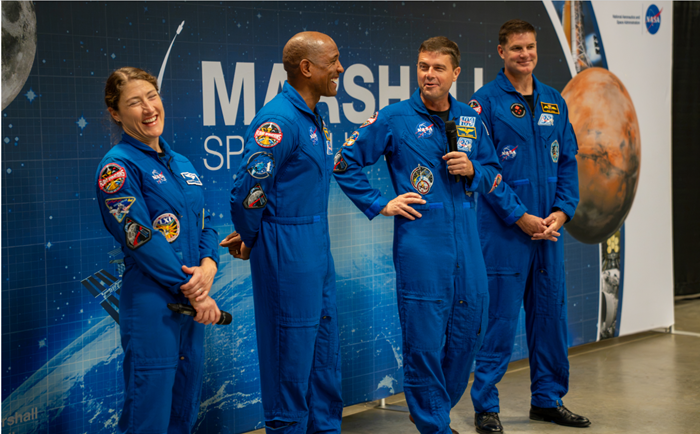
- Crew named June 9, 2026 (Bresnik, Parmitano, Rubio, Douglas)—indicates serious programmatic commitment
- Mission requires “one or both providers” to succeed—not necessarily both
Critical Assumptions and Their Failure Probabilities
Assumption 1: SLS/Orion launches in 2027
- Post-Artemis II, Orion heat shield concerns should be better understood
- SLS stacking underway suggests realistic hardware flow
- Historical NASA major milestone slippage rate remains high (~40-50%)
- Probability this assumption holds: ~65%
Assumption 2: At least one commercial lander test article is ready for docking in 2027
- Blue Origin had a rocket explosion in May 2026; NASA says still on track
- SpaceX Starship is in active development; Starship V3 reportedly being prepared as test article
- “One or both providers” language reduces dual-dependency risk substantially
- Probability this assumption holds: ~72%
Assumption 3: Mission succeeds once launched (no major anomaly during ~2-week flight)
- Three-vehicle coordination is novel but LEO rendezvous is less complex than lunar ops
- Artemis II success boosts confidence in Orion systems
- First-time rendezvous with these large vehicles introduces non-trivial risk
- Probability once underway: ~82%
Timeline Analysis
- 17 months remaining (July 2026 → December 2027)
- NASA targeting “mid-to-late 2027”
- Historical NASA crewed spaceflight: ~35-45% of major milestones hit on initial schedule
- Multi-vehicle coordination with commercial partners adds complexity and external schedule dependencies beyond NASA’s control
Combined Probability Calculation
P(Launches in 2027) × P(Commercial lander ready) × P(Mission success once underway)
= 0.65 × 0.72 × 0.82 ≈ 0.38
Calibration Checks
- Base rate of questions resolving positively in these competitions: ~35%
- The simplified mission profile (LEO vs. lunar) is a genuine positive vs. the original Artemis III architecture
- Blue Origin explosion introduces non-trivial risk to the Blue Moon side
- Even if Blue Origin is delayed, SpaceX Starship readiness could still allow partial success
- Historical overconfidence bias: adjust slightly downward from ~40% toward ~37-38%
Probability: 37%
End
About The Author