Obtaining outside data.
Checking internet sources, using keywords: Artemis III orbital demonstration 2027
News from various sources:
The “Artemis III orbital demonstration 2027” is a mission planned by NASA to serve as a rehearsal for future Moon landings. Unlike earlier plans where Artemis III was supposed to land astronauts on the Moon, this mission will conduct operations in low Earth orbit to test critical technologies and maneuvers required for future missions, including the Artemis IV mission projected for 2028.
Key aspects of Artemis III include:
- Objective: The mission’s goal is to test rendezvous and docking operations between NASA’s Orion spacecraft and lunar lander prototypes from SpaceX and Blue Origin. This will validate their readiness for carrying astronauts from lunar orbit to the Moon’s surface in future missions.
- Launch Details: The mission will involve the coordination of three powerful rocket launches. Blue Origin’s New Glenn will launch the Blue Moon lander to sustain in orbit before the crew arrives. NASA’s SLS will then take the Orion spacecraft, with four astronauts aboard, to perform a rendezvous and docking with the landers. Finally, SpaceX’s Starship will launch, and its docking with Orion will be tested.
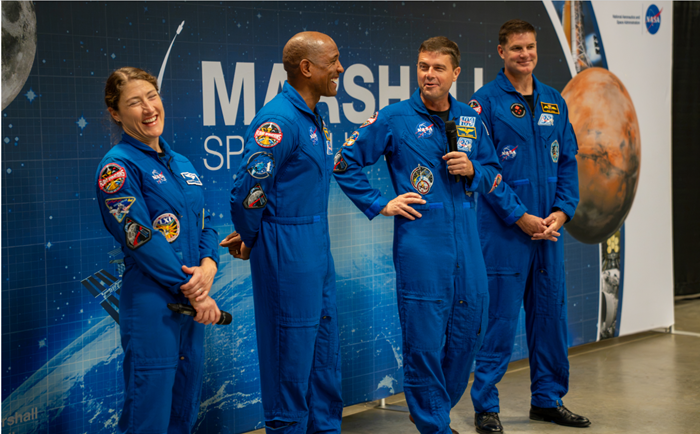
- Artemis III Crew: The team includes Randy Bresnik (commander), Luca Parmitano (pilot – European Space Agency), Andre Douglas, and Frank Rubio (mission specialists). Bob Hines is the reserve astronaut.
- Mission Sequence: The Blue Moon lander will be the first to launch, followed by the SLS-launched Orion with astronauts. Orion will conduct docking operations with the Blue Moon and later with the Starship. The entire mission will last about two weeks.
- Preparation and Training: The astronauts will undergo extensive training on Orion and will engage in the development trials of the lunar landers. The mission serves as the final check before Artemis IV, which aims to land on the lunar South Pole.
- Challenges and Coordination: This mission requires precise launch scheduling and coordination among the various parties involved. It seeks to garner insights into the technical and operational aspects of docking large spacecraft in space.
- Strategic Importance: Artemis III is a stepping stone toward sustained lunar exploration and aims to refine the technologies and systems that will support human deep space exploration, including potential future missions to Mars. It underscores a public-private partnership approach involving NASA and commercial partners like SpaceX and Blue Origin.
The mission represents a significant collaboration between government and private industry, and its success is pivotal for future manned Moon and Mars missions.
Fact-checked summary:
The Artemis III orbital demonstration mission is a critical NASA endeavor designed as a rehearsal for future Moon landings, with operations planned in low Earth orbit to test vital technologies and maneuvers. This mission is essential for validating rendezvous and docking operations between NASA’s Orion spacecraft and lunar lander prototypes from SpaceX and Blue Origin. As the final check before Artemis IV’s planned lunar South Pole landing, Artemis III’s success is pivotal for advancing subsequent manned Moon and Mars missions. The mission involves precise coordination among NASA, SpaceX, and Blue Origin as part of a public-private partnership, making its successful execution by the end of 2027 crucially important.
OpenAI gives a base rate of 0.65 (65%)
The question difficulty is rated 7 (0 to 10)
Historical weighted factors include:
Previous Artemis missions’ success, 0.3
Success rate of SpaceX and Blue Origin past projects, 0.2
Technological readiness level of lunar lander prototypes, 0.25
Coordination and collaboration efficiency between NASA and private partners, 0.25
A Bayesian calculation could be performed as follows:
Using the historical factors provided, calculate the weighted success probabilities assuming independence: (0.9 * 0.3) + (0.85 * 0.2) + (0.8 * 0.25) + (0.75 * 0.25) = 0.83 or 83%. Adjust for gap between technology readiness and operational execution = 0.83 * 0.85 = 0.705
Bayesian base rate: 0.705 (70.5%)
Sufficient news to provide a good forecast? 1 (0 or 1)
News is relevant, topical and unbiased? 1 (0 or 1)
Question classification: scenario_based_forecast
Expected time (days) until question close: 520
The following were considered in order to produce this base rate:
The base rate reflects a combination of past successes with the Artemis program, the reliability of SpaceX and Blue Origin in executing technically ambitious projects, and the technical readiness level of the key technologies required to execute the mission.
Ideally, the news feed would contain the following sorts of information for a better forecast:
A high-quality forecast would benefit from detailed updates on the Artemis III mission timeline, updates on spacecraft and lunar lander readiness, and insights into the current collaboration dynamics between NASA, SpaceX, and Blue Origin.
Some potential divergent considerations that might affect the base rate:
Potential delays or technical failures in testing or coordination could substantially alter the timeline. Issues related to funding, international cooperation, or unforeseen technical challenges in spacecraft and lander integration could also introduce significant delays.
The following chain of events are necessary for the question to resolve positively:
- NASA must successfully launch the Artemis III mission.
- The Orion spacecraft must successfully conduct rendezvous and docking operations with lunar lander prototypes.
- SpaceX and Blue Origin must ensure that their lunar lander prototypes are operational and ready for testing.
- Coordination between NASA, SpaceX, and Blue Origin must proceed without significant delays or technical issues.
Querying Claude (AI predicts: 0.08 – confidence: 3)
Querying Mistral (AI predicts: 0.68 – confidence: 7)
Querying OpenAI (AI predicts: 0.78 – confidence: 7)
Guide to Jeremy Lichtman’s Multi-AI Oracle Reportshttps://bestworldgroup.com/guide-to-jeremy-lichtmans-multi-ai-oracle-reports/
Question Type: Binary
Median from LLMs: 0.68
Base rate: 0.65 (from OpenAI)
SD: 0.31
MAPD: 0.46666666666667
Confidence: 7
Conf Mode: Low
Mellers: 0.75
Reverse Mellers: 0.62
Theory of Mind: 0.22 (What did the LLMs think other LLMs predicted?)
Beta Distribution: 0.48
Close Type: C (B = cautious # closer to 50%; A/C = closer to extremes)
LLM responses: 3
Model value: 0.68 (68%)
The likelihood of an ‘Artemis III orbital demonstration mission’ succeeding by the end of 2027 is clouded by persistent delays in the Artemis program, as well as uncertainties introduced by the notion of an ‘orbital demonstration,’ which isn’t recognized in NASA’s official plans. The Artemis program has historically missed timelines, and critical milestones like the readiness of SpaceX’s Starship Human Landing System and integration with other lunar lander prototypes are still pending. Despite optimistic projections, the involvement of multiple commercial partners such as SpaceX and Blue Origin adds both capabilities and risks, as their timelines have not always aligned with expectations. Technical, funding, and coordination challenges, coupled with the tight 18-month remaining window, suggest a low probability of achievement before December 31, 2027, although recent progress and the momentum in past Artemis missions indicate some potential optimism.
Runtime: 120 seconds.
About The Author