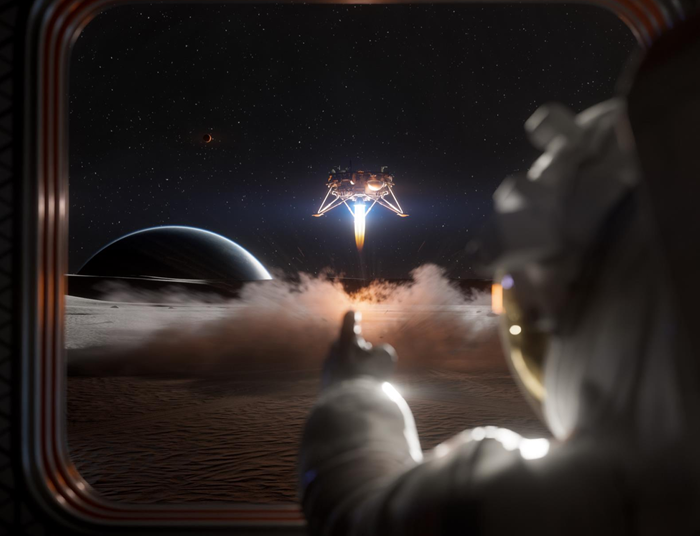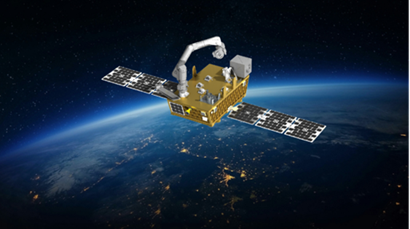
Artist concept of the FFR Mission’s robotic system payload atop the Astro Digital spacecraft. The robotic arm, provided by Motiv Space Systems, will perform robotic demonstrations in orbit.
Obtaining outside data.
Checking internet sources, using keywords: space habitat humans 2027
News from various sources:
The relevant content extracted from the document pertains to NASA’s Fly Foundational Robots mission set for 2027. Here’s a summary
NASA is planning a mission in 2027 called the Fly Foundational Robots, which will test a robotic arm developed by Motiv Space Systems. The mission will take place in low-Earth orbit and will involve a commercial robotic arm capable of dexterous manipulation, autonomous tool use, and moving across spacecraft structures in zero or partial gravity.
The Fly Foundational Robots mission is part of NASA’s efforts to develop technologies that enable construction, maintenance, and servicing of habitats and infrastructures in space. This initiative is expected to make space exploration cheaper and faster, akin to the advancement that reusable rockets represented for space launches.
Motiv Space Systems, founded in 2014, has two robotic tools, xLink and ModuLink, that may be used in this mission. The tested robotic arm’s functions include on-orbit assembly, manipulation tasks, deploying payload elements, and servicing satellites, which are vital for future space habitats and infrastructure.
NASA and private partners aim to ascertain if such technology can repair and refuel spacecraft, construct habitats and infrastructures in space, maintain life support systems on the Moon and Mars, and assist astronauts during missions. The mission seeks collaborators for further demonstration opportunities, allowing guest roboticists to participate.
The project is expected to pave the way for complex robotic technologies in space, potentially revolutionizing industries such as construction, medicine, and transportation. This development supports Bo Naasz from NASA, who emphasizes building a dominant space economy and sustained human presence on the Moon and Mars.
This initiative is part of NASA’s broader vision to prepare for a human expansion into the solar system, with a focus on developing a robust space economy through technological advancements in space robotics.
Fact-checked summary:
NASA’s Fly Foundational Robots mission in 2027 will test a commercial robotic arm developed by Motiv Space Systems, focusing on technologies relevant to space construction, maintenance, and servicing. This mission aims to demonstrate advanced robotic capabilities, such as dexterous manipulation and autonomous tool use, within low-Earth orbit. These technological advancements are crucial for the assembly and maintenance of space habitats that could enable human visits. Additionally, this initiative is part of NASA’s efforts to develop technologies for constructing and maintaining life-supporting habitats on the Moon and Mars, which are critical for creating environments suitable for future human habitation. However, while these developments are significant for the overall goal of expanding human capabilities in space, they do not confirm a direct plan for human visits to new space habitats by the end of 2027.
OpenAI gives a base rate of 0.1 (10%)
The question difficulty is rated 8 (0 to 10)
A Bayesian calculation could be performed as follows:
Using historical factors, base rate is adjusted by considering the most impactful factor, ‘advances_in_robotics_and_AI’ (0.3), and current events like the NASA mission. Probability is updated using the formula P(A|B) = [P(B|A) * P(A)] / P(B), assuming a moderate likelihood for advancements.
Bayesian base rate: 0.15 (15%)
Sufficient news to provide a good forecast? 1 (0 or 1)
News is relevant, topical and unbiased? 1 (0 or 1)
Question classification: scenario_based_forecast
Expected time (days) until question close: 610
The following were considered in order to produce this base rate:
The base rate was derived by estimating the historical success rate of similar missions leading to human visits by assessing the feasibility and timelines of ongoing projects, weighted against historical advancements and timelines of space exploration.
Ideally, the news feed would contain the following sorts of information for a better forecast:
Additional information is needed on NASA’s strategic priorities, funding allocations specific to human space exploration endeavors, and any partnership deals with commercial space enterprises.
Some potential divergent considerations that might affect the base rate:
Any acceleration in technological breakthroughs, increased funding or prioritization by NASA, or unexpected geopolitical interests in space exploration could significantly enhance the probability of human visits to new space habitats by 2027.
- Successful demonstration of advanced robotic capabilities in NASA’s Fly Foundational Robots mission. Very likely
- Development of space habitats suitable for human visits and habitation. Unlikely
- Official NASA plan for human visits to new space habitats by the end of 2027. Unlikely
- Resolution of any technical, financial, or logistical challenges for human space habitation. Possible
The following chain of events are necessary for the question to resolve positively:
Querying Claude (AI predicts: 0.07 – confidence: 4)
Querying Mistral (AI predicts: 0.35 – confidence: 6)
Querying OpenAI (AI predicts: 0.15 – confidence: 5)
Explanations of the statistical measures listed below.
Question Type: Binary
Median from LLMs: 0.15
Base rate: 0.1 (from OpenAI)
SD: 0.12
MAPD: 0.18666666666667
Confidence: 5
Conf Mode: Normal
Mellers: 0.07
Reverse Mellers: 0.24
Theory of Mind: 0.12 (What did the LLMs think other LLMs predicted?)
Beta Distribution: 0.24
Close Type: A (B = cautious # closer to 50%; A/C = closer to extremes)
LLM responses: 3
Model value: 15%
The reasoning across the AI analyses suggests that the probability of a new space habitat being visited by humans before the end of 2027 is low, chiefly due to historical base rates, the lack of scheduled and confirmed crewed missions to new habitats, and technical delays in projects like Haven-1. Despite some advancements in space technologies and activities, such as robotic missions designed to lay groundwork for future human habitation, these do not directly contribute to immediate visits. The uncertainty surrounding the definition of ‘new space habitat’ and potential accelerations due to geopolitical pressures or unexpected technological breakthroughs are noted as factors that could alter the probability, but they remain speculative. Ultimately, the consensus is that while progress is being made in space habitat development, it is unlikely that any will see human visitation within the short 20-month window remaining until the end of 2027.
Runtime: 82 seconds.
About The Author