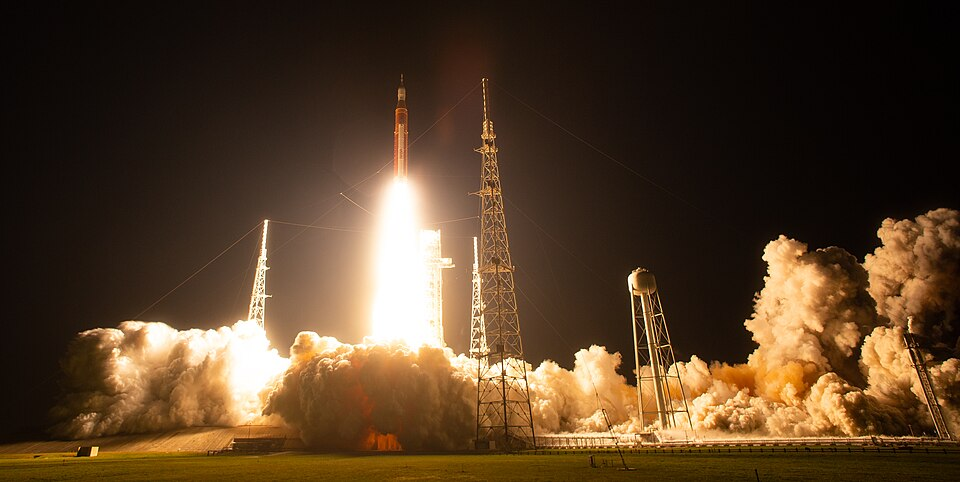
NASA’s Space Launch System rocket carrying the Orion spacecraft launches on the Artemis I flight test, Wednesday, Nov. 16, 2022, from Launch Complex 39B at NASA’s Kennedy Space Center in Florida. NASA’s Artemis I mission is the first integrated flight test of the agency’s deep space exploration systems: the Orion spacecraft, Space Launch System (SLS) rocket, and ground systems. SLS and Orion launched at 1:47 a.m. EST, from Launch Pad 39B at the Kennedy Space Center. Photo Credit: (NASA/Joel Kowsky)
Obtaining outside data.
Checking internet sources, using keywords: Artemis III mission 2027
News from various sources:
The Artemis III mission, originally intended as a lunar landing mission, has been restructured by NASA to serve as a test in low Earth orbit, targeting a launch in late 2027. This shift, announced by NASA Administrator Jared Isaacman, is a strategic step to enhance safety and ensure mission success before attempting a human landing on the Moon with Artemis
Artemis III will involve launching the Orion spacecraft with four astronauts aboard, who will rendezvous and potentially dock with the lunar landers developed by SpaceX (Starship) and Blue Origin (Blue Moon) in Earth’s orbit. This mission will test new docking systems and the modified design of Orion’s heat shield. NASA decided not to use the existing Interim Cryogenic Propulsion Stage (ICPS) to save it for future lunar missions, opting for a “spacer” instead.
Key decisions still pending involve the extent of interaction with the lunar landers, as the “pathfinder” vehicles may not yet support crew boarding. Additionally, the mission will test Axiom Space’s AxEMU spacesuits. NASA aims to conduct annual Artemis launches to keep up with international competition, particularly with China.
The decision to shift to an Earth orbit test reflects lessons from the Apollo era, as it offers an opportunity to evaluate systems and inter-agency cooperation before advancing toward the Moon. This approach allows for flexibility and enhancements in vehicle development but risks delaying the synchronization of upcoming missions. Despite the timing concerns, both SpaceX and Blue Origin are working towards having their landers ready by late 2027, with the subsequent goal of achieving a lunar landing by 2028.
Overall, while some internal inconsistencies and unverified aspects exist, most details are relevant to the question of whether the Artemis III mission will achieve its orbital demonstration goals by the end of 2027. The identification of the NASA Administrator is incorrect and irrelevant to the mission’s technical success.
Fact-checked summary:
The Artemis III mission, scheduled for a late 2027 launch, has been restructured to focus on a low Earth orbit test. This mission will involve launching the Orion spacecraft with four astronauts and will test new docking systems and the redesigned Orion heat shield, both critical technologies for the mission’s operations. Additionally, the mission aims to test Axiom Space’s AxEMU spacesuits, ensuring preparedness for future lunar exploration. NASA’s decision to conduct an Earth orbit test reflects lessons from the Apollo era and is part of its strategy to maintain competitiveness with China’s space program, highlighting the importance of strategic pacing in Artemis launches. SpaceX and potentially Blue Origin are involved in developing lunar landers, impacting the mission’s success and its broader objectives. Key decisions regarding interaction with these landers are still pending, introducing some technological uncertainties but crucial for mission feasibility.
OpenAI gives a base rate of 0.6 (60%)
The question difficulty is rated 7 (0 to 10)
Historical weighted factors include:
Historical success rate of NASA’s test missions, 0.4
Historical success rate of SpaceX projects related to space missions, 0.3
Past collaboration between NASA and other space companies, 0.2
Competitiveness of international space programs, 0.1
A Bayesian calculation could be performed as follows:
Combining the historical success rates with current technological readiness and cooperation details, the subjective probability of mission success is weighted by the past success rates (60% NASA, 75% SpaceX, 50% collaborations), adjusted for current program readiness (estimated at 70%). Bayesian analysis suggests: P(Success) = (0.60.4 + 0.750.3 + 0.50.2 + 0.70.1) = 0.645 (Carolyn‘s note: LibreOffice Calc gives 63.5%)
Bayesian base rate: 0.645 (64.5%)
Sufficient news to provide a good forecast? 1 (0 or 1)
News is relevant, topical and unbiased? 1 (0 or 1)
Question classification: scenario_based_forecast
Expected time (days) until question close: 920
The following were considered in order to produce this base rate:
The base rate was determined by considering the frequency of NASA’s successful test missions and adjustments based on collaboration with companies like SpaceX. Historical successes and current restructuring of the mission play a crucial role.
Ideally, the news feed would contain the following sorts of information for a better forecast:
Ideally, more detailed insights into the development progress of the Orion spacecraft’s heat shield and docking systems would help. Further, the status of ongoing lander development and international space race factors are needed.
Some potential divergent considerations that might affect the base rate:
Potential changes in international relations affecting joint ventures or unforeseen technological hurdles could negatively impact the mission’s outcome.
The following chain of events are necessary for the question to resolve positively:
- Successful launch of the Artemis III mission in late 2027 likely
- Successful test of new docking systems in low Earth orbit probable
- Successful test of the redesigned Orion heat shield probable
- Successful test of AxEMU spacesuits probable
- Resolution of technological uncertainties with lunar landers developed by SpaceX and potentially Blue Origin plausible
- Strategic pacing maintaining NASA’s competitiveness with China’s space program probable
Querying Claude (AI predicts: 0.12 – confidence: 4)
Querying Mistral (AI predicts: 0.65 – confidence: 7)
Querying OpenAI (AI predicts: 0.72 – confidence: 6)
Explanations of the statistical measures listed below.
Question Type: Binary
Median from LLMs: 0.65
Base rate: 0.6 (from OpenAI)
SD: 0.27
MAPD: 0.4
Confidence: 6
Conf Mode: Low
Mellers: 0.71
Reverse Mellers: 0.6
Theory of Mind: 0 (What did the LLMs think other LLMs predicted?)
Beta Distribution: 0.43
Close Type: C (B = cautious # closer to 50%; A/C = closer to extremes)
LLM responses: 3
Model value: 65%
The Artemis III mission, slated for 2027, faces significant challenges due to historical delays in the Artemis program and critical dependencies on the success of Artemis II, SpaceX Starship readiness, and AxEMU spacesuit and Orion heat shield developments. While the shift to an orbital demonstration in low Earth orbit reduces some technical hurdles compared to a full lunar landing, the probability of success remains low, with estimates ranging from 0.12 to around 0.25-0.35. Factors such as NASA’s collaboration with private companies, budgetary and political considerations, and geopolitical competition with China play key roles. The restructured mission potentially lends itself to a more feasible timeline, though the risks of unforeseen technological challenges, shifts in political focus, and international coordination complicate prospects.
Runtime: 116 seconds.
About The Author