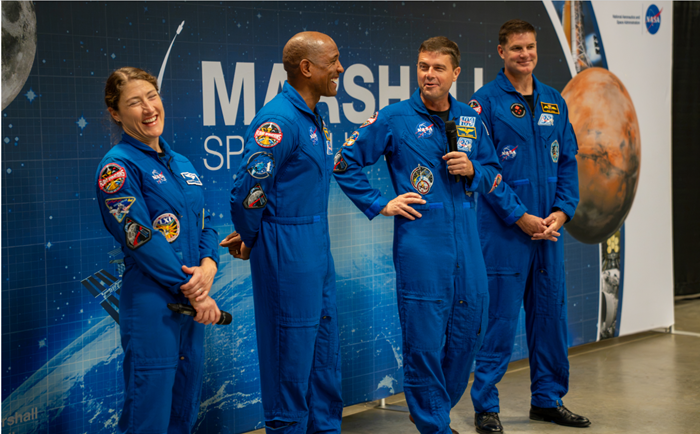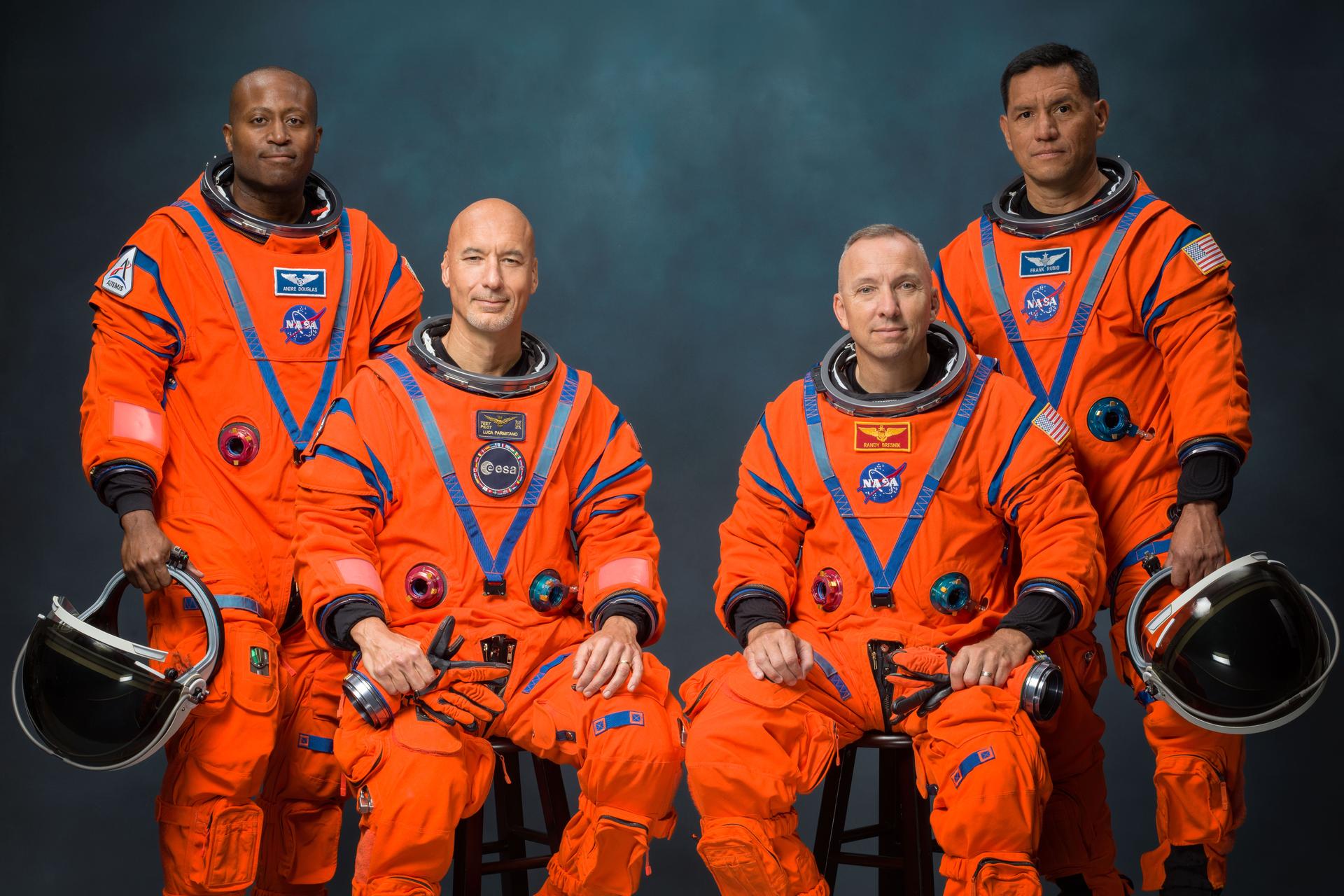
Meet the astronauts who will carry out a series of objectives in low Earth orbit to demonstrate critical systems needed for a future lunar landing, helping NASA and its partners reduce risk before Americans return to the Moon on Artemis IV. The Artemis III crew poses for an official portrait (from left: Andre Douglas, Luca Parmitano, Randy Bresnik, Frank Rubio). Credit: NASA/by Bill Staffor
Obtaining outside data.
Checking internet sources, using keywords: space habitat human mission 2027
News from various sources
The content provided is primarily centered around NASA’s plans and initiatives leading up to human missions to the Moon and Mars, particularly the Artemis program. Here is a summary of the key information extracted
NASA’s Simulation Mission 2027:
- NASA seeks volunteers for a one-year space habitat simulation at the Johnson Space Center in Houston, starting in August 2027. This study aims to simulate conditions like those on the Moon and Mars, assisting with the preparation for human missions under the Artemis program.
- The habitat will feature two isolated environments: one simulating a spacecraft and another a planetary base. Activities will include mock Mars walks and rover usage.
- Applicants must meet specific requirements, including being a U.S. citizen or green card holder, aged 30-55, no taller than 6’1, proficient in English, and holding a degree in relevant scientific fields.
Artemis Program Overview:
- NASA’s Artemis program includes a series of missions aimed at lunar exploration and long-term human presence on the Moon as a stepping stone to Mars.
- Artemis II (2026) completed a 10-day mission, circling the Moon, setting the stage for future missions.
- Artemis III (2027) will focus on testing docking capabilities between Orion and commercial lunar landers in Earth orbit, with astronauts testing docking procedures ahead of a planned lunar landing in Artemis IV (2028).
Artemis III Mission Specifics:
- Scheduled for 2027, this mission will involve complex operations in Earth orbit for testing rendezvous and docking procedures using spacecraft developed by Blue Origin and SpaceX.
- The Artemis III mission will not attempt a lunar landing but will validate systems critical for subsequent lunar exploration missions, such as Artemis IV, planned for 2028.
- Four astronauts named for the mission include Randy Bresnik, Luca Parmitano, Andre Douglas, and Frank Rubio, with Bob Hines as backup.
Future Moon and Mars Missions:
- NASA is working towards creating a lunar base by 2032 to facilitate long-term human habitation and research, serving as a precursor to crewed missions to Mars.
- These missions aim to foster international partnerships, technological advancements, and deeper solar system exploration.
Public Participation and Preparation:
- NASA encourages public engagement through opportunities like the simulated space habitat volunteer initiative.
- These efforts contribute to the overall strategy of preparing both technology and human factors for future deep space exploration and potential colonization.
Given the facts above, while NASA is advancing towards new space habitats, none are scheduled to be visited by humans before the end of 2027 according to the specific plans and timelines discussed. The most critical relevant fact is the plan for a lunar base by 2032; however, this is beyond the 2027 cutoff.
Fact-checked summary:
Based on the fact-checked information, the Artemis program’s objective is to use lunar exploration as a stepping stone to Mars, with the specific goal of eventually establishing a lunar base by 2032. The Artemis II mission, which completed a 10-day lunar flyby in 2026, and the Artemis III mission, scheduled for 2027 to test docking capabilities in Earth orbit, are significant milestones towards this overarching plan. While these missions provide important context for NASA’s advancements in human space travel and the development of space habitats, they do not directly result in a new space habitat being visited by humans before the end of 2027. However, the establishment of a lunar base remains a critical long-term goal of NASA’s exploration strategy.
OpenAI gives a base rate of 0.1 (10%)
The question difficulty is rated 7 (0 to 10)
Historical weighted factors include:
Historical NASA mission timelines, 0.4
Rate of space technology development, 0.3
Funding and political support for space missions, 0.2
International collaboration and private sector involvement, 0.1
A Bayesian calculation could be performed as follows:
Using the historical factors, and considering the likelihood of each necessary event, I assign a prior probability of 0.1 to visiting a new space habitat by 2027, given NASA’s past timelines and current missions. Updating with the likelihood of necessary events, the Bayesian estimate remains low, as key technologies and timelines are not aligned for 2027 completion.
Bayesian base rate: 0.08 (8%)
Sufficient news to provide a good forecast? 1 (0 or 1)
News is relevant, topical and unbiased? 1 (0 or 1)
Question classification: scenario_based_forecast
Expected time (days) until question close: 497
The following were considered in order to produce this base rate:
The base rate was derived by evaluating NASA’s historical mission completions, current progress on Artemis missions, and the technological challenges associated with building a lunar habitat. The likelihood of these events aligning into a new habitat visit by the end of 2027 is historically low.
Ideally, the news feed would contain the following sorts of information for a better forecast:
Additional information on future NASA mission timelines, technological development status, and international collaborations would be valuable. Insight into private sector contributions could also affect the timeline.
Some potential divergent considerations that might affect the base rate:
The successful acceleration of technology development or increased political and financial support could enable a faster timeline. Any unforeseen technological breakthroughs would significantly alter the forecast.
The following chain of events are necessary for the question to resolve positively:
- Completion of Artemis III mission in 2027, with successful docking in Earth orbit. (Moderately likely)
- Development and testing of technologies for a lunar habitat. (Unlikely by end of 2027)
- Completion of at least one lunar habitat that can support human life. (Highly unlikely by end of 2027)
- Approval and funding from NASA and relevant government bodies to continue lunar habitat development. (Moderately likely)
Querying Claude (AI predicts: 0.07 – confidence: 5)
Querying OpenAI (AI predicts: 0.15 – confidence: 6)
Guide to Jeremy Lichtman’s Multi-AI Oracle Reports
Question Type: Binary
Median from LLMs: 0.11
Base rate: 0.1 (from OpenAI)
SD: 0.04
MAPD: 0
Confidence: 5.5
Conf Mode: Normal
Mellers: 0.05
Reverse Mellers: 0.2
Theory of Mind: 0.2 (What did the LLMs think other LLMs predicted?)
Beta Distribution: 0.36
Close Type: A (B = cautious # closer to 50%; A/C = closer to extremes)
LLM responses: 2
Model value: 0.11 (11%)
The likelihood of humans visiting a new space habitat by the end of 2027 is deemed low due to the current status of space habitat development projects and historical trends. Since the last new crewed habitat, the International Space Station, there has been no similar advancement, resulting in a low base rate for such occurrences. While commercial endeavors like Axiom Space’s modules, Starlab, and Orbital Reef show potential, their timelines suggest a more realistic target of mid-to-late 2020s or even early 2030s for human visitation. NASA’s Artemis program indicates no imminent plans to visit a new habitat by 2027, and the Gateway station doesn’t support a visit within this period. Existing operational stations, like China’s Tiangong, wouldn’t qualify unless expanded significantly. However, the unpredictability of commercial space initiatives and geopolitical dynamics, alongside the possibility of accelerated advancements or undisclosed projects, suggest a small but non-negligible chance of earlier success, with a rough probability converging around 0.07 (7%).(Carolyn’s note: Why is the Model Value 11% instead of 7%? The Multi-AI Oracle is designed to avoid going “too close” to zero.)
Runtime: 116 seconds.
About The Author