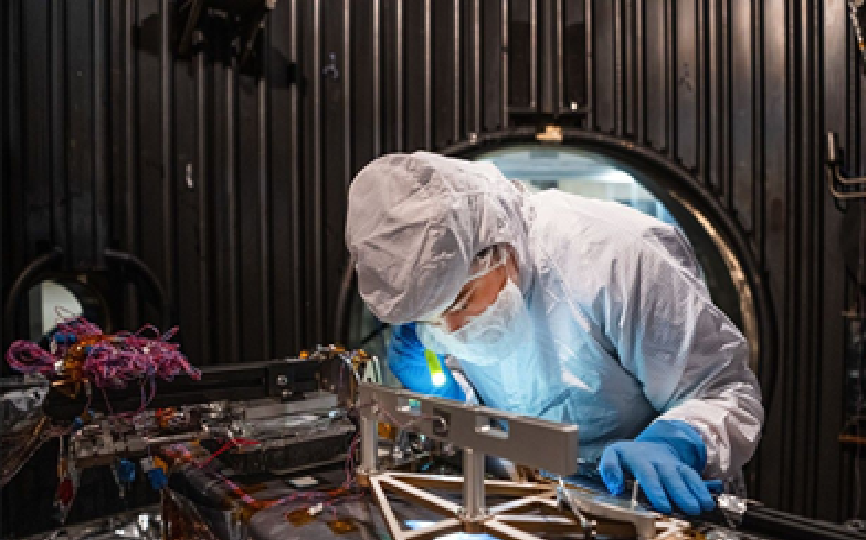
Mechanical Engineer Brie Ludwig inspects the Lunar Environment Monitoring Station (LEMS), a compact, autonomous, and self-sustaining seismometer suite designed to carry out continuous, long-term monitoring of the lunar seismic environment at the South Polar region. NASA/Denny Henry. Source: https://science.nasa.gov/missions/artemis/nasa-completes-astronaut-deployed-science-instrument-for-lunar-surface/
Grok response:
1. Moon to Mars | NASA’s Artemis Program
Official NASA program overview page (last updated August 17, 2026). This is the resolution source listed in the question criteria. It officially describes Artemis III as a low-Earth-orbit demonstration mission planned for 2027 to evaluate one or both commercial human landing systems from SpaceX and Blue Origin, with crew launching in Orion on SLS to test rendezvous and docking. The page notes Artemis IV as the first lunar landing targeted for 2028 and confirms the overall architecture after the February 2026 replan. It also highlights the named crew and ongoing hardware progress.[1]
2. NASA Marches Toward Artemis III Mission in 2027, Names Crew Members
NASA news release (June 9, 2026). NASA announced the four-person crew (Randy Bresnik commander, Luca Parmitano pilot/ESA, Andre Douglas and Frank Rubio mission specialists, Bob Hines backup) and provided the first detailed concept of operations. Blue Origin’s Blue Moon Mark 2 test article launches first and can loiter up to 90 days; Orion/SLS follows for ~2 days of docked operations (including possible crew ingress); then SpaceX Starship V3 test article docks for ~1 day before Orion returns. The release emphasized risk reduction for the 2028 Artemis IV landing and noted hardware milestones already underway.[2]
3. How NASA’s Artemis III Lander Test Will Pave Way for Moon Landings
NASA article (July 15, 2026). This details the technical approach: both providers will fly test articles (SpaceX Starship Version 3 with added nose docking adapter; Blue Origin Mark 2 crew cabin with full avionics/software). Three launches occur in succession (New Glenn first, then SLS, then Starship) to practice processing, communications, and two sequential dockings. NASA, SpaceX, and Blue Origin will use the data to refine systems before uncrewed and crewed lunar flights, with astronauts potentially entering at least one lander. It underscores the mission’s role as a “dress rehearsal” closer to home.[3]
4. Put it in pencil: NASA’s Artemis III mission will launch no earlier than late 2027
Ars Technica report (April 28, 2026). NASA Administrator Jared Isaacman told Congress that SpaceX and Blue Origin indicated their lander test articles would be ready for a late-2027 rendezvous and docking demonstration, slipping from the mid-2027 target announced in February. The article notes remaining uncertainties around orbit altitude and SLS configuration (spacer vs. ICPS) and highlights NASA’s desire for annual cadence after Artemis II. It frames the date as vendor-driven rather than SLS/Orion-limited.[4]
5. NASA Administrator ‘extremely confident’ in Artemis 3 mission in 2027
Spaceflight Now article (August 14/20, 2026). Isaacman stated he is “extremely confident” Artemis III will launch in 2027, citing active SLS stacking (4 of 10 SRB segments already stacked) and engine integration. He expressed optimism on SpaceX cadence if they maintain frequent Starship flights through late 2026 and noted Blue Origin has a year to recover New Glenn. The piece positions the mission as less than a year away from its three-launch sequence.[5]
6. NASA says Artemis III mission on schedule as Blue Origin repairs launchpad
Reuters report (July 20, 2026). Isaacman confirmed NASA remains on track for the 2027 demonstration despite the May 28 New Glenn explosion that damaged Blue Origin’s only operational pad. He said SLS and Orion (under NASA’s control) are progressing “incredibly well” and that Blue Origin has a full year to fly New Glenn as Plan A, with contingencies available. The article notes industry skepticism about lander readiness but quotes NASA’s continued planning.[6]
7. Artemis III (Wikipedia)
Encyclopedia entry (last updated August 20, 2026). It summarizes the February 2026 replan that converted Artemis III from a 2027 lunar landing into a LEO demonstration, the June crew announcement, and the three-launch sequence with Blue Origin loitering first. It notes the SLS will fly a non-propulsive spacer instead of ICPS (reserved for Artemis IV) and that the mission tests docking, life support, and possible spacesuit interfaces. The page compiles official NASA statements and press details on hardware status.[7]
8. Artemis progress building lunar return roadmap
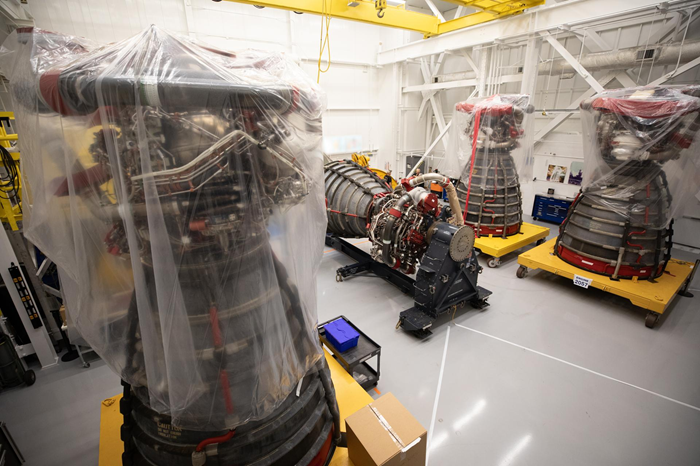
NASASpaceFlight.com update (August 9, 2026). This reports Orion crew and service modules joined (July 30 milestone), SRB stacking underway (accelerated ~4 months vs. Artemis II), all four RS-25 engines delivered, and spacer fabrication advancing at Marshall. It also covers reuse of Artemis II Orion components to speed later missions and ongoing simulations. The article portrays NASA as accelerating integration timelines after Artemis II’s April 2026 success.[8]
9. Inside NASA Marshall’s progress on Artemis III hardware, plans for new SLS upper stage
Aerospace America (August 24, 2026). Marshall teams started spacer fabrication in April and by August had a barrel and rings built, targeting December 2026 completion (8-month flight-hardware build). Formal verification testing of the spacer configuration begins in October. The piece quotes officials on focused testing of the few changes from Artemis II and Isaacman’s mid-August optimism about risk reduction for Artemis IV.[9]
10. NASA Joins Artemis III Orion Modules; Rocket Hardware Update
NASA blog (July 2026, covering July 30 joining). Engineers mated the Orion crew and European Service Module, a key integration step. SRB stacking began in early July; the final RS-25 engine arrived July 21. Spacer welding at Marshall reached the eighth and final barrel weld. The update emphasizes outpacing Artemis II timelines and beginning launch simulations.[10]
The official NASA Artemis page (the stated resolution source) continues to list the low-Earth-orbit demonstration for 2027 with no change as of its August 17, 2026 update. The mission was formally added in February 2026 when NASA converted the original 2027 lunar-landing plan into a risk-reduction flight modeled on Apollo 9: four astronauts launch on SLS/Orion to practice rendezvous and docking with test versions of the SpaceX Starship HLS and/or Blue Origin Blue Moon Mark 2. Artemis IV remains the first surface landing, targeted for 2028. NASA named the crew on June 9, 2026, and published a sequential three-launch profile: Blue Origin New Glenn first (lander can loiter 30–90 days), then SLS/Orion for roughly two days of docked operations (possible crew ingress and spacesuit tests), then SpaceX Starship V3 (with added docking adapter) for about one day, followed by Orion splashdown. The SLS will use a structural spacer rather than the ICPS upper stage (saved for Artemis IV).
Hardware under NASA’s direct control is advancing on an accelerated cadence after Artemis II’s successful April 2026 lunar fly-around. The Artemis III core stage arrived at Kennedy in April, engines were delivered by late July, SRB stacking started in early July (four of ten segments stacked by mid-August), Orion modules were joined July 30, and spacer fabrication at Marshall is targeting December 2026 completion. Launch simulations and heat-shield work continue. NASA Administrator Jared Isaacman has repeatedly expressed high confidence, most recently stating in mid-August that he is “extremely confident” of a 2027 launch and that stacking would not have begun otherwise.
The commercial landers remain the largest schedule risk. Both providers told NASA in April they could support a late-2027 demonstration (a slip from the original mid-2027 target). SpaceX is flying Starship V3—the version planned for the test article—and achieved a major success on Flight 13 (July 24, 2026): full-duration burns, Starlink V3 deployment, first intact splashdown, and heat-shield data. Isaacman has said frequent late-2026 flights would increase confidence. Blue Origin’s New Glenn exploded during a May 28, 2026 static-fire test, destroying the vehicle and damaging its only operational pad (LC-36). Reconstruction began within days; the company aims to resume flights by the end of 2026. Isaacman has called New Glenn Plan A and said Blue Origin has a full year, with NASA holding contingencies. A March 2026 NASA OIG report had already flagged schedule and technical challenges for both HLS contractors that could affect 2028 landing dates; those concerns persist but have not produced a new official slip for the 2027 demo.
No further official date change has been announced since the April “late 2027” vendor input. NASA publicly targets mid-to-late 2027. The mission could theoretically proceed with only one lander if the other slips. Success would require the full sequence (or a one-lander variant) plus safe crew return by December 31, 2027. Historical NASA human-spaceflight schedules have frequently slipped, and a late-2027 launch would leave little margin for weather, anomalies, or recovery time. Recent updates (stacking, Orion mating, Starship V3 progress, NASA leadership statements) indicate movement toward a 2027 attempt rather than an immediate delay into 2028, but the commercial elements and multi-vehicle complexity keep the outcome uncertain. Prediction markets do not currently have a liquid contract matching this exact resolution criteria.
Extracted resolution criteria links:
[‘https://www.nasa.gov/humans-in-space/artemis/‘]
=== Forecast Result ===
As an expert superforecaster, my analysis is grounded in a careful weighing of the available evidence, acknowledging both optimistic progress and significant historical and systemic risks. The question is whether the Artemis III orbital demonstration mission will succeed by the end of 2027. This requires not just a launch, but the successful completion of key mission objectives, including rendezvous and docking, before the deadline
Reasoning Rationale
- Favorable Factors (Arguments for “Yes”)
- Strong Political Will and Official Commitment: NASA leadership, including the administrator, has repeatedly and recently expressed high confidence in a 2027 launch. [10, 12, 5-sm] The mission has a named crew, a detailed concept of operations, and is the central focus of the Artemis program for 2027. [2-sm] This level of public commitment creates immense pressure to meet the target.
- Tangible Progress on NASA Hardware (SLS/Orion): The elements under NASA’s direct control are proceeding at an accelerated pace compared to previous missions. [8-sm] Key milestones like the joining of the Orion crew and service modules and the stacking of the Solid Rocket Boosters (SRBs) are complete or underway. [8, 10-sm] The use of a structural spacer instead of a propulsive upper stage simplifies the SLS vehicle for this specific mission, reducing technical risk. [7-sm, 9-sm]
- Pragmatic Mission Redefinition: The shift in February 2026 from a lunar landing to a low-Earth orbit (LEO) demonstration was a crucial de-risking move. An LEO test is technically less demanding and provides a more forgiving environment for a first-time docking with new commercial vehicles. This makes the 2027 target far more plausible than the original landing plan.
- Flexibility in Success Criteria: The mission requires docking with “one or both” commercial landers. This provides critical redundancy. If Blue Origin’s significant schedule risks materialize, the mission can still be deemed a success by docking with only the SpaceX Starship, greatly increasing the overall probability of meeting the resolution criteria.
- Rapid Progress from SpaceX: SpaceX has demonstrated an accelerated testing cadence and achieved a major milestone with the first intact splashdown and recovery of a Starship vehicle. Their ability to iterate and fly frequently means they could have a relatively mature Starship V3 ready for the 2027 demonstration. [5-sm]
- Unfavorable Factors (Arguments for “No”)
- Extremely Tight Schedule with No Margin: The official timeline has already slipped from “mid-2027” to “late 2027,” driven by vendor input. [4-sm] A launch in late 2027 leaves zero buffer for weather delays, last-minute technical snags, or issues during the multi-week mission itself. The resolution requires mission completion by December 31, 2027, not just a launch. A slip of even a few weeks from a Q4 launch target would cause the resolution to be “No.”
- Critical Risk in Commercial Partner Readiness: This is the dominant uncertainty.
- Blue Origin: The May 2026 New Glenn explosion severely damaged their only launchpad. While recovery is underway, the timeline to repair the pad, successfully fly New Glenn, and have the Blue Moon test article ready for a 2027 launch is extremely aggressive and widely seen as a major risk.
- SpaceX: While progressing rapidly, the HLS Starship is a complex, modified vehicle that has not yet flown. The overall Starship program still needs to master key technologies like orbital refueling for the full lunar architecture. Any significant failure in their test flights leading up to the mission could ground the fleet and cause a cascading delay.
- Inherent Complexity of the Mission: The demonstration involves a sequence of three separate launches (New Glenn, SLS, Starship) and two complex rendezvous and docking operations. [3-sm] The probability of a delay or failure in any single element of this chain is significant. In complex engineering projects, the likelihood of all serial components working on schedule is often overestimated.
- Powerful Base Rate of Delays: Large, novel government spaceflight programs almost invariably face schedule slips. The history of SLS, JWST, and commercial crew programs demonstrates that delays of months or years are the norm, not the exception. A successful on-time execution of Artemis III in 2027 would be a historical outlier.
Key Assumptions and Synthesis
My forecast hinges on three critical assumptions:
- Assumption: The SLS/Orion hardware will be ready for a launch attempt in 2027. The evidence strongly supports this. Probability this assumption is wrong: 10% (i.e., a 90% chance of being ready).
- Assumption: At least SpaceX will be ready with a launch-ready Starship test article in 2027. This is the crux of the forecast. Given their progress and the flexibility of needing only one partner, this is plausible but fraught with risk. Probability this assumption is wrong: 35% (i.e., a 65% chance SpaceX is ready). Blue Origin’s readiness is a bonus, not a necessity for a “Yes” resolution.
- Assumption: A “late 2027” launch attempt will not slip into 2028 due to minor delays or the time needed to complete the mission. This is my primary reason for pessimism. The historical base rate is overwhelming. Even if all hardware is ready for a November 2027 launch, a minor technical issue or a string of bad weather could easily push the actual launch past the point where the ~2-week mission could be completed by December 31st. Probability of a slip from late 2027 into 2028 due to “normal” friction: High.
Conclusion:
While NASA’s commitment is strong and its own hardware is progressing well, the mission’s success is ultimately dependent on the readiness of at least one commercial partner and the unforgiving nature of a hard deadline with no margin for error. The high probability of “normal” schedule slips affecting a complex, multi-element program leads me to be skeptical that the mission will be successfully completed within the 2027 calendar year. The most likely scenario is a slip of the launch into the first or second quarter of 2028. The current momentum and political will make a 2027 attempt likely, but completion by the deadline is less probable. Adjusting for the superforecaster tendency toward overconfidence and acknowledging the strong historical base rate of delays, I will set the probability below 50%.
Probability: 41%
End
About The Author