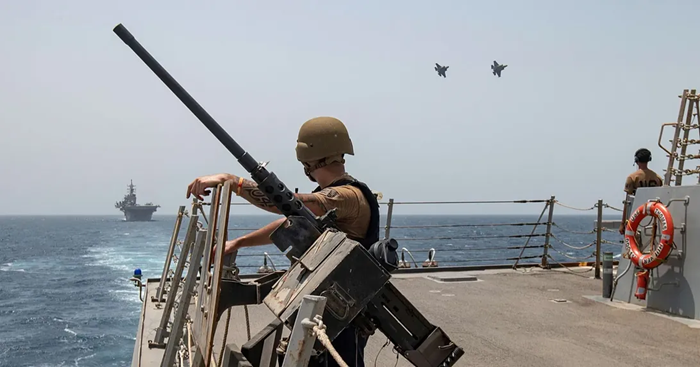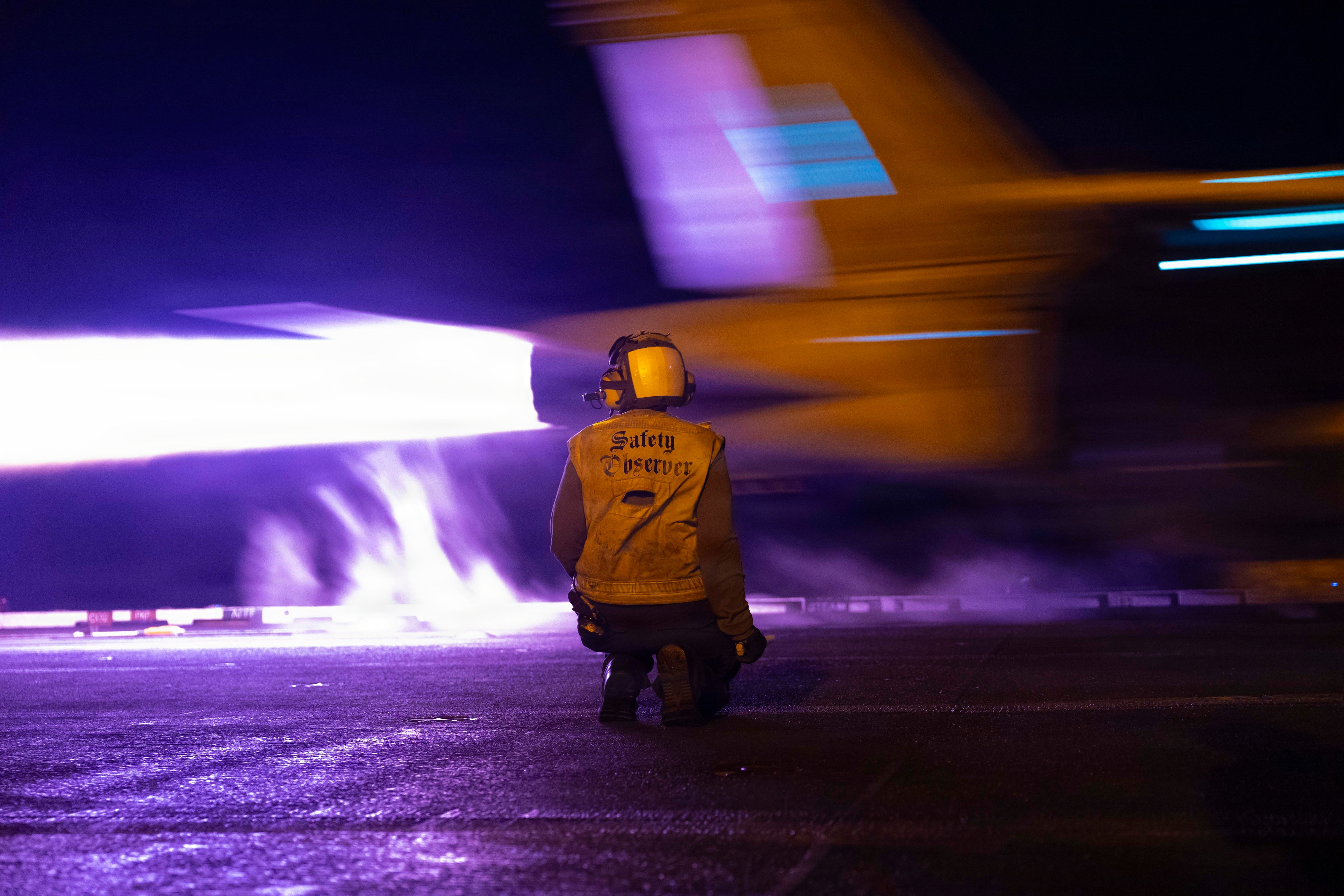
USS George H.W. Bush (CVN 77) Conducts Night Flight Operation. A U.S. Sailor conducts flight operations aboard Nimitz-class aircraft carrier USS George H.W. Bush (CVN 77), July 29, 2026. George H.W. Bush is deployed to the U.S. 5th Fleet area of operations to support maritime security and stability in the Middle East. (U.S. Central Command photo)
Grok response
1. Brent crude oil – Price – Chart – Historical Data – News
https://tradingeconomics.com/commodity/brent-crude-oil
August 18, 2026
Brent crude stood at 91.21 USD per barrel, up 0.38% on the day and 38.60% year-over-year. Trading Economics models project 90.41 by end of Q3 2026 and 104.28 in 12 months. Recent news highlights prices climbing as US-Iran peace prospects faded after President Trump declined to extend an interim deal, with Hormuz shipping talks continuing without US involvement.
2. Short-Term Energy Outlook
https://www.eia.gov/outlooks/steo/
August 11, 2026
The EIA forecasts Brent averaging $87 per barrel for full-year 2026, $85 in Q3, and declining to $78 in Q4 before $69 in 2027. Assumptions include persistent Strait of Hormuz constraints through August 2026, further inventory draws, and most Middle East production recovering only in early 2027. US crude production is seen at 13.8 million barrels per day in 2026.
3. Oil Market Report – August 2026
https://www.iea.org/reports/oil-market-report-august-2026
August 12, 2026
IEA projects global oil demand declining 1.6 million barrels per day in 2026 due to high prices and Hormuz disruptions, with supply falling 4.3 million barrels per day. Inventories dropped 410 million barrels since the war began, creating a 1.8 million barrel per day deficit in Q3. Benchmark prices showed a $40 range in July, with North Sea Dated around $92 recently.
4. Oil Prices Forecast | J.P. Morgan Global Research
https://www.jpmorgan.com/insights/global-research/commodities/oil-prices
August 2026 (latest update)
J.P. Morgan expects Brent to average $86 in Q3 2026, $80 in Q4, and $78 by year-end. The bank anticipates a later shift toward a $60s regime in the second half of 2027 as Persian Gulf supply recovers to near-full levels. This follows earlier cuts citing weaker inventory draws and softer demand.
5. Oil (Brent) Price
https://markets.businessinsider.com/commodities/oil-price
August 18, 2026
Brent traded at 91.03, with a 52-week range of 58.72 to 126.41. The data underscores extreme volatility over the past year, including a wartime peak above 126 in April 2026. Current levels remain well above the 52-week low recorded in December 2025.
6. OPEC further lowers 2026 global oil demand growth forecast
https://www.reuters.com/business/energy/opec-further-lowers-2026-global-oil-demand-growth-forecast-2026-08-12/
August 12, 2026
OPEC revised 2026 demand growth down to 580,000 barrels per day, its fourth consecutive cut. The group sees a milder impact from the Iran conflict on consumption than the IEA. This contrasts with IEA’s view of outright demand contraction this year.
7. Oil prices fall to levels not seen since start of US-Israel war on Iran
https://www.aljazeera.com/economy/2026/7/2/oil-prices-fall-to-levels-not-seen-since-start-of-us-israel-war-on-iran
July 2, 2026
Brent dropped below $71, down more than 38% from the April 30 peak above $126, returning to pre-war levels amid reports of progress toward ending the conflict. Prices later rebounded as hostilities resumed. This marked one of the sharper intra-year declines in 2026.
8. Citi Raises Brent Forecast for 2026; Sees $150 Oil if Hormuz Disruption Persists
https://energynow.com/2026/04/citi-raises-brent-forecast-for-2026-sees-150-oil-if-hormuz-disruption-persists/
2026 (updated context)
Citi lifted its base-case 2026 averages to $110 (Q2), $95 (Q3), and $80 (Q4), with a 50% probability. A persistent Hormuz disruption scenario could see spikes to $150 and quarterly averages near $130. This reflects heightened risk premiums from ongoing Middle East tensions.
9. Brent Crude Oil Futures Quotes
https://www.cmegroup.com/markets/energy/crude-oil/brent-crude-oil.html
August 13, 2026
The futures curve showed backwardation with October 2026 at 88.52, November 86.57, December 84.39, January 2027 at 82.64, and February 2027 at 81.29. This indicates the market prices in a gradual decline through late 2026 and into 2027 while remaining well above $80.
10. Barclays cuts Brent price forecasts for 2026 and 2027
https://www.reuters.com/business/energy/barclays-cuts-brent-price-forecasts-2026-2027-2026-06-26/
June 26, 2026
Barclays reduced its 2026 Brent average to $96 (from $100) and 2027 to $85 after increased Hormuz flows. The cut followed signs of recovering supply. Even the revised figure remains substantially above $50.
Brent crude is currently trading around 91.21 USD per barrel as of August 18, 2026, according to the resolution source Trading Economics. This is up roughly 38-39% from a year earlier, with a 52-week range of approximately 58.72 to 126.41. Within 2026 itself, prices started the year in the mid-60s, spiked above 126 in late April amid the US-Iran/Israel conflict and Hormuz disruptions, fell as low as about 69-71 in early July during a temporary pause in fighting, and have since rebounded to the low 90s as tensions persist and an interim peace memorandum expired. The 2026 year-to-date low remains well above 50 (around 64-70 based on available monthly and quarterly data), so the question hinges on whether a sharp drop occurs in the remaining four-plus months.[1]
Major forecasting agencies have revised 2026 outlooks upward due to ongoing supply disruptions but still expect a decline from current levels later this year. The EIA’s August STEO sees a full-year 2026 average of $87, with $85 in Q3 and $78 in Q4 as inventories begin to rebuild once production recovers more fully in 2027 (average $69). The IEA is more bearish on demand, projecting a 1.6 million barrel per day contraction in 2026 from high prices and logistics issues, alongside a 4.3 million barrel per day supply drop, yet this has supported prices via inventory draws of 410 million barrels since the conflict started. OPEC is more optimistic on demand (only +0.58 million barrels per day growth) and sees less war-related destruction. Bank forecasts cluster in a similar range: J.P. Morgan at $86/80/78 for Q3/Q4/year-end 2026; Barclays around $96 for the year; others like Citi and Goldman Sachs have higher base cases or upside scenarios to $110-150 if Hormuz remains severely constrained. Trading Economics’ model is an outlier on the bullish side for the next 12 months. No major house currently projects an average or even a quarterly print near or below 50 for the rest of 2026.[2]
The futures curve as of mid-August is in backwardation, pricing October 2026 around 88.5, December around 84.4, and early 2027 contracts in the low 80s. This implies the market anticipates easing but not a collapse. Pre-conflict forecasts from late 2025 (EIA near $54-55, some banks $55-58) were far lower and have been overtaken by events; the war created a tight market with depleted buffers. Recent price action has been toward higher levels: Brent has risen for multiple sessions as President Trump signaled no interest in extending the US-Iran interim deal and Hormuz transit remains problematic, with some covert shipping continuing but overall flows reduced. July saw a $40 intra-month range, illustrating geopolitics-driven volatility.[3]
Downside risks that could theoretically push prices toward or below 50 include a rapid, complete de-escalation allowing full Gulf production recovery (8+ million barrels per day still shut in at times), combined with demand destruction from already-elevated prices, possible European recession/stagflation (high energy costs have raised recession odds according to some analysts), strong US output (EIA at 13.8 million barrels per day), and any broader economic slowdown. IEA notes demand already contracting and product markets tight, which could accelerate if prices stay high. However, even J.P. Morgan’s longer-term view only reaches the low $60s in the second half of 2027 after recovery. A drop of more than 45% from current levels in the next four months would be extreme even for oil, though not impossible given 2020 or 2014-2016 precedents. Seasonality (typically firmer Q4 demand) and current inventory tightness argue against it in the near term. Prediction markets show negligible odds of sub-50 prints even for the remainder of August. Overall, authoritative sources and recent data point to continued support from geopolitics in the short run, followed by a moderated decline that stays well above 50 through year-end 2026, though a surprise resolution plus surplus could increase the tail risk.[4]
Extracted resolution criteria links:
[‘https://tradingeconomics.com/commodity/brent-crude-oil’]
=== Forecast Result ===
Reasoning and Analysis
Current Situation
Brent crude is trading at ~$91.21/bbl as of August 18, 2026 (confirmed by the resolution source, TradingEconomics). For this question to resolve YES, prices must fall more than $41/bbl (~45%) from current levels in the remaining ~4.5 months of 2026.
2026 Historical Range Context
- 52-week range: ~$58.72 – $126.41
- 2026 YTD low: approximately $59-71 (started mid-60s in January, briefly dipped to ~$70-71 in July during peace negotiations)
- Even at its most pessimistic point in 2026, Brent remained ~$20+ above the $50 threshold
Forecaster Consensus
All major forecasting bodies project late-2026 Brent well above $50:
- EIA August STEO: $78/bbl average Q4 2026
- J.P. Morgan: $80/bbl Q4, $78 year-end
- Goldman Sachs: ~$80/bbl Q4
- Morgan Stanley/Citi: ~$70-75/bbl Q4
- ICE Futures curve: December 2026 at ~$84.39/bbl
- No institution projects below $60/bbl for 2026
What Would Need to Happen for Sub-$50
- Rapid, complete geopolitical de-escalation – full Hormuz reopening, complete Iran peace deal
- Simultaneous severe demand destruction – global recession/demand shock
- OPEC+ discipline breakdown – members flooding the market
- All three occurring simultaneously within 4.5 months
Even during July’s temporary peace talks, Brent only dipped to ~$69-71. A drop of 45%+ from current levels in ~19 weeks is extraordinarily unlikely.
Historical Base Rates
- 2020 COVID crash: Brent fell ~70% but from ~$65 (not $91), and to ~$15-20, driven by unprecedented simultaneous demand collapse + supply war
- 2014-2016 bear market: 65% decline but over 18 months
- In no recent scenario has Brent fallen 45%+ in ~4.5 months starting from $90+
Critical Assumptions Assessment
- Hormuz disruptions persist (probability it fails: ~20%) → Even with resolution, market wouldn’t reach $50 in isolation
- No catastrophic global recession (probability it fails: ~10%) → A severe recession might push oil lower but rarely to $50 from $90+ in 4 months
- OPEC maintains some discipline (probability it fails: ~15%) → Combined with above events, still unlikely to reach $50
Timeline Analysis
- Sub-$50 in 1 month: ~0.5%
- Sub-$50 in 3 months: ~1.5%
- Sub-$50 by year-end: ~2%
The probability distribution is extremely skewed against resolution. The geopolitical support, current level (~$91), and consensus forecasts all argue strongly against this. The question requires an event that would be historically unprecedented in its speed from current price levels.
Probability: 2%
End
About The Author