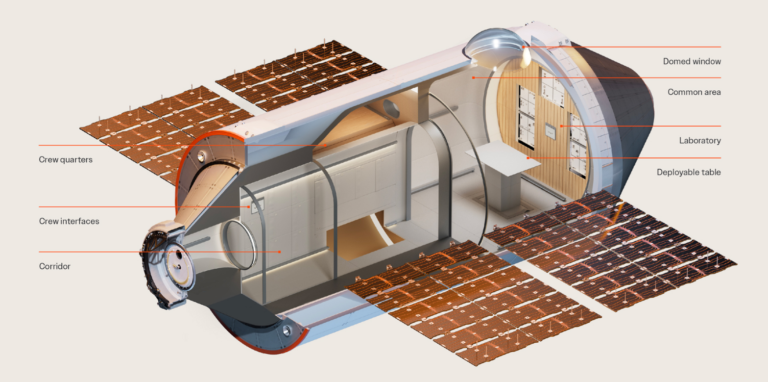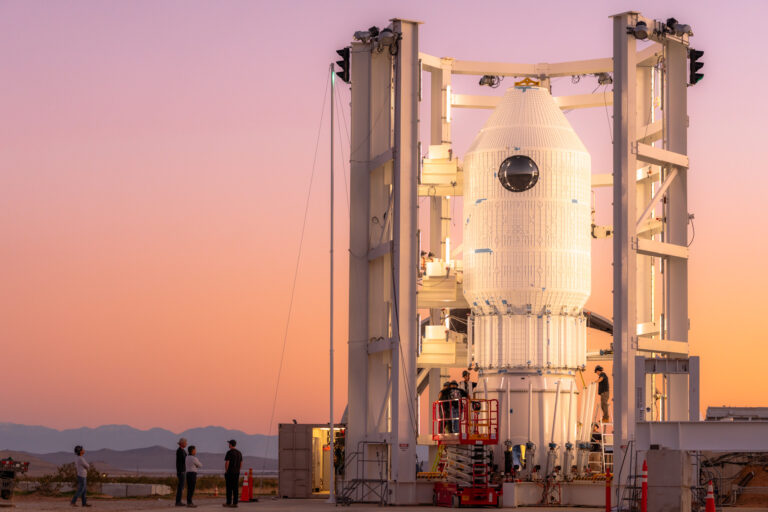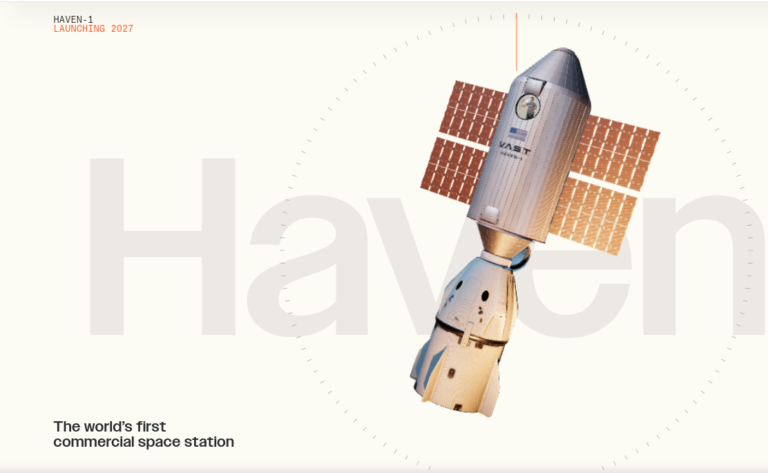
Image: Personal crew quarters, such as that depicted here of a woman happily asleep in the Haven-1 space habitat. Source: https://www.vastspace.com/haven-1
Deepseek Binary response:
The resolution hinges almost entirely on Vast’s Haven-1, the only new space habitat with a credible path to a human visit before the end of 2027. Other candidates are either far behind (Starlab: 2029, Orbital Reef: no firm date, Starship-based station: not near-term).
Key evidence:
- Haven-1 is targeting a Falcon 9 launch no earlier than Q1 2027, with hardware in final integration and environmental testing planned for late 2026.
- Vast plans the first crewed mission, Vast-1, using Crew Dragon, with multiple crewed missions mentioned for 2027.
- However, space hardware schedules frequently slip. Haven-1 itself has already slipped from earlier targets to Q1 2027.
- A crewed visit requires a successful uncrewed launch, station checkout, and a subsequent Crew Dragon docking—all within a tight window if launch slips past mid-2027.
Probabilistic assessment:
- P(Haven-1 launches by Q2 2027) ≈ 70–75%
- Given a Q1 launch, P(first crewed visit by end 2027) ≈ 75–80%
- Given a Q2 launch, P(first crewed visit by end 2027) ≈ 50–60%
- Given a later launch, probability drops sharply.
- Other habitats contribute negligible additional probability.
Combining these yields a best estimate in the low-to-mid 50% range. The research is bullish but explicitly notes significant schedule risk. To compensate for historical overconfidence, I keep the forecast modest.
Assumptions that could most alter the outcome:
- Haven-1 launch slips beyond mid-2027 (failure probability ~30%). This would likely push the first crewed visit to 2028.
- Even with a Q1 launch, Crew Dragon and station readiness delay the crewed mission past December 2027 (failure probability ~25%).
- No other new habitat becomes visitable (failure probability <5%).
These assumptions support a final probability near 55%.
Data sufficiency: Sufficient
Probability: 55%
Grok response:
Haven-1 (Vast Space) is the only plausible candidate for a new space habitat that could see a human visit before the end of 2027, with a launch targeted for Q1 2027 and initial crewed missions planned shortly afterward, though significant schedule risks remain. Other projects like Starlab and Orbital Reef have later timelines (2029 or beyond), and no firm plans exist for a NASA Starship-based station in that window.[1][2]
- Haven-1 – Wikipedia (Encyclopedia entry on Vast’s planned station). Published: 2026-10-13. Summary: Haven-1 is slated for NET Q1 2027 launch on Falcon 9 as the first commercial space station; first crewed Vast-1 mission would deliver four astronauts via Crew Dragon for 10–30 days after uncrewed docking verification. Integration began January 2026 with ongoing tests; plans include multiple short Dragon missions over its ~3-year life.[1]
- Vast Maintains Early 2027 Haven-1 Launch – Aviation Week (Industry report). Published: 2026-09-18. Summary: CEO Max Haot confirmed Q1 2027 target remains on track after earlier schedule reset; station is in final integration phases. This positions it ahead of competitors for initial commercial operations.[2]
- Space Stations – Venture Atlas (Industry overview updated daily). Published: 2026-10-14. Summary: Haven-1 flight structure in final integration with solar arrays and computers in testing as of mid-October 2026; targets 2027 launch without needing the new NASA CLDC contract. Starlab and others are competing but on slower paths.[3]
- 40 crew-days: why Vast’s first space station skips closed-loop life support – nexi.fund (Analysis). Published: 2026-10-09. Summary: Haven-1 plans only ~40 total crew-days across its life via four short missions of four astronauts each; relies on open-loop systems and docked Dragon for support. Launch slipped to Q1 2027 with environmental tests planned for late 2026.[4]
- ESA and Vast: the new MoU… – The SpaceInfo Club (ESA partnership report). Published: 2026-10-06. Summary: ESA-Vast agreement includes four crewed missions in 2027 involving Haven-1 (first crewed visit planned); one French astronaut already selected for Vast-1. Launch now expected early 2027 after delays.[5]
- Vast’s Haven-1 continues to advance… – NASASpaceFlight.com (Technical update). Published: 2026-07-04. Summary: Multiple milestones achieved; Vast-1 inaugural four-person crew via Crew Dragon targeted for up to 30 days after 2027 launch. European astronauts involved in related 2027 plans.[6]
- Haven-1 — Vast (Official company page). Published/updated: 2026-10-12. Summary: Targets 2027 launch for the single-module station with 45 m³ habitable volume; supports two-week missions for four crew using Crew Dragon. Emphasizes private and government use.[7]
- Starlab (space station) – Wikipedia (Entry on Voyager-led project). Published: 2026-10-10. Summary: Planned launch no earlier than 2029 on Starship as a single integrated unit; completed Commercial Critical Design Review with NASA in February 2026. Aimed at continuous crew of four but far beyond 2027.[8]
- Starlab Space Station | Voyager (Official project site). Published/updated: 2026-10-09. Summary: Single-launch Starship mission targeted before ISS retirement (around 2030); Hilton designing crew quarters. Focus on science park capabilities with no 2027 operations planned.[9]
- NASA Seeks US Industry Plans for Commercial Space Stations – NASA (Official release). Published: 2026-10-09. Summary: Final RFP issued October 9, 2026, for commercial LEO destinations; proposals due Dec 8, awards expected spring 2027. Supports post-ISS transition with services starting later; multiple bidders including Vast, Starlab, and others.[10]
Haven-1 remains the frontrunner but faces tight timelines. As of October 2026, Vast reports ongoing integration, fit-checks, and upcoming environmental testing at NASA facilities, with the Q1 2027 launch window holding in recent statements.[3][11] A crewed visit would require successful uncrewed Dragon docking verification post-launch, crew training (potentially compressed), and no further slips—historically common in space hardware. Limited total crew time (~40 days across missions) underscores its demonstration nature.[4]
Orbital Reef (Blue Origin/Sierra Space) shows limited recent progress toward near-term operations. The project is referenced in CLD Phase 1 milestones and an older 2025 ESA agreement, but no firm 2027 launch or crewed timeline appears in 2026 sources; it trails Haven-1 in maturity.[12][13]
Starlab targets 2029 at earliest. It completed key NASA design reviews in early 2026 and is bidding on the new commercial contracts, but its Starship-launched architecture and manufacturing phase place operations well after 2027.[8][14]
No credible near-term path exists for a NASA Starship-derived space station habitat. Discussions focus on using Starship for launches or logistics rather than a dedicated new station module in this timeframe.[15]
Broader context from October 2026 NASA RFP: Awards in spring 2027 could accelerate development, but initial services and crewed visits are expected closer to the ISS retirement around 2030.[10][3] No other commercial habitats show credible human-visit potential before end-2027. Schedules remain fluid, with Haven-1’s success hinging on the next 6–12 months of testing and launch execution.
Extracted resolution criteria links:
[‘https://voyagertechnologies.com/starlab/,’, ‘https://www.space.com/nasa-considering-spacex-starship-space-station‘, ‘https://www.blueorigin.com/destinations,’]
=== Forecast Result ===
=== Reasoning ===
The resolution hinges almost entirely on Vast’s Haven-1, the only new space habitat with a credible path to a human visit before the end of 2027. Other candidates are either far behind (Starlab: 2029, Orbital Reef: no firm date, Starship-based station: not near-term).
Key evidence:
- Haven-1 is targeting a Falcon 9 launch no earlier than Q1 2027, with hardware in final integration and environmental testing planned for late 2026.
- Vast plans the first crewed mission, Vast-1, using Crew Dragon, with multiple crewed missions mentioned for 2027.
- However, space hardware schedules frequently slip. Haven-1 itself has already slipped from earlier targets to Q1 2027.
- A crewed visit requires a successful uncrewed launch, station checkout, and a subsequent Crew Dragon docking—all within a tight window if launch slips past mid-2027.
Probabilistic assessment:
- P(Haven-1 launches by Q2 2027) ≈ 70–75%
- Given a Q1 launch, P(first crewed visit by end 2027) ≈ 75–80%
- Given a Q2 launch, P(first crewed visit by end 2027) ≈ 50–60%
- Given a later launch, probability drops sharply.
- Other habitats contribute negligible additional probability.
Combining these yields a best estimate in the low-to-mid 50% range. The research is bullish but explicitly notes significant schedule risk. To compensate for historical overconfidence, I keep the forecast modest.
Assumptions that could most alter the outcome:
- Haven-1 launch slips beyond mid-2027 (failure probability ~30%). This would likely push the first crewed visit to 2028.
- Even with a Q1 launch, Crew Dragon and station readiness delay the crewed mission past December 2027 (failure probability ~25%).
- No other new habitat becomes visitable (failure probability <5%).
These assumptions support a final probability near 55%.
Data sufficiency: Sufficient
Probability: 55%
End
About The Author