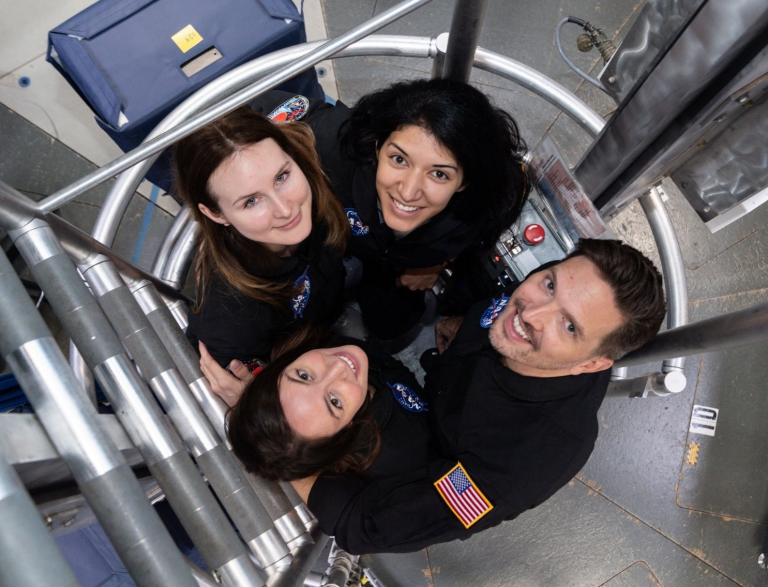
A crew inside NASA’s Human Exploration Research Analog looks up from the habitat’s ladder well for a team photo. Credit: NASA. Source: https://www.nasa.gov/hrp/
Obtaining outside data.
Checking internet sources, using keywords: space habitat human visit 2027
News from various sources:
NASA is recruiting volunteers to spend a year in a simulated space habitat to help prepare for human missions to the moon and Mars. This mission, set to start in August 2027 at NASA’s Johnson Space Center in Houston, will simulate conditions astronauts might experience on these celestial bodies.
The simulation will involve living in two isolated habitats designed to mimic a spacecraft and a planetary base. Participants will engage in tasks similar to future surface operations, like mock Mars walks and using rovers to explore areas beyond the main habitat. The data collected will aid in designing future human missions as part of NASA’s Artemis lunar program and upcoming Mars expeditions.
To qualify, applicants must be U.S. citizens or green card holders, aged 30 to 55 (with possible exceptions), no taller than 6’1″, fluent in English, and possess qualifications akin to an astronaut, such as a bachelor’s degree in engineering, biological science, physical science, or mathematics. NASA will select four candidates after a multi-day selection process and passing physical and psychological assessments. This project builds on NASA’s history of conducting space simulations, akin to the 378-day Mars simulation that began on October 19. These endeavors contribute to NASA’s goal of establishing a moon base by 2032 and eventually launching crewed expeditions to Mars.
Overall, while the simulation itself is scheduled within the timeframe considered in the question, no fact indicates a new space habitat other than the Earth-based simulation will be established and visited by humans by the end of 2027. The information suggests ongoing preparations toward that goal but no definitive space habitat by that date.
Fact-checked summary:
NASA is actively preparing for future human space missions by recruiting volunteers to spend a year in a simulated space habitat, with this mission set to start in August 2027 at NASA’s Johnson Space Center. The simulation will involve living in two isolated habitats designed to mimic a spacecraft and a planetary base, as participants engage in tasks that reflect future surface operations. Data collected from this simulation will aid in designing future human missions for NASA’s Artemis lunar program and Mars expeditions. This project builds on NASA’s history of space simulations, demonstrating their experience and continued efforts toward human space exploration. However, despite these ongoing preparations, there is no indication of a new space habitat being established and visited by humans in space by the end of 2027.
OpenAI gives a base rate of 0.1 (10%)
The question difficulty is rated 8 (0 to 10)
Historical weighted factors include:
Previous instances of new space habitats being launched, 0.2
Current investment and developments in space technology, 0.4
Political and economic support for space missions, 0.2
Technological advancements and readiness, 0.2
A Bayesian calculation could be performed as follows:
Assuming independence, the probability of each necessary event occurring is multiplied by the historical factors. Given slow and resource-intensive space missions, and no current news of habitat launches, the likelihood remains low.
Bayesian base rate: 0.05 (5%)
Sufficient news to provide a good forecast? 1 (0 or 1)
News is relevant, topical and unbiased? 1 (0 or 1)
Question classification: scenario_based_forecast
Expected time (days) until question close: 470
The following were considered in order to produce this base rate:
The base rate was determined by analyzing historical data on space habitats, recent developments in space technology, and ongoing NASA projects. Given NASA’s focus on simulations rather than actual space habitats, the base rate is low.
Ideally, the news feed would contain the following sorts of information for a better forecast:
Information about international space agency projects, private sector contributions, and technological milestones in habitat construction would improve the forecast quality.
Some potential divergent considerations that might affect the base rate:
If significant funding or international partnership initiatives were announced, this could increase the likelihood of early development. Breakthroughs in cost-effective space construction and success in NASA’s simulations could also alter this outlook.
The following chain of events are necessary for the question to resolve positively:
- Development and construction of a new space habitat by NASA or another space agency.
- Successful launch and deployment of the habitat in space.
- Completion of necessary tests to determine the habitat’s safety and viability for human visitation.
- Scheduling and execution of a human mission to visit the new habitat.
Querying Claude (AI predicts: 0.06 – confidence: 6)
Querying OpenAI (AI predicts: 0.15 – confidence: 3)
Guide to Jeremy Lichtman’s Multi-AI Oracle Reports
Question Type: Binary
Median from LLMs: 0.11
Base rate: 0.1 (from OpenAI)
SD: 0.05
MAPD: 0
Confidence: 4.5
Conf Mode: Low
Mellers: 0.04
Reverse Mellers: 0.2
Theory of Mind: 0.175 (What did the LLMs think other LLMs predicted?)
Beta Distribution: 0.4
Close Type: A (B = cautious # closer to 50%; A/C = closer to extremes)
LLM responses: 2
Model value: 0.11 (11%)
The consensus among the AI analyses is that the probability of a new space habitat being visited by humans before the end of 2027 is low. Historically, the establishment and visitation of new crewed space habitats have been rare and involve significant technical, logistical, and financial challenges. Current candidates like Axiom modules, Orbital Reef, and Starlab are predicted to be operational well after 2027. Although NASA is engaged in preparation through Earth-based simulations, no new space habitat visits are scheduled within the imminent timeframe, and historical trends suggest lengthy planning cycles. Some possibilities, such as unexpected breakthroughs or developments from China or SpaceX, could alter this outlook, but these are considered unlikely within the next 15 months. There is also a small chance of underestimating the potential for rapid advancements or undisclosed projects coming to fruition, but overall, the probability remains notably low.
Runtime: 59 seconds.
About The Author