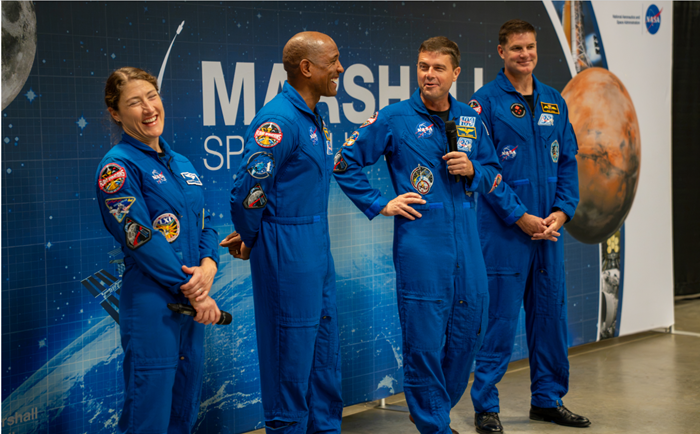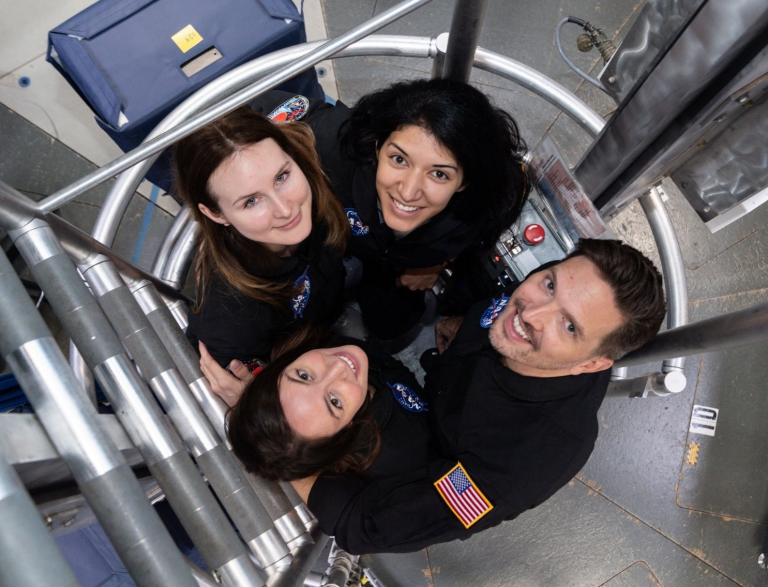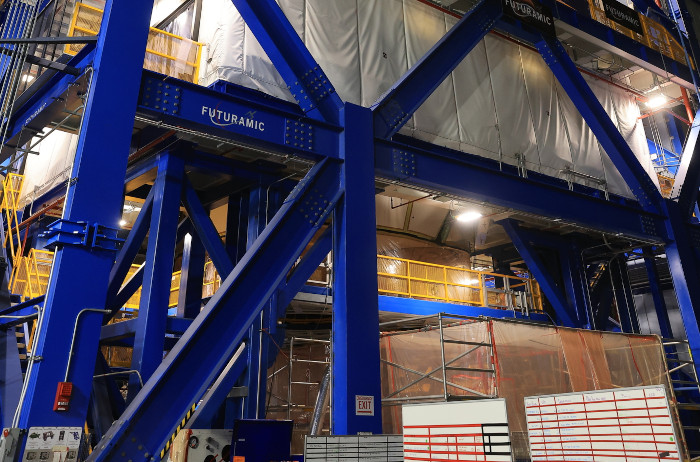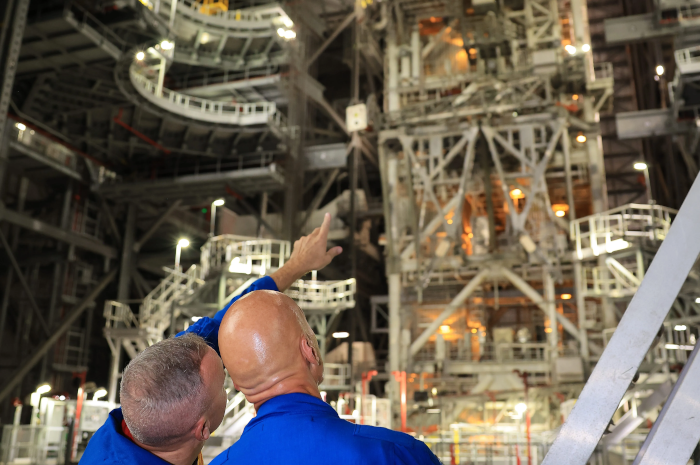
NASA astronaut Randy Bresnik (left) and ESA (European Space Agency) astronaut Luca Parmitano view progress on the solid rocket booster integration in High Bay 3 inside the Vehicle Assembly Building at NASA’s Kennedy Space Center in Florida on Wednesday, Sept. 2, 2026. Image credit: NASA/Kim Shiflett. Source: https://www.nasa.gov/image-article/artemis-iii-crew-visits-nasa-kennedys-vehicle-assembly-building/
Deepseek Binary response:
The key gating factor is not SLS/Orion—NASA hardware is progressing well, Artemis II already flew crewed in April 2026, and Artemis III Orion/SLS integration is underway with booster stacking and engine delivery completed. The real uncertainty lies with the commercial lander test articles. The resolution criteria allow the mission to succeed with “one or both” providers, which materially raises the chance because NASA can potentially proceed with whichever lander is ready.
SpaceX’s Starship V3 is advancing, but as of September 2026 it is only approaching its first orbital attempt; a dockable HLS test article with Orion-compatible docking hardware by end-2027 is plausible but not assured. Blue Origin faces a longer path: the May 2026 New Glenn explosion damaged its pad, return-to-flight is targeted for end-2026, and a Blue Moon MK2 demonstrator by 2027 is aggressive. At least one provider being ready by late-2027 is perhaps a 65–70% proposition. Given SLS/Orion readiness, a roughly 2-week LEO mission, and docking execution risk, the overall chance of successful completion by 31 December 2027 is meaningfully below 50%.
The most important assumptions are: (1) the mission can resolve yes with only one commercial provider—if both are required, the probability drops sharply toward single digits; (2) at least one provider can deliver a dockable test article in time; (3) NASA can launch by approximately mid-December 2027 to complete a two-week mission before year-end. Each carries non-trivial failure risk. Balancing recent optimism from NASA and hardware progress against historical schedule slips and commercial delays, I estimate a modest but not negligible chance.
Data sufficiency: Sufficient
Probability: 38%
Grok response:
1. Moon to Mars | NASA’s Artemis Program (NASA official page)
Date: Page last updated September 15, 2026.
NASA describes Artemis III as a demonstration mission in low Earth orbit planned for 2027 to evaluate one or both commercial human landing systems from SpaceX and Blue Origin. The crew will launch in Orion on SLS to test rendezvous and docking operations needed for future lunar surface missions. Artemis IV remains targeted as the first lunar landing in 2028.[1]
2. Artemis III – Wikipedia
Date: Last edited September 20, 2026.
The mission is a crewed LEO demonstration (not a lunar landing) planned for 2027 with a no-earlier-than June 2027 launch date, involving four astronauts testing rendezvous/docking with Blue Origin and SpaceX HLS test articles. SLS will use a non-propulsive spacer instead of an upper stage; Blue Origin’s vehicle launches first and can loiter up to 90 days. Crew members are Randy Bresnik (commander), Luca Parmitano (pilot), Frank Rubio, and Andre Douglas.[2]
3. NASA Marches Toward Artemis III Mission in 2027, Names Crew Members (NASA news release)
Date: June 9, 2026.
NASA named the Artemis III crew and provided mission details for the 2027 Earth-orbit test flight essential for Artemis IV in 2028. Blue Origin’s lander pathfinder launches first, followed by SLS/Orion crew for ~2 days of docked tests including crew entry; then SpaceX Starship pathfinder for ~1 day of testing. Hardware progress includes Orion docking system integration and SLS stacking planned for summer 2026.[3]
4. How NASA’s Artemis III Lander Test Will Pave Way for Moon Landings (NASA article)
Date: July 15, 2026.
Both SpaceX and Blue Origin will fly test articles of their crewed landers; Blue Origin launches first on New Glenn, then SLS/Orion, then Starship V3 with added docking system. The campaign involves three major rocket launches in a short timeframe to practice rendezvous, docking, and operations, with Orion as the chaser spacecraft. This reduces risk before 2028 lunar landings.[4]
5. Put it in pencil: NASA’s Artemis III mission will launch no earlier than late 2027 (Ars Technica)
Date: April 28, 2026.
NASA Administrator Jared Isaacman stated SpaceX and Blue Origin confirmed they could meet a late 2027 rendezvous/docking test, later than NASA’s prior mid-2027 target. The LEO mission may not require the remaining SLS upper stage (saving it for Artemis IV). Details on orbit altitude and SLS configuration were still under review at the time.[5]
6. NASA says Artemis III mission on schedule as Blue Origin repairs launchpad (Reuters)
Date: July 20, 2026.
Administrator Isaacman said NASA remains on track for the 2027 Artemis III docking test despite Blue Origin’s May 2026 New Glenn explosion and pad damage. NASA has contingency plans if New Glenn delays further; Isaacman expressed confidence Blue Origin has a year to recover. SLS and Orion elements under NASA control were progressing well.[6]
7. NASA’s Management of the Human Landing System Contracts (NASA OIG report IG-26-004)
Date: March 10, 2026.
Both SpaceX and Blue Origin faced schedule delays and technical/integration challenges that could impact HLS delivery, with SpaceX’s lander not ready for a June 2027 lunar landing (pre-revision). NASA’s firm-fixed-price approach controlled costs well (SpaceX +6%, Blue Origin <1%). The report predates the February 2026 shift of Artemis III to an LEO demonstration.[7]
8. New Glenn Return to Flight (Blue Origin news)
Date: June 30, 2026.
CEO Dave Limp stated Blue Origin lost the lightning tower, transporter-erector, and hydraulics in the May 28 explosion but tank farm and other infrastructure survived. Reconstruction uses a new hybrid horizontal/vertical CONOPS; debris cleanup finished in 9 days and pad rebuild started. The company still targets return to flight by end of 2026.[8]
9. SpaceX’s Starship will orbit Earth for first time during next flight (New Scientist)
Date: September 18, 2026.
Starship Flight 14 (first orbital attempt, targeting ~10-hour mission with Starlink V3 satellites) was planned for September 22, 2026 (later retargeted). This follows Flight 13 in July 2026 and represents progress on V3/Block 3 hardware needed for the HLS test article. SpaceX is advancing toward operational capabilities relevant to the 2027 LEO demonstration.[9]
10. NASA Joins Artemis III Orion Modules; Rocket Hardware Update (NASA blog)
Date: August 5, 2026 (content covering July 2026 events).
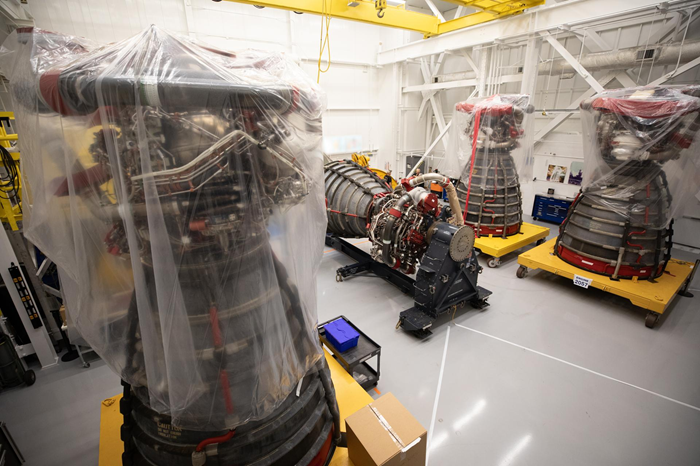
Orion crew and service modules were joined July 30-31, 2026, at Kennedy Space Center, outpacing Artemis II timelines; docking system integration and heat shield work continued. SLS booster stacking began early July, all four RS-25 engines delivered by July 21, and spacer barrel welding completed at Marshall. This shows NASA-controlled hardware remaining on an accelerated path for 2027.[10]
NASA’s official Artemis page (resolution source, last updated September 15, 2026) continues to list Artemis III as a 2027 LEO demonstration to test rendezvous and docking with one or both commercial HLS providers (SpaceX Starship and Blue Origin Blue Moon), with crew launching on SLS/Orion.The mission was added/re-scoped in February 2026 after Artemis II delays, shifting the first lunar landing to Artemis IV in 2028. Hardware under NASA control is advancing: Orion modules mated in late July 2026, SLS stacking and engine installation underway in summer 2026, spacer fabrication progressing at Marshall, and heat shield/docking system work continuing. This is faster than Artemis II integration in some areas.[10]
Commercial HLS status is the primary risk. SpaceX is progressing Starship V3 (relevant to the test article with added docking adapter); Flight 13 occurred in July 2026 and Flight 14 (first orbital, with Starlink payload) was targeted for late September 2026 after FAA clearance. Blue Origin’s New Glenn exploded during a May 28, 2026 hot-fire test, destroying the vehicle and damaging LC-36 (lightning tower, transporter-erector)..[6]
Extracted resolution criteria links:
[‘https://www.nasa.gov/humans-in-space/artemis/‘]
=== Forecast Result ===
=== Reasoning ===
The key gating factor is not SLS/Orion—NASA hardware is progressing well, Artemis II already flew crewed in April 2026, and Artemis III Orion/SLS integration is underway with booster stacking and engine delivery completed. The real uncertainty lies with the commercial lander test articles. The resolution criteria allow the mission to succeed with “one or both” providers, which materially raises the chance because NASA can potentially proceed with whichever lander is ready.
SpaceX’s Starship V3 is advancing, but as of September 2026 it is only approaching its first orbital attempt; a dockable HLS test article with Orion-compatible docking hardware by end-2027 is plausible but not assured. Blue Origin faces a longer path: the May 2026 New Glenn explosion damaged its pad, return-to-flight is targeted for end-2026, and a Blue Moon MK2 demonstrator by 2027 is aggressive. At least one provider being ready by late-2027 is perhaps a 65–70% proposition. Given SLS/Orion readiness, a roughly 2-week LEO mission, and docking execution risk, the overall chance of successful completion by 31 December 2027 is meaningfully below 50%.
The most important assumptions are: (1) the mission can resolve yes with only one commercial provider—if both are required, the probability drops sharply toward single digits; (2) at least one provider can deliver a dockable test article in time; (3) NASA can launch by approximately mid-December 2027 to complete a two-week mission before year-end. Each carries non-trivial failure risk. Balancing recent optimism from NASA and hardware progress against historical schedule slips and commercial delays, I estimate a modest but not negligible chance.
Data sufficiency: Sufficient
Probability: 38%
End
About The Author