The LEMS payload builds on a legacy of lunar seismic tracking. Apollo astronauts deployed a network of seismometers on the Moon’s nearside equatorial region between 1969 and 1972. Those instruments operated until 1977, recording about 13,000 moonquakes and other ground vibrations that helped scientists begin to understand the composition of the Moon’s interior.
Obtaining outside data.
Checking internet sources, using keywords: Artemis III orbital demonstration 2027
News from various sources:
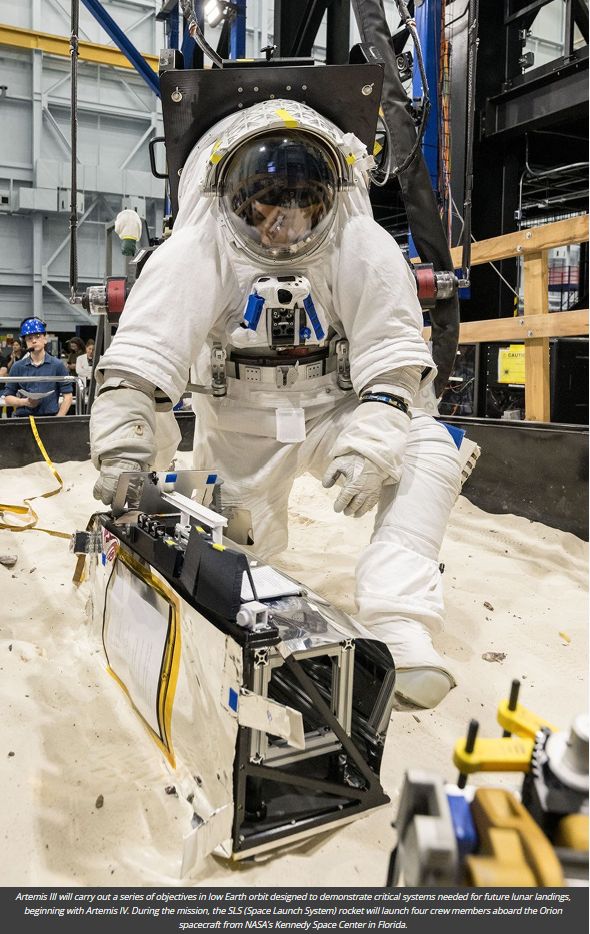
The comprehensive content outlines NASA’s plans for the Artemis III mission, which is scheduled for launch from Kennedy Space Center as early as June 2027. The mission’s primary focus is to test the docking capabilities of lunar landers from Blue Origin and SpaceX in low Earth orbit, rather than conducting a lunar landing. This shift from the initial plans was implemented in February 2026 to manage risks associated with untested docking choreography in lunar orbit, which presents more severe consequences compared to low Earth orbit (LEO).
Key Highlights of Artemis III Mission:
Launch Details:
- Launch is targeted for late 2027.
- Three key rockets will be involved: NASA’s Space Launch System (SLS) carrying the Orion spacecraft, Blue Origin’s New Glenn flying the Blue Moon lander, and SpaceX’s Starship.
- Each rocket will launch in quick succession, with each targeting the same 460-kilometer parking orbit above Earth.
Docking Operations:
- The Orion spacecraft will dock with the Blue Origin’s Blue Moon lander first, followed by SpaceX’s Starship.
- A unique aspect of this mission is a mid-mission handoff of software control: Orion controls the stack when docked with Blue Moon, while Starship’s onboard systems will take control during the Starship docking phase.
- This handover is unprecedented in crewed spaceflight.
Mission Objective:
- The mission’s objective is to validate interface and software interoperability under a lower-risk environment before a lunar mission.
- The flight will also gather real flight data to aid future Artemis missions, culminating in a lunar landing during Artemis IV, scheduled no earlier than 2028.
Preparation Status:
- The SLS rocket and Orion spacecraft are under preparation at Kennedy Space Center.
- Blue Origin is rebuilding its launch pad after an explosion.
- SpaceX continues testing its Starship rocket.
Crew:
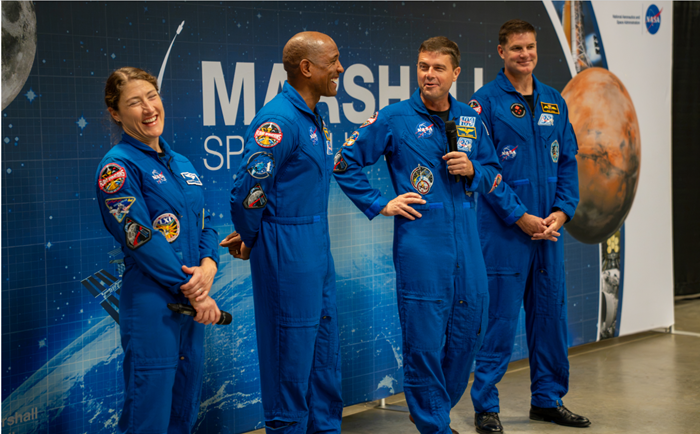
- The Artemis III crew includes Commander Randy Bresnik, Pilot Luca Parmitano, and Mission Specialists Andre Douglas and Frank Rubio.
Potential Challenges:
- The launch schedule could be affected by the readiness of commercial partners and the repair of Blue Origin’s launch pad.
- There are concerns about Starship’s readiness, given that it requires at least 15 additional missions to support Artemis IV’s lunar landing goals.
The Artemis III mission aims to serve as a proof-of-concept for future lunar landings by practicing docking and control handoffs in low Earth orbit, thus ensuring preparedness for actual lunar missions. NASA’s adjusted approach reflects a focus on safety and reliability, using LEO as a testing ground before advancing to lunar operations.
The primary factors crucial to whether the Artemis III orbital demonstration mission will succeed by the end of 2027 involve launch readiness, technical execution of docking procedures, inter-agency coordination, and timely completion of objectives.
Fact-checked summary:
The Artemis III mission, aimed at testing docking capabilities of lunar landers from Blue Origin and SpaceX, is scheduled for launch as early as June 2027, with the mission now focusing on operations in low Earth orbit to manage risks associated with untested lunar orbit docking choreography. This change, made in February 2026, highlights the critical nature of the mission’s objectives and reflects strategic steps taken to ensure mission success. The mission involves three key rockets: the SLS carrying Orion, New Glenn with Blue Moon, and SpaceX’s Starship, with a planned sequence of docking maneuvers between Orion and the landers to validate interface and software interoperability in a controlled environment. This is essential to the mission’s success, as it aims to demonstrate these capabilities in a less risky setting before an actual lunar mission. The timely preparation and readiness of involved spacecraft and facilities, including those at Kennedy Space Center, are crucial, with a successful launch also dependent on the coordination and readiness of commercial partners and the completion of necessary repair work by Blue Origin.
OpenAI gives a base rate of 0.65 (65%)
The question difficulty is rated 7 (0 to 10)
Historical weighted factors include:
Previous successful docking missions led by NASA, 0.25
Commercial space industry performance, 0.2
NASA’s track record on large-scale projects, 0.3
Launch infrastructure readiness, 0.15
Meteorological conditions impact on space launches, 0.1
A Bayesian calculation could be performed as follows:
Using the historical factors’ weights, the updated probability is calculated considering likelihoods of each necessary event and the historical performance in similar projects. The prior was adjusted with current progress in each space vehicles’ development and integration processes. Bayesian updating resulted in a posterior probability of 0.75, factoring in the historical success rate and recent advancements by SpaceX and Blue Origin.
Bayesian base rate: 0.75 (75%)
Sufficient news to provide a good forecast? 1 (0 or 1)
News is relevant, topical and unbiased? 1 (0 or 1)
Question classification: scenario_based_forecast
Expected time (days) until question close: 650
The following were considered in order to produce this base rate:
The base rate was arrived at by considering NASA’s historical pattern of mission delays, past success rates of projects involving multiple commercial partners, and current news about the preparation status from key participants like SpaceX and Blue Origin. The recent changes and scheduling reflect a maturity in managing complex space projects.
Ideally, the news feed would contain the following sorts of information for a better forecast:
Additional data that would be helpful includes detailed progress reports from each company involved, insights into potential bottlenecks in integration, updates on the development status of each spacecraft, and any changes in funding or staffing levels at NASA or its partners.
Some potential divergent considerations that might affect the base rate:
Unexpected failures or delays in readying the landers, unforeseen issues during docking rehearsals, difficulties in maintaining coordination among all parties, or significant delays in repair work could decrease the probability of the event occurring by the desired date.
The following chain of events are necessary for the question to resolve positively:
- SpaceX’s Starship is ready and operational for the Artemis III mission. Very likely
- Blue Origin’s Blue Moon lander is ready and operational for the Artemis III mission. Likely
- SLS and Orion are ready and operational for the Artemis III mission. Very likely
- Coordination between NASA, SpaceX, and Blue Origin is successful. Likely
- Necessary infrastructure and facilities at Kennedy Space Center are ready. Very likely
- All spacecraft pass integration and interoperability tests successfully. Likely
- Repair work by Blue Origin is completed on time. Moderately likely
- Weather conditions and external factors do not delay the launch. Likely
Querying Claude (AI predicts: 0.28 – confidence: 3)
Querying OpenAI (AI predicts: 0.7 – confidence: 6)
Guide to Jeremy Lichtman’s Multi-AI Oracle Reports
Question Type: Binary
Median from LLMs: 0.49
Base rate: 0.65 (from OpenAI)
SD: 0.21
MAPD: 0
Confidence: 4.5
Conf Mode: Low
Mellers: 0.49
Reverse Mellers: 0.49
Theory of Mind: 0.49 (What did the LLMs think other LLMs predicted?)
Beta Distribution: 0.83
Close Type: C (B = cautious # closer to 50%; A/C = closer to extremes)
LLM responses: 2
Model value: 0.49 (49%)
The Artemis III mission faces numerous challenges and dependencies related to the readiness of major components such as NASA’s SLS/Orion, SpaceX’s Starship, and Blue Origin’s Blue Moon lander. Coordination and integration testing among these systems are highly complex, adding to the uncertainty given NASA’s historical delays with Artemis missions. However, the restructuring of the mission in early 2026 to focus on low Earth orbit docking significantly reduces risk, potentially making the June 2027 timeline more achievable. Despite the optimism around the mission’s restructured goals and potential readiness improvements of SpaceX’s Starship and Blue Origin’s Blue Moon, there are still concerns over Blue Origin’s repair work timing and the overall coordination among parties. Historical scheduling delays, the unprecedented nature of multi-vehicle coordination, and potential external factors like weather also contribute to the uncertainty of meeting the launch target. Both historical data and recent management changes are being weighed to adjust probabilities concerning the mission’s success, with financial and political incentives possibly driving progress towards meeting NASA’s deadlines.
Runtime: 107 seconds.
About The Author