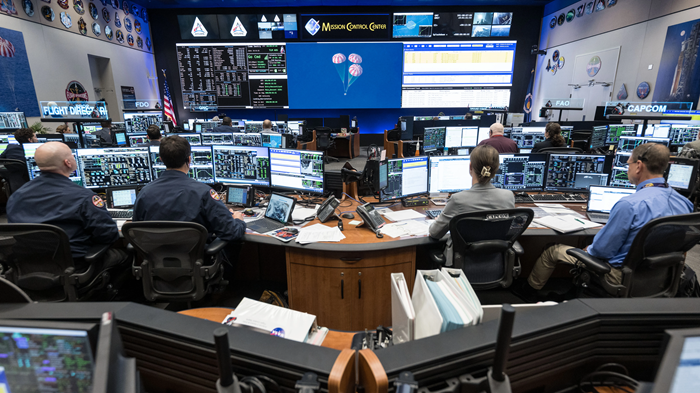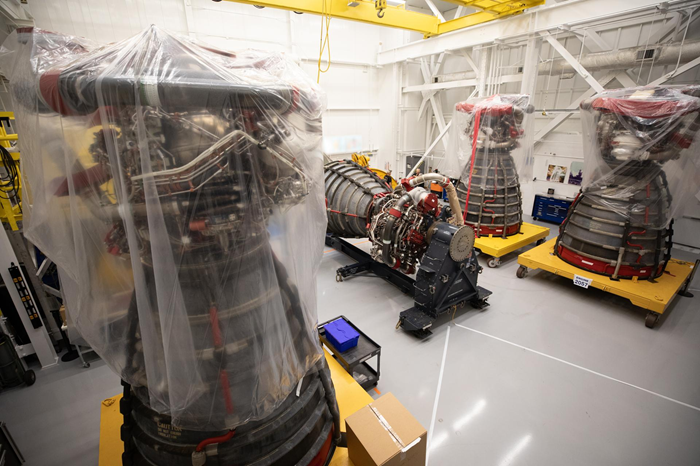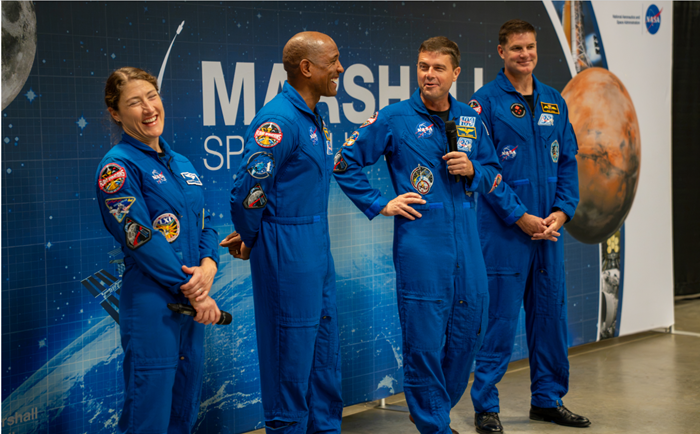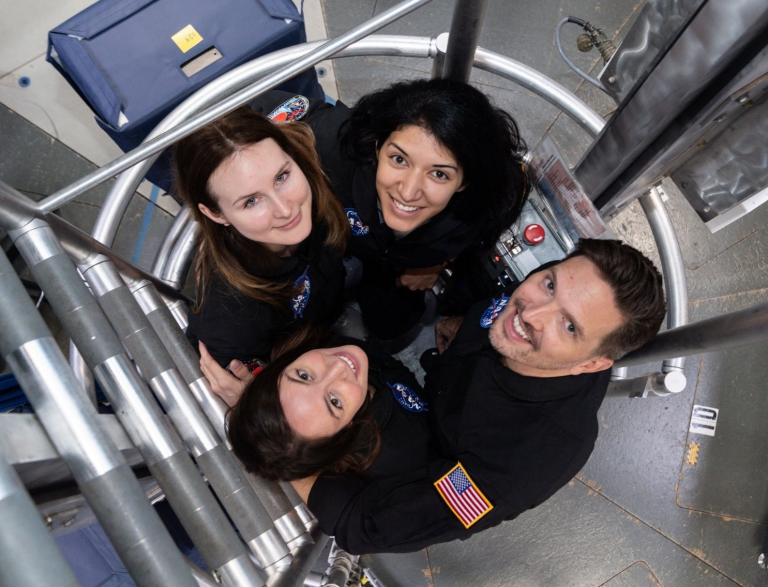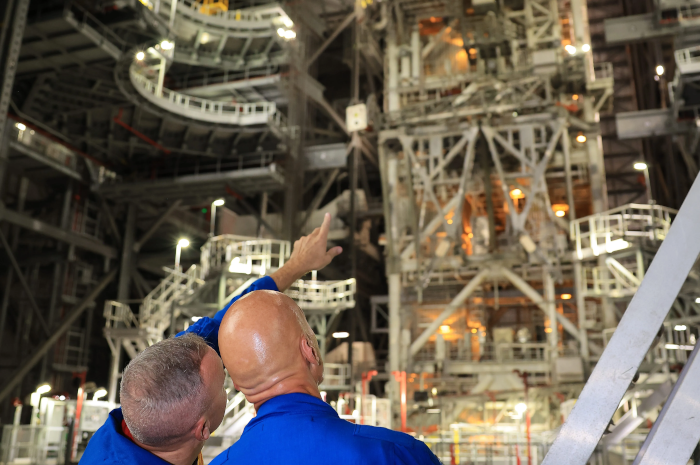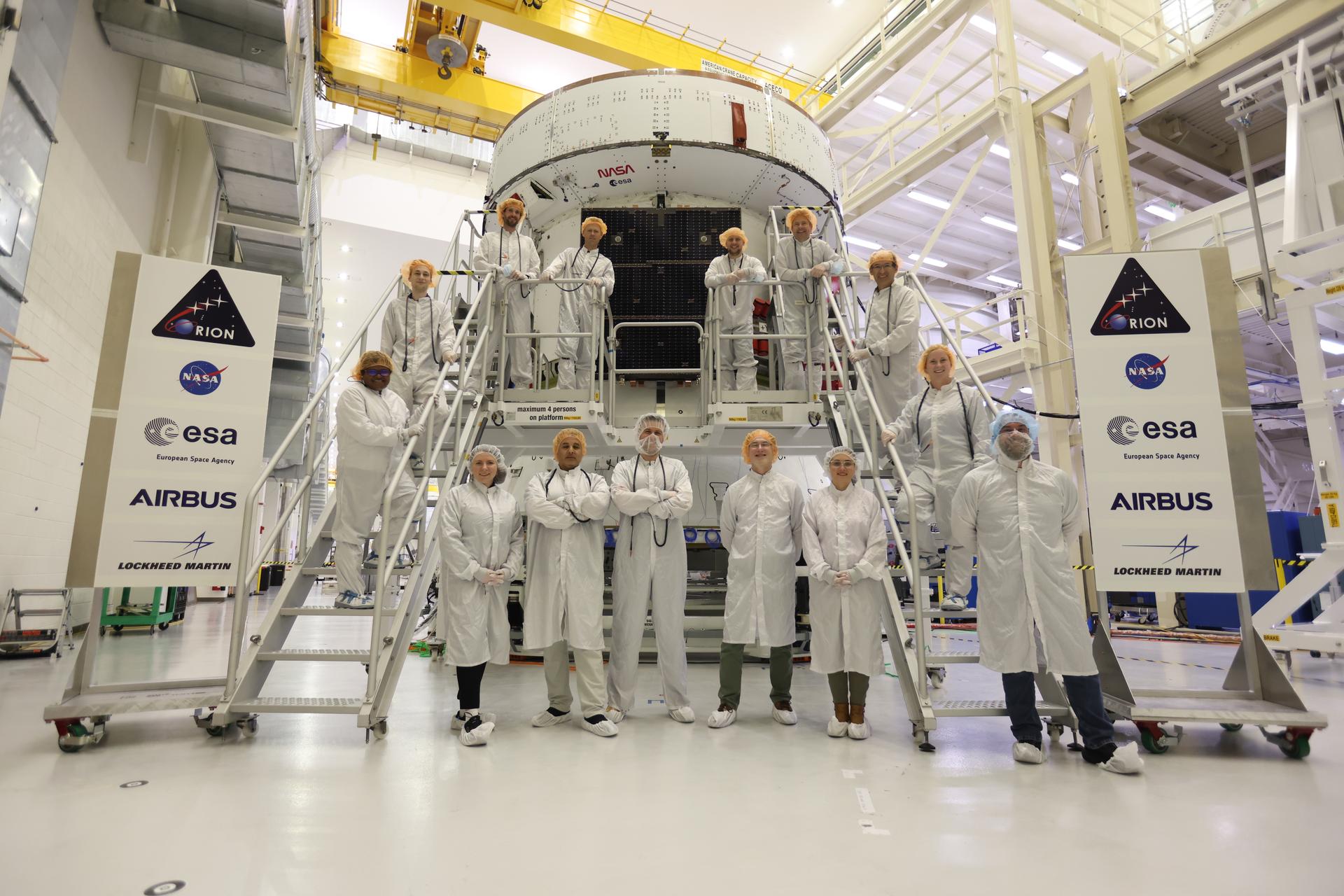
NASA and its partners work on the solar array wings for the agency’s Artemis III Orion spacecraft inside the Neil A. Armstrong Operations and Checkout Building at NASA’s Kennedy Space Center in Florida. Orion’s solar arrays, manufactured and installed by ESA (European Space Agency) and its contractor Airbus, have been temporarily installed ahead of acoustic testing on the spacecraft. Image Credit: NASA/Ben Smegelsky Source: https://www.nasa.gov/image-detail/amf-ksc-20260430-ph-jbs01_0004/
Grok response:
Recent official NASA updates and news (as of mid-2026) indicate the Artemis III LEO demonstration mission remains targeted for a mid-to-late 2027 launch, with active hardware assembly and testing underway.[1]
The mission profile was revised in February 2026 from a lunar landing attempt to a crewed low-Earth orbit demonstration focused on rendezvous, docking, and systems interoperability testing with commercial Human Landing System (HLS) prototypes from SpaceX (Starship test article) and Blue Origin (Blue Moon test vehicle). This change preserves the Interim Cryogenic Propulsion Stage for Artemis IV (targeted early 2028 for the first crewed lunar landing) and reduces risk.[2]
NASA’s primary Artemis program page (updated April 10, 2026) explicitly lists Artemis III as the 2027 LEO demo mission to test one or both commercial landers.[3]
Key recent developments include SLS core stage delivery and stacking progress at Kennedy Space Center (KSC), solid rocket booster segments arriving and being mounted, Orion heat shield installation (upgraded design), European Service Module readiness, launch simulations, and crew announcement (June 2026).[1][2]
July 2026 reporting describes NASA as “full steam ahead,” with hardware integration advancing toward a 2027 target despite prior program challenges.[1][4]
The mission involves three launches (SLS/Orion crewed, plus separate commercial launches of the lander test articles), orbital docking operations in ~230 nmi LEO, systems evaluations, and a safe crew return—described by NASA as highly complex.[2]
Historical context shows repeated timeline shifts (e.g., earlier plans slipped due to Orion heat shield issues, Starship development/refueling needs, and safety reviews), but the 2026 revision explicitly positioned Artemis III as a 2027 stepping stone to enable the 2028 landing.[5][6]
As of August 2026 (current date), no public announcements indicate further delays pushing the demo beyond 2027; preparations emphasize risk reduction for later lunar missions.[1]
10 Citations
- NASA Moon to Mars | Artemis Program (nasa.gov, page last updated Apr 10, 2026): Official program overview explicitly scheduling Artemis III as the 2027 LEO demonstration to test commercial landers from SpaceX and Blue Origin; describes strengthened architecture with this added mission ahead of Artemis IV lunar landing target in early 2028.[3]
- Artemis III (nasa.gov/mission/artemis-iii): Details the crewed 2027 LEO demonstration objectives for critical systems testing needed for future landings, including rendezvous/docking with commercial HLS vehicles; notes 4-person crew and 2027 launch.[7]
- Artemis III (Wikipedia, last crawled Aug 3, 2026): Summarizes the Feb 27, 2026 revision to LEO demo mission (NET 2027) instead of lunar landing; outlines three-launch profile, crew, and test article details for Blue Origin and SpaceX vehicles.[2]
- ‘Full steam ahead’: NASA ramps up prep for Artemis III astronaut launch in 2027 (Space.com, published Jul 15, 2026): Reports active SLS stacking, Orion heat shield work, simulations at KSC, and mid-to-late 2027 target; notes “full steam ahead” despite prior setbacks.[1]
- NASA will test SpaceX and Blue Origin Moon landers… (ScienceDaily, published Jul 23, 2026; article references June 11, 2026): Describes 2027 Artemis III plans for separate rendezvous/docking tests with Blue Origin and SpaceX prototypes in LEO using Orion/SLS.[4]
- NASA Details Docking and Software Protocols for Revised Artemis III LEO Demonstration (Satnews, published Jul 15, 2026): Covers new operational parameters published July 15, 2026, for the 2027 docking/integration tests validating dual commercial lander platforms.[8]
- Taking the Low Road: Artemis III and Earth Orbit (Museum of Science, published May 23, 2026): Explains the shift to 2027 LEO test (using SLS core stage only) to enable Artemis IV lunar landing in 2028; highlights simplified profile benefits.[9]
- Artemis III (en.wikipedia.org/wiki/Artemis_III, last crawled Aug 3, 2026): Details spacecraft, crew (announced June 2026), and history of the Feb 2026 revision; notes ongoing development of lander test articles.[2]
- Moon project delays among barrage of challenges for NASA (UPI, published Mar 12, 2026): Discusses safety panel concerns leading to the Artemis III revision (landing pushed to Artemis IV); notes technical/budgetary issues but affirms new demo plan.[5]
- Why is NASA overhauling its Artemis moon program? (CBS News, published Feb 27, 2026): Reports on the major Feb 2026 overhaul re-profiling Artemis III as 2027 LEO demo due to safety and realism concerns with original landing timeline.[6]
Additional context from sources: No major 2026 setbacks are reported that would prevent a 2027 attempt; focus remains on hardware progress and simulations. Earlier delays (pre-2026) were driven by heat shield fixes, lander tech (e.g., Starship refueling), and safety reviews, but the current LEO scope is positioned as lower-risk preparation.[1][2] Success would require on-time launches, successful dockings, and crew return—elements NASA is actively preparing for through 2027.
Extracted resolution criteria links:
[‘https://www.nasa.gov/humans-in-space/artemis/‘]
=== Forecast Result ===
Reasoning and Analysis
Current Status Assessment (August 3, 2026)
The mission has made meaningful progress:
- Artemis III re-profiled to LEO demo (February 2026) — simpler scope
- Crew announced (June 2026)
- SLS hardware actively being assembled/stacked at KSC
- “Full steam ahead” language from NASA and Space.com (July 2026)
- Target remains “mid-to-late 2027” with ~17 months remaining
Critical Assumptions and Their Failure Probabilities
Assumption 1: Commercial landers (SpaceX/Blue Origin test articles) will be ready by mid-2027
- Probability of failure: ~45%
- This is the biggest risk. Starship is still in active test campaign with no firm schedule. Blue Origin’s Blue Moon Mark 2 needs to launch on New Glenn and park in LEO for 30 days BEFORE Orion arrives. GAO flagged Starship refueling as a specific risk. Three separate launch vehicles must all succeed.
Assumption 2: Artemis II has already successfully completed (or will by early 2027) allowing Artemis III to proceed
- Probability of failure: ~15-20%
- The research suggests Artemis III hardware preparation is advanced, implying Artemis II has likely flown or is imminent. But any Artemis II issues cascade to III.
Assumption 3: No major SLS/Orion show-stoppers
- Probability of failure: ~15%
- Orion heat shield work and stacking are ongoing; new Starlink payload integration adds steps. Generally lower risk than landers.
Historical Base Rate Calibration
- NASA major missions routinely slip 1-3 years past stated targets
- Artemis I slipped repeatedly; Artemis II slipped from 2024 to later
- Community trackers already flag “DELAY EXPECTED”
- This forecasting competition has ~35% base positive resolution rate
- The mission requires success, not just launch — adding ~15-20% conditional failure probability
Probability Timeline Analysis
| Timeline | P(launch) | P(success | launch) |
|---|---|---|---|
| By end 2027 | ~42% | ~80% | ~34% |
| By end 2028 | ~75% | ~80% | ~60% |
| By end 2026 | ~0% | ~80% | ~0% |
The mission is not equally distributed across months — it’s a discrete event concentrated in H2 2027. The 17-month window is sufficient IF commercial landers hit development milestones, but those milestones are the key risk driver.
Key Factors Pulling Down from Naive Estimate
- Three separate launch vehicles required (SLS, New Glenn, Starship/equivalent)
- No firm launch date announced despite 17 months out
- 30-day lander pre-positioning adds another point of failure
- Described as “one of the most complex missions ever”
- Historical NASA pattern: “2027 target” ≠ “2027reality”
- Compensating for overconfidence bias in past competitions
Probability: 30%
End
About The Author