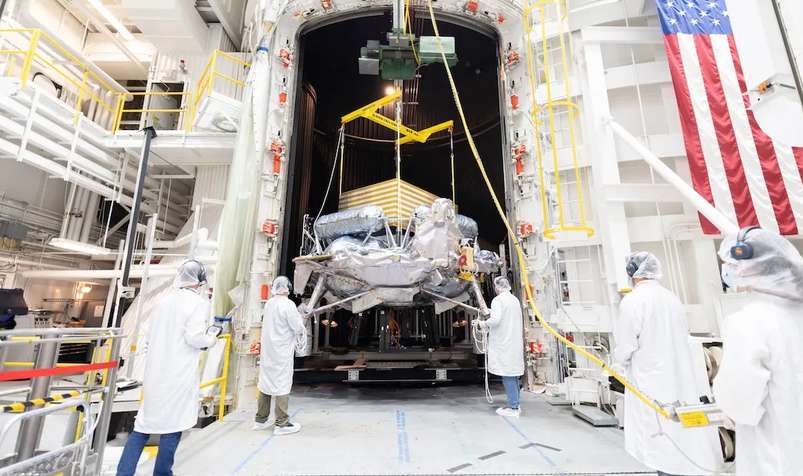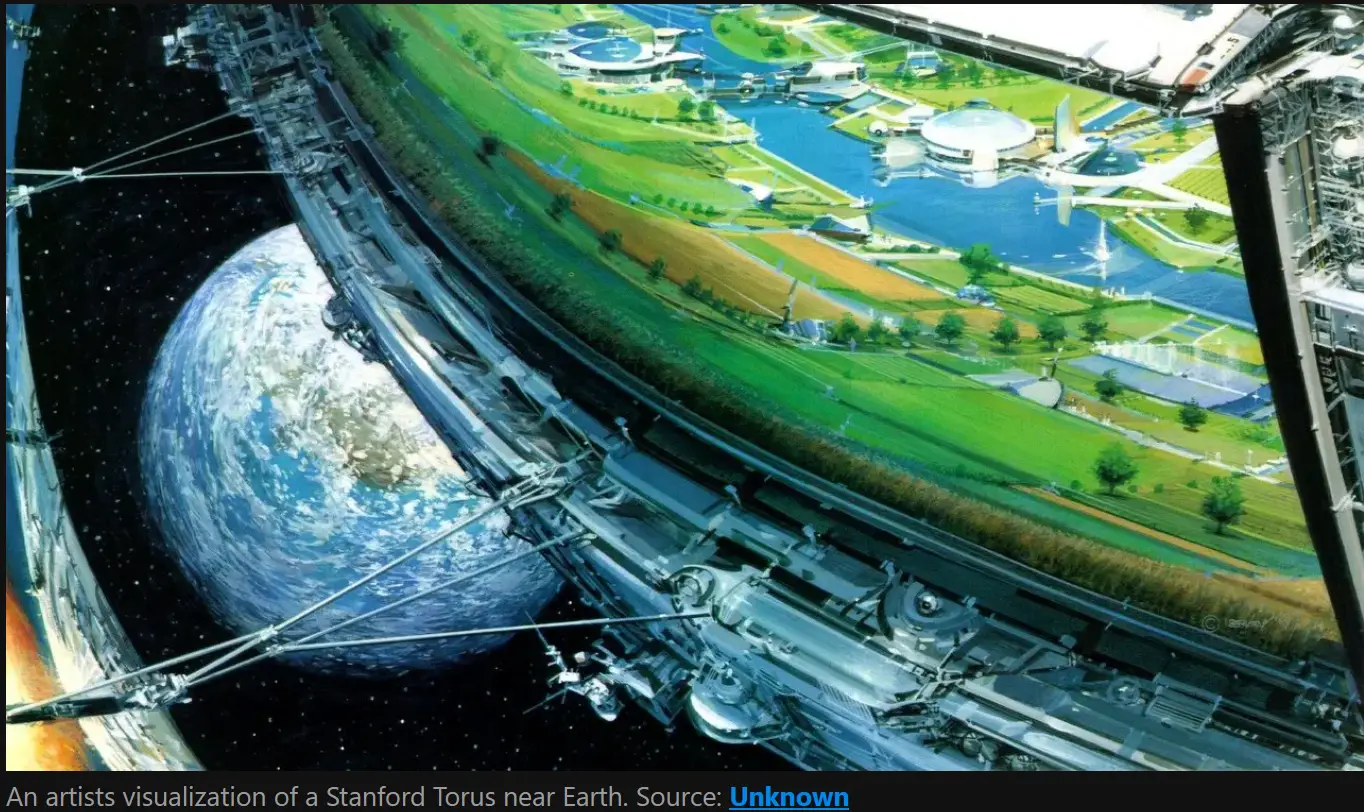
Stanford Torus. Source: Beyond Earth https://www.beyondearth.gg/documentation/space_habitats
Obtaining outside data.
Checking internet sources, using keywords: new space habitat humans 2027
News from various sources:
No relevant news found.
Fact-checking news summary:
Based on the summary provided, no specific facts are listed. However, let’s analyze the situation in terms of the original question (“Will any new space habitat be visited by humans before the end of 2027?”) and the summary provided (“No relevant news found.”).
Since the summary states, “No relevant news found,” here are some implicit facts:
Fact: There is no current news or announcements regarding new space habitats being visited by humans by the end of 2027.
- Correctness: True, based on the summary.
- Importance: Critical, as this directly impacts the prediction regarding the visitation of new space habitats.
- Relevance: True, because knowing the latest news or announcements directly affects the ability to answer the original question.
Fact: The absence of relevant news leads to uncertainty about new space habitats being visited by humans before 2027.
- Correctness: True, assuming no updated information changes this status.
- Importance: Important, as the absence of news does not rule out future developments but does influence current expectations.
- Relevance: True, relevant to assessing expectations regarding future human space travel to new habitats.
No explicit facts are stated in the summary, but these inferred facts are crucial for the assessment related to the original question.
Fact-checked summary:
The examination of available information indicates that there are no current announcements or news regarding new space habitats that will be visited by humans before the end of 2027. This is a critical fact as it directly impacts the prediction regarding the potential visitation of such habitats within the specified timeframe. Additionally, the absence of relevant news contributes to the uncertainty about new space habitats being visited by humans before 2027. This lack of information is important because it does not rule out future developments but influences current expectations regarding human space travel to new habitats.
OpenAI gives a base rate of 0.1 (10%)
The question difficulty is rated 7 (0 to 10)
Historical weighted factors include:
Past human space habitat missions, 0.4
Current space exploration funding trends, 0.3
Tech advancements in space travel, 0.2
International collaboration in space exploration, 0.1
A Bayesian calculation could be performed as follows:
P(Visit|News) = (P(News|Visit) * P(Visit)) / ((P(News|Visit) * P(Visit)) + (P(News|No Visit) * P(No Visit))). Assuming that P(News|Visit) is low due to lack of announcements, P(Visit) is low, and P(News|No Visit) is moderate, a low updated probability emerges.
Bayesian base rate: 0.15 (15%)
Sufficient news to provide a good forecast? 0 (0 or 1)
News is relevant, topical and unbiased? 1 (0 or 1)
Question classification: scenario_based_forecast
Expected time (days) until question close: 640
The following were considered in order to produce this base rate:
The base rate starts from the observation of similar historical events where new space habitats have been introduced and visited by humans. Given the relative infancy of space habitat exploration, examples such as the ISS in low Earth orbit require significant time and investment. Current global space program budgets and mission timelines don’t currently support significant human habitation outside previously established areas in the nearby future.
Ideally, the news feed would contain the following sorts of information for a better forecast:
Additional information on planned missions, the current status of space habitat projects, potential international collaborations, funding allocations to space agencies, and developments in private space enterprise would assist in refining this forecast.
Some potential divergent considerations that might affect the base rate:
Potential for rapid technological breakthroughs or unexpected increases in funding could accelerate development and mission planning. Enhanced international cooperation, notably among major space-faring nations, could also advance timelines more quickly than historical precedents would suggest.
The following chain of events are necessary for the question to resolve positively:
- Development of new space habitats for human habitation before the end of 2027. (Unlikely)
- Announcement and funding of missions to visit these new space habitats. (Low likelihood)
- Successful launch, journey, and arrival of a human-crewed mission to these new habitats. (Low likelihood before end of 2027)
Querying Claude (AI predicts: 0.08 – confidence: 6)
Querying Mistral (AI predicts: 0.25 – confidence: 6)
Querying OpenAI (AI predicts: 0.05 – confidence: 6)
Explanations of the statistical measures listed below.
Question Type: Binary
Median from LLMs: 0.08
Base rate: 0.1 (from OpenAI)
SD: 0.09
MAPD: 0.13333333333333
Confidence: 6
Conf Mode: Normal
Mellers: 0.03
Reverse Mellers: 0.17
Theory of Mind: 0.1 (What did the LLMs think other LLMs predicted?)
Beta Distribution: 0.5
Close Type: A (B = cautious # closer to 50%; A/C = closer to extremes)
LLM responses: 3
Model value: 8%
The reasoning across the AIs reflects a consensus that the probability of humans visiting a new space habitat by the end of 2027 is low due to historical, current, and logistical factors. Historically, space habitats take many years to develop, and as of April 2026, no major announced or funded programs are likely to be completed in the short timeframe remaining. The timeline for current projects like NASA’s Lunar Gateway, private commercial ventures (Orbital Reef, Axiom Station), or extensions of existing habitats is likely beyond 2027. The possibility of undisclosed programs or rapid technological breakthroughs could potentially alter these projections, especially if geopolitical factors accelerate efforts. There’s also an acknowledgment that what qualifies as a ‘new’ habitat can impact the prediction, especially with potential modular additions or new configurations being counted as such. Despite the consideration of tail risks like classified projects or accelerated developments, the likelihood remains low in light of existing public information.
Runtime: 76 seconds.
About The Author