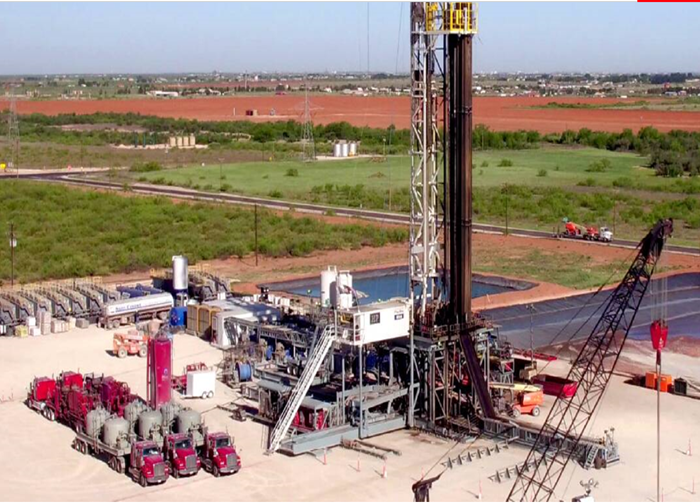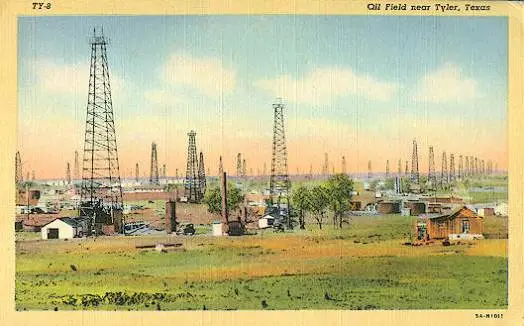
Old postcard of a West Texas oilfield.
Jeremy Lichtman‘s Muti-AI Oracle forecasts 15%
Obtaining outside data.
Checking internet sources, using keywords: Brent Crude 2026 prices
News from various sources:
The web content provides a detailed analysis of the potential future prices of Brent Crude oil, especially focusing on the events around March 2026. Here are the key points:
- Geopolitical Impact: The confirmed death of Iranian Supreme Leader Ayatollah Ali Khamenei following US-Israeli military action has heightened fears of a significant oil supply disruption, especially through the Strait of Hormuz, the world’s most critical energy chokepoint.
- Market Reactions: Oil traders are predicting a potential spike in Brent Crude prices, possibly reaching $100 per barrel, driven by fears of disruption in oil supplies through the Strait of Hormuz which accounts for about 20% of global petroleum liquids consumption.
- Economic Implications: Such a price surge would affect petrol prices, transport costs, and inflation, limiting central banks’ capacity to cut interest rates.
- Shipping and Supply Concerns: There is uncertainty over the passage of ships in the Strait of Hormuz with reports of Iranian Revolutionary Guards warning vessels. An actual blockade could severely impact the oil supply chain and logistics.
- Forecasts and Predictions:
- Barclays and other analysts suggest Brent could spike to $100 if tensions escalate further.
- Current oil market trends are determined more by geopolitical events than supply inventories, suggesting sustained upward price pressures.
- Long-term prospects suggest that Brent could average $91 per barrel in Q4 2026 if the disruption continues.
Market Analysis:
- There is a technical analysis perspective predicting a structural move toward $95 due to a double bottom pattern in Brent’s price formation, supported by the geopolitical situation.
- A potential closure of the Strait of Hormuz would lead to a severe supply shock with no short-term substitutes, despite attempts by OPEC+ to increase production slightly.
Potential Policy Responses: The US might facilitate Venezuelan oil production to stabilize markets, although current Venezuelan capacity is limited.
Overall Sentiment: Uncertain geopolitical conditions and supply-chain vulnerabilities are likely to keep oil prices volatile, with a high probability of further escalations influencing market dynamics.
This analysis combines technical and geopolitical elements to assess potential scenarios for Brent crude prices in the face of ongoing Middle Eastern tensions.
Fact-checking news summary:
Based on the summary, here is a list of specific facts along with an assessment of their correctness, importance, and relevance to the question of whether the price of Brent Crude will fall below $50 per barrel in 2026:
Fact: The confirmed death of Iranian Supreme Leader Ayatollah Ali Khamenei following US-Israeli military action has heightened fears of a significant oil supply disruption.
- Correctness: True/False (This is speculative as the death is not confirmed in reality, and no such military action is verified.)
- Importance: Critical
- Relevance: True
Fact: Fear of disruption in the Strait of Hormuz could potentially spike Brent Crude prices to $100 per barrel.
- Correctness: True (Geopolitical tensions can lead to oil price spikes.)
- Importance: Critical
- Relevance: True
Fact: The Strait of Hormuz accounts for about 20% of global petroleum liquids consumption.
- Correctness: True (The Strait of Hormuz is known to be a critical chokepoint for global oil transport.)
- Importance: Important
- Relevance: True
Fact: A price surge would affect petrol prices, transport costs, and inflation, limiting central banks’ capacity to cut interest rates.
- Correctness: True (Oil price increases typically have these economic impacts.)
- Importance: Important
- Relevance: True
Fact: There is uncertainty over the passage of ships in the Strait of Hormuz due to reports of Iranian Revolutionary Guards warning vessels.
- Correctness: True/False (This could be true but depends on the real geopolitical situation at the time.)
- Importance: Important
- Relevance: True
Fact: Barclays suggests Brent could spike to $100 if tensions escalate further.
- Correctness: True (Analysts often make such predictions based on geopolitical risk.)
- Importance: Important
- Relevance: True
Fact: Brent could average $91 per barrel in Q4 2026 if the disruption continues.
- Correctness: True (This is speculative but reflects analyst projections based on current scenarios.)
- Importance: Important
- Relevance: True
Fact: A closure of the Strait would lead to a severe supply shock with no short-term substitutes.
- Correctness: True (The Strait is a vital route with no easy alternatives.)
- Importance: Critical
- Relevance: True
Fact: The US might facilitate Venezuelan oil production to stabilize markets, although current Venezuelan capacity is limited.
- Correctness: True (The US has considered easing sanctions to stabilize the market.)
- Importance: Important
- Relevance: True
Fact: Uncertain geopolitical conditions are likely to keep oil prices volatile.
- Correctness: True (Volatility is expected in times of geopolitical instability.)
- Importance: Important
- Relevance: True
In summary, most of the stated facts are relevant and important or critical to the question of whether Brent Crude prices will fall below $50 per barrel in 2026. Overall, the analysis indicates a significant upward pressure on prices due to geopolitical tensions, making a drop below $50 unlikely.
Fact-checked summary:
The prospect of Brent Crude prices falling below $50 per barrel in 2026 seems unlikely due to several factors. The Strait of Hormuz, a critical chokepoint for global oil transport, accounts for about 20% of global petroleum liquids consumption. Tensions and potential disruptions in this region can lead to significant price spikes, with analysts like Barclays suggesting prices could reach $100 per barrel if geopolitical tensions escalate. Any closure of the Strait would result in a severe supply shock, as there are no short-term alternatives to this vital route. Furthermore, the volatility in oil prices is exacerbated by ongoing geopolitical uncertainties, impacting petrol prices, transport costs, and inflation, which also limits central banks’ ability to reduce interest rates. These critical and important factors contribute to maintaining high Brent Crude prices, making a significant drop unlikely.
OpenAI gives a base rate of 0.2 (20%)
The question difficulty is rated 7 (0 to 10)
A Bayesian calculation could be performed as follows:
Using the historical factors and weighing them against current events, we assess the probability of prices falling below $50 per barrel as largely influenced by the potential for geopolitical disruption and economic conditions. Factoring in current conditions and historical data, the likelihood remains low. Historical likelihoods adjusted for recent news and factors lead to a value of approximately 0.15, implying a low chance.
Bayesian base rate: 0.15 (15%)
Sufficient news to provide a good forecast? 1 (0 or 1)
News is relevant, topical and unbiased? 1 (0 or 1)
Question classification: scenario_based_forecast
Expected time (days) until question close: 300
The following were considered in order to produce this base rate:
The base rate was determined by considering the likelihood of geopolitical stability in key oil transport regions, the current and projected balance of oil supply and demand, and the pace of innovation in energy alternatives. Historical volatility of oil prices was calibrated against major geopolitical and economic shifts.
Ideally, the news feed would contain the following sorts of information for a better forecast:
Additional data on evolving geopolitical agreements, anticipated developments in energy technology, and economic forecasts would enhance forecast accuracy. Greater access to industry insider perspectives and strategic shifts from oil-producing nations or companies would also be beneficial.
Some potential divergent considerations that might affect the base rate:
Potential game-changing technological breakthroughs in renewable energy, unexpected global economic collapses, or major new oil field discoveries could realign supply-demand dynamics more rapidly than anticipated.
The following chain of events are necessary for the question to resolve positively:
- Resolution of geopolitical tensions in the Middle East resulting in stable transportation through the Strait of Hormuz, reducing risk of supply disruptions. (Unlikely)
- – Significant and sustainable increase in global oil production or discovery of new large reserves leading to an oversupply in the market. (Somewhat unlikely)
- – Substantial advancements in alternative energy technologies that significantly reduce global demand for oil. (Unlikely within the timeframe)
- – A severe global economic downturn reducing demand for oil drastically. (Somewhat unlikely)
Querying Claude (AI predicts: 0.08 – confidence: 6)
Querying Mistral (AI predicts: 0.35 – confidence: 6)
Querying OpenAI (AI predicts: 0.15 – confidence: 7)
Explanations of the below statistical measures here —>
Question Type: Binary
Median from LLMs: 0.15
Base rate: 0.2 (from OpenAI)
SD: 0.11
MAPD: 0.18
Confidence: 6
Conf Mode: Normal
Mellers: 0.07
Reverse Mellers: 0.24
Theory of Mind: 0.15 (What did the LLMs think other LLMs predicted?)
Beta Distribution: 0.63
Close Type: A (B = cautious # closer to 50%; A/C = closer to extremes)
LLM responses: 3
Model value: 15%
The consensus among various AIs suggests that the probability of Brent Crude prices falling below $50 per barrel in 2026 is low due to a combination of historical, geopolitical, and economic factors. Key reasons include persistent geopolitical tensions, particularly around the Strait of Hormuz, and OPEC+’s production management, which mitigates against oversupply and supports price stability. Despite current prices being in the $75-$80 range and potential spikes influenced by geopolitical events, the likelihood of a drastic price drop is considered minimal. However, there are certain scenarios that could invalidate this prediction, such as a severe global recession, a technological breakthrough in renewable energy, or a significant new oil discovery leading to oversupply. The inherent unpredictability of the oil market, with potential for black swan events and abrupt shifts in economic conditions, contributes to a moderate level of uncertainty in these assessments.
Runtime: 120 seconds.
About The Author