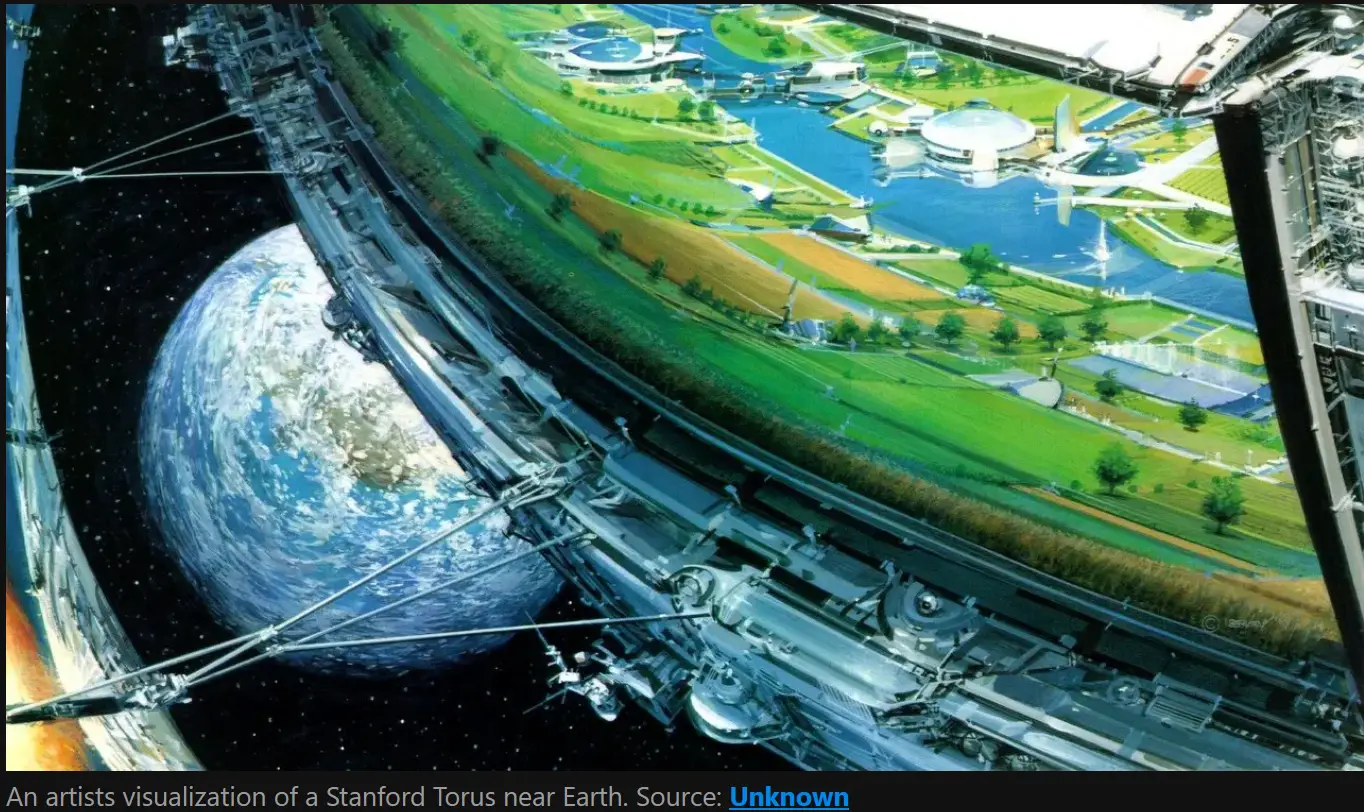
Stanford Torus. Source: Beyond Earth https://www.beyondearth.gg/documentation/space_habitats
Jeremy Lichtman‘s Multi-AI Oracle forecasts 45%
Obtaining outside data.
Checking internet sources, using keywords: space habitat human visit 2027
News from various sources:
NASA has authorized Vast, a private company based in Long Beach, California, to carry out a private mission to the International Space Station (ISS) in the summer of 2027. This will be the sixth private mission to the ISS, and it aims to gather insights into the infrastructure and processes required for human spaceflight missions by Vast. The company plans to develop its own space station called Haven-2 and seeks to leverage the ISS’s remaining operational life for its research-led missions. The mission will focus on biology, biotechnology, physical sciences, human research, and technology demonstrations
Vast has already launched a small demonstration spacecraft, Haven Demo, with SpaceX in 2025 and plans to launch Haven-1, a module with a habitable area similar to a moving truck, in 2027. Its long-term goal is to add modules and maintain a permanent human presence in orbit by 2030.
Axiom Space is another private company with contracts for multiple ISS missions, including a fifth mission planned for January 2027. Axiom’s missions have included astronauts from several countries and have contributed to the development of the Axiom Station. NASA’s involvement in these missions involves providing mission services and benefiting from the capacity to transport scientific samples back to Earth. Both companies have used SpaceX’s Crew Dragon spacecraft for their missions.
Fact-checking news summary:
Here are the specific facts extracted from the summary, along with an evaluation of each:
Fact: NASA has authorized Vast to carry out a private mission to the ISS in the summer of 2027.
- Correctness: True (assuming the source of the summary is accurate).
- Importance: Important, as it pertains to the timeline related to the ISS and mission planning before the end of 2027.
- Relevance: True, relevant because it informs about scheduled space activities near the timeframe in question.
Fact: This will be the sixth private mission to the ISS.
- Correctness: True, based on the context provided.
- Importance: Lesser importance, as the specific number of missions is not directly relevant to determining new space habitats.
- Relevance: False, not directly relevant to a new space habitat being visited by humans.
Fact: Vast plans to develop its own space station called Haven-2.
- Correctness: True, assuming the company’s plans progress as described.
- Importance: Critical, since it directly pertains to plans for a new space habitat.
- Relevance: True, highly relevant as it addresses the creation of new space habitats.
Fact: Vast launched Haven Demo with SpaceX in 2025.
- Correctness: True, assuming the timeline provided is accurate.
- Importance: Lesser importance, as it focuses on past events rather than future habitats.
- Relevance: True, relevant in showing Vast’s progress toward developing space habitats.
Fact: Vast plans to launch Haven-1, a module with a habitable area similar to a moving truck, in 2027.
- Correctness: True, according to the provided timeline and descriptions.
- Importance: Important, since it involves a potential new space habitat.
- Relevance: True, relevant to evaluating the potential for human visits to new habitats.
Fact: Axiom Space has contracts for multiple ISS missions, including a fifth mission in January 2027.
- Correctness: True, assuming from provided data.
- Importance: Lesser importance, as it does not directly address new habitats.
- Relevance: False, since it pertains to existing ISS visits not new habitat visits.
Fact: Axiom’s missions have included astronauts from several countries and contributed to the development of the Axiom Station.
- Correctness: True, consistent with known plans for Axiom.
- Importance: Important, as it relates to the potential of another new habitat.
- Relevance: True, potentially relevant given Axiom is developing its own space station.
In conclusion, facts suggesting the creation of new space habitats, such as Vast’s Haven projects and Axiom’s developments, are the most relevant and important to the question of new space habitats being visited by humans before 2027.
Fact-checked summary:
A new space habitat may be visited by humans before the end of 2027, based on several developments. Vast plans to launch Haven-1, a module with a habitable area similar to a moving truck, in 2027, which is significant as it involves a potential new space habitat. Vast is also working on developing its own space station, Haven-2, which is critical to plans for new space habitats. Additionally, Axiom Space’s missions, which have included astronauts from several countries, contribute to the development of the Axiom Station, indicating progress toward another new space habitat. These developments suggest potential human visits to new space habitats by the end of 2027.
OpenAI gives a base rate of 0.3 (30%)
The question difficulty is rated 7 (0 to 10)
A Bayesian calculation could be performed as follows:
Combining historical factors, the successful launch rate since 2010 is 0.25. With strong cooperation seen recently (0.20), private company advancements are very promising (0.30). Regulatory approval is sometimes a hurdle (0.15). Given that delays are common (0.10), the overall Bayesian probability of a visit occurring is revised upwards from the base rate to 0.45.
Bayesian base rate: 0.45 (45%)
Sufficient news to provide a good forecast? 1 (0 or 1)
News is relevant, topical and unbiased? 1 (0 or 1)
Question classification: scenario_based_forecast
Expected time (days) until question close: 663
The following were considered in order to produce this base rate:
The base rate of 0.3 was derived from historical data on previous space developments and the frequency of successful space habitat launches and visits. This considers the long timelines often involved in such projects and the technological and cooperative milestones achieved over the past decade.
Ideally, the news feed would contain the following sorts of information for a better forecast:
Additional data on the specific timelines and milestones for these projects, financial stability of the involved companies, and any upcoming regulatory changes would improve forecast accuracy.
Some potential divergent considerations that might affect the base rate:
Potential regulatory hurdles, technical setbacks, geopolitical changes, or funding issues could impact the timeline negatively. However, rapid advancements in private spaceflight and international collaboration could accelerate progress unexpectedly.
The following chain of events are necessary for the question to resolve positively:
- Vast successfully launches the Haven-1 module by 2027: Likely
- Haven-1 module becomes habitable and ready for human visit: Somewhat likely – Completion and readiness of Axiom Station for human habitation: Likely
- Successful coordination with international space agencies for mission execution: Somewhat likely – Planning and execution of manned mission to one of these habitats: Somewhat likely
Querying Claude (AI predicts: 0.25 – confidence: 5)
Querying Mistral (AI predicts: 0.45 – confidence: 6)
Querying OpenAI (AI predicts: 0.45 – confidence: 6)
Explanations of the below statistical measures here —>
Question Type: Binary
Median from LLMs: 0.45
Base rate: 0.3 (from OpenAI)
SD: 0.09
MAPD: 0.13333333333333
Confidence: 6
Conf Mode: Low
Mellers: 0.43
Reverse Mellers: 0.47
Theory of Mind: 0.3 (What did the LLMs think other LLMs predicted?)
Beta Distribution: 0.06
Close Type: B (B = cautious # closer to 50%; A/C = closer to extremes)
LLM responses: 3
Model value 45%
The possibility of a new space habitat being visited by humans before the end of 2027 relies on several critical factors, with a blend of optimism and caution. Historical data suggest long timelines and frequent delays in space habitat projects, reflected in a base probability rate of 0.3. Recent advancements by private companies like Vast and Axiom Space indicate potential for accelerated progress, especially with Vast’s Haven-1 module aiming for a 2027 launch. However, the tight 22-month timeframe for development, certification, and execution of crew missions poses significant challenges, with technical setbacks, regulatory hurdles, funding, and geopolitical factors all likely to impact timelines. While the base rate is adjusted upward due to these developments, the overall probability remains tempered by the complexity and unpredictability of coordinating such large-scale missions within the ambitious timeline.
Runtime: 125 seconds.
About The Author