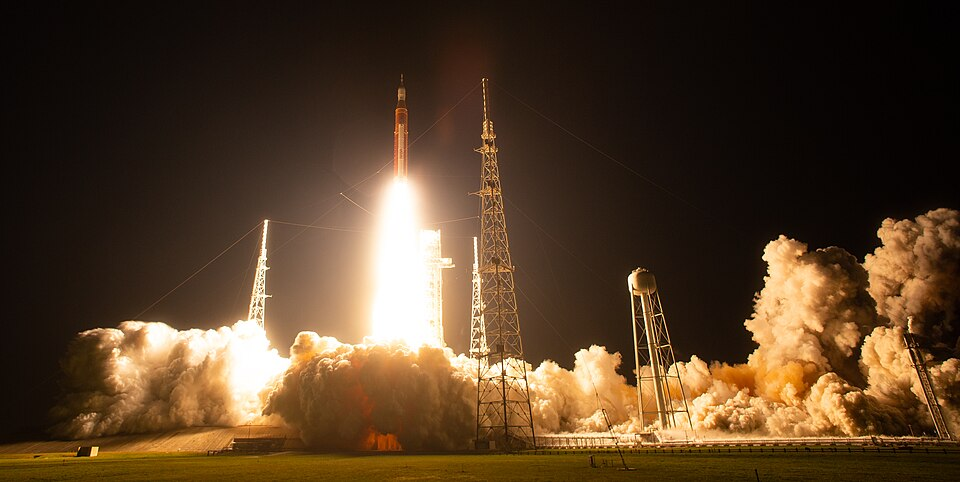
NASA’s Space Launch System rocket carrying the Orion spacecraft launches on the Artemis I flight test, Wednesday, Nov. 16, 2022, from Launch Complex 39B at NASA’s Kennedy Space Center in Florida. NASA’s Artemis I mission is the first integrated flight test of the agency’s deep space exploration systems: the Orion spacecraft, Space Launch System (SLS) rocket, and ground systems. SLS and Orion launched at 1:47 a.m. EST, from Launch Pad 39B at the Kennedy Space Center. Photo Credit: (NASA/Joel Kowsky)
OpenAI gives a base rate of 0.6 (60%)
The question difficulty is rated 7 (0 to 10)
Historical weighted factors include:
Funding consistency, 0.25
Historical success rates of similar NASA missions, 0.35
Technical readiness levels achieved, 0.25
External geopolitics and policy stability, 0.15
A Bayesian calculation could be performed as follows:
Using historical success rates as a prior (0.7) and adjusting for current readiness and external factors (estimated at 0.6), we estimate using a simple multiplication of adjusted factors: (0.7 * 0.95 + 0.6 * 0.05).
Bayesian base rate: 0.675 (67.5%)
Sufficient news to provide a good forecast? 0 (0 or 1)
News is relevant, topical and unbiased? 0 (0 or 1)
Question classification: scenario_based_forecast
Expected time (days) until question close: 611
The following were considered in order to produce this base rate:
The base rate is determined by examining the historical frequency of mission completions by NASA, adjusted for the complexity of Artemis III. Given the scarcity of completed missions of similar scale and the known delays in space missions, a conservative estimate was used.
Ideally, the news feed would contain the following sorts of information for a better forecast:
Additional details about current progress, test schedules, and milestones from NASA, along with geopolitical stability assessments, would improve the forecast accuracy.
Some potential divergent considerations that might affect the base rate:
The base rate could differ if new significant data becomes available, such as breakthroughs in development or unforeseen challenges, which is relatively high in technological ventures.
The following chain of events are necessary for the question to resolve positively:
- Successful funding and budget allocation for Artemis III mission by NASA — Likelihood: Likely –
- Resolution of technical challenges related to the Artemis III spacecraft — Likelihood: Somewhat likely
- Successful testing and demonstration phases before the end of 2027 — Likelihood: Somewhat likely
- No major delays from external factors such as political shifts, natural disasters, or major technical setbacks — Likelihood: Somewhat unlikely
Querying Claude (AI predicts: 0.06 – confidence: 5)
Querying Mistral (AI predicts: 0.55 – confidence: 6)
Querying OpenAI (AI predicts: 0.55 – confidence: 5)
Explanations of the statistical measures listed below.
Question Type: Binary
Median from LLMs: 0.55
Base rate: 0.6 (from OpenAI)
SD: 0.23
MAPD: 0.32666666666667
Confidence: 5
Conf Mode: Low
Mellers: 0.57
Reverse Mellers: 0.53
Theory of Mind: 0 (What did the LLMs think other LLMs predicted?)
Beta Distribution: 0.62
Close Type: B (B = cautious # closer to 50%; A/C = closer to extremes)
LLM responses: 3
Model value: 55%
The reasoning presented by the AIs generally agrees that the Artemis III mission is unlikely to succeed by the end of 2027 due to several overlapping factors. These include: delays in the development of key components such as SpaceX’s Starship Human Landing System and Axiom Space lunar spacesuits, as well as NASA’s Space Launch System and Orion spacecraft readiness. Additionally, uncertainty in funding and potential budget cuts, coupled with historical delays in NASA missions, compound the issue. Political and external factors, such as U.S. elections and economic pressures, further complicate the mission’s timeline. While there is a possibility of an ‘orbital demonstration,’ it is not a part of the official Artemis III mission profile, which adds to the confusion given the lack of updates and transparency from NASA. The AIs suggest that the mission’s reliance on unproven technologies like the Starship HLS and unforeseen risks in political and technical areas reduce its likelihood of success within the ambitious timeframe.
Runtime: 49 seconds.
About The Author