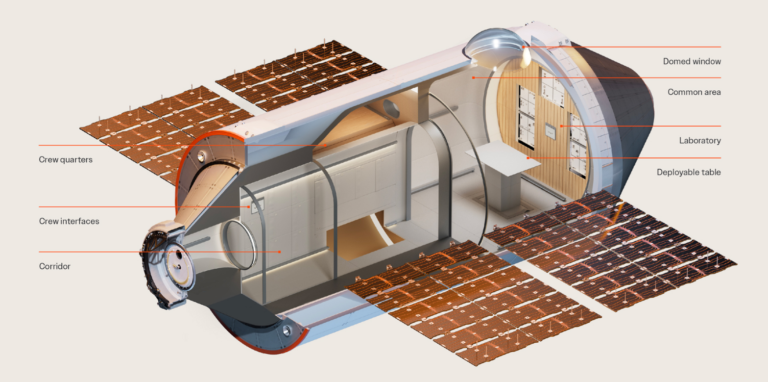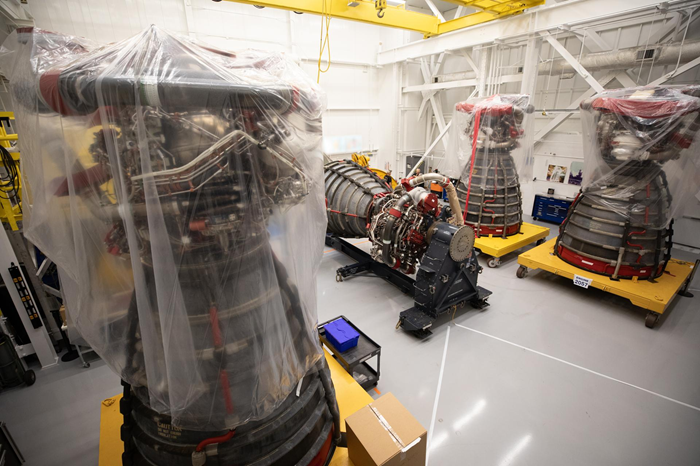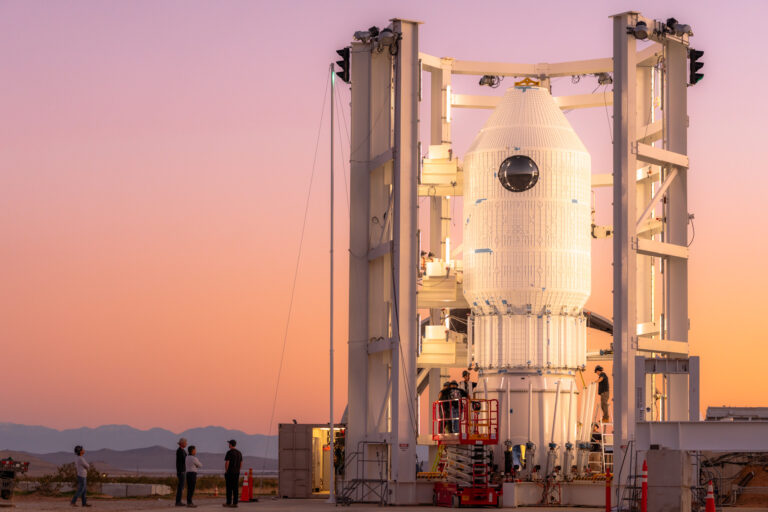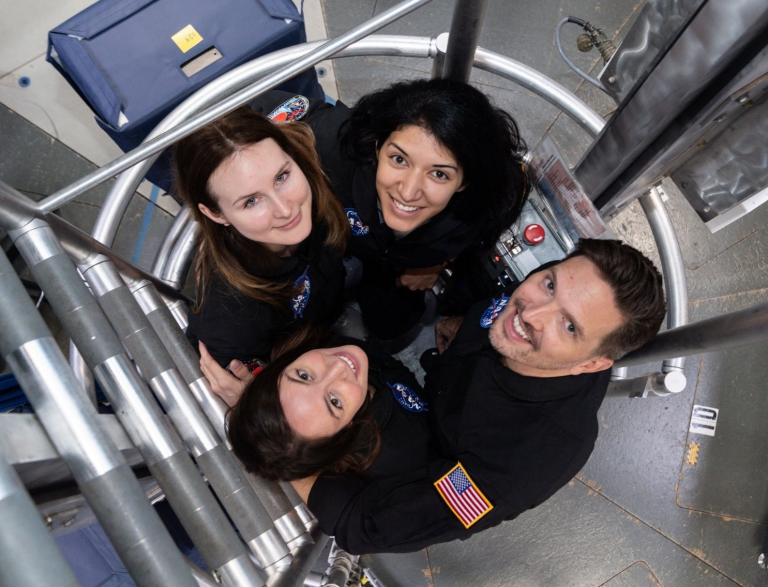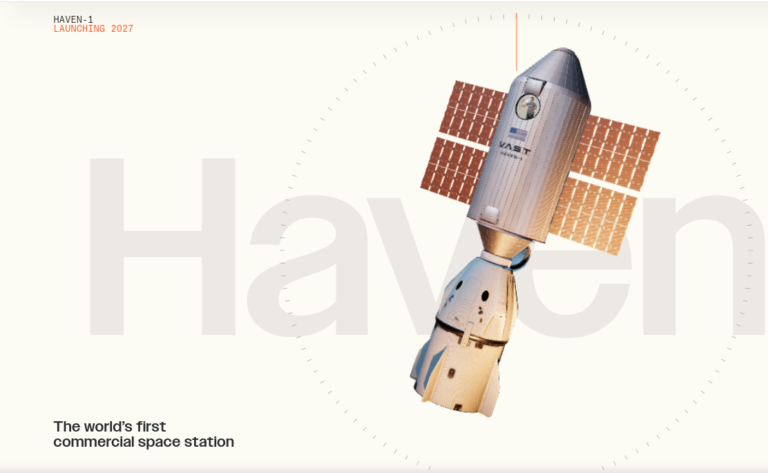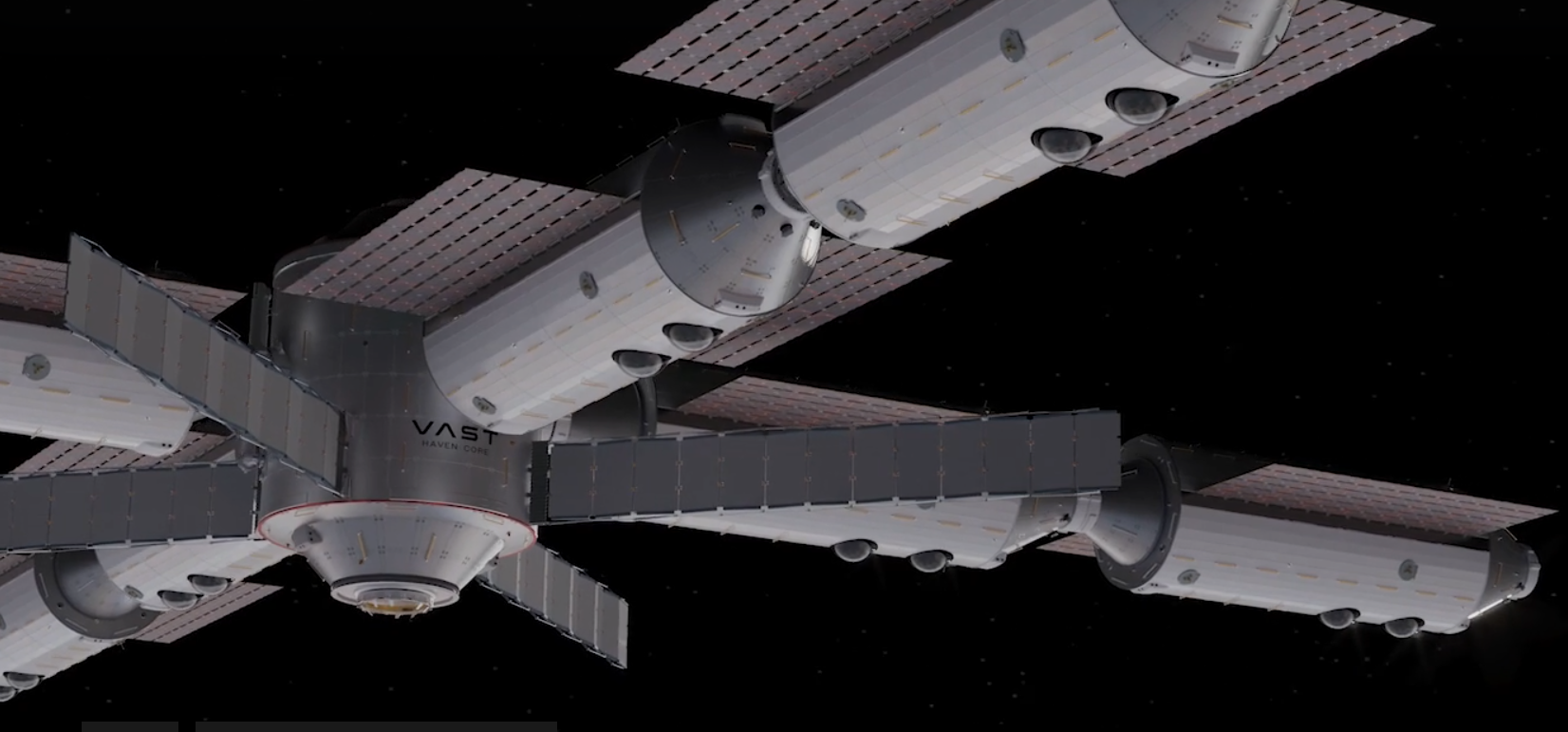
Haven-2 concept by Vast Space. Source: https://www.vastspace.com/haven-2
Obtaining outside data.
Checking internet sources, using keywords: space habitat humans 2027
News from various sources:
The content focuses on the development of space habitats with artificial gravity, which could play a significant role in human deep-space exploration by 2027. The US company Vast is spearheading this effort with plans to launch the Haven-1 space habitation module in 2027, followed by Haven-2 in 2030. These modules will serve as platforms for scientific research on stem cells and protein crystal growth.
Vast’s ultimate goal is to develop an artificial gravity station capable of hosting a crew of 40 by rotating at 3.5 rpm, simulating a gravity-like environment to counteract the detrimental effects of microgravity such as bone and muscle loss. This technology could extend the time humans can spend in space, facilitating longer missions to Mars and beyond.
The concept of artificial gravity has been around since it was first proposed by Konstantin Tsiolkovsky and later popularized in films like “2001: A Space Odyssey”. Previous projects by NASA and Stanford University, such as the Stanford Torus and the Nautilus-X, explored similar ideas but faced budgetary constraints.
Vast aims to support the broader goal of enabling millions of humans to inhabit the solar system, both preserving Earth and allowing civilization to thrive beyond it.
The critical fact pertaining to a human visit to a new space habitat by 2027 is the planned launch of the Haven-1 module in that year, as it suggests the potential for visitation.
Fact-checked summary:
Vast plans to launch the Haven-1 space habitation module in 2027, which is a critical development directly related to the potential for human visitation to a new space habitat before the end of that year. This launch is significant as it suggests the possibility of human presence in the newly developed space habitat within the 2027 timeframe. While other aspects of Vast’s endeavors, such as subsequent modules planned for later years and the research applications of these habitats, are important for understanding broader objectives, they do not directly impact the timeline of human visitation by 2027.
OpenAI gives a base rate of 0.3 (30%)
The question difficulty is rated 7 (0 to 10)
A Bayesian calculation could be performed as follows:
Using the historical factors, I calculate the Bayesian probability. If each historical factor represents a conditional probability that could support the event, then multiplying the adjusted likelihoods of necessary events by these weights, we get: (0.5 * High probability of launch success) + (0.2 * Moderate for validation) + (0.1 * Regulatory success) + (0.1 * Training timelines) + (0.1 * Low scheduling feasibility) = Bayes probability factor of approximately 0.35.
Bayesian base rate: 0.35 (35%)
Sufficient news to provide a good forecast? 1 (0 or 1)
News is relevant, topical and unbiased? 1 (0 or 1)
Question classification: scenario_based_forecast
Expected time (days) until question close: 560
The following were considered in order to produce this base rate:
The base rate is derived from assessments of historical space module launches, which have a good track record but must be tempered by the notable challenges involved in validating new space habitats, training crew, and regulatory clearances.
Ideally, the news feed would contain the following sorts of information for a better forecast:
Additional data on Vast’s project management, historical success rates of first-time efforts in space habitation, and specific regulatory frameworks that apply would enhance the forecast’s accuracy.
Some potential divergent considerations that might affect the base rate:
Potential for unexpected technical issues, delays in launch schedules, or unforeseen regulatory hurdles could drastically change the probability of successful habitation within the timeframe.
The following chain of events are necessary for the question to resolve positively:
- Vast successfully launches the Haven-1 module by the end of 2027. High
- Technical validation and safety checks of Haven-1 are completed successfully post-launch. Moderate
- Securing necessary regulatory approvals for human habitation in space. Moderate
- Astronauts or other humans are trained and prepared for habitation in Haven-1. Moderate
- Scheduling alignment with launch of a crewed mission to visit Haven-1 before 2028. Low
Querying Claude (AI predicts: 0.28 – confidence: 4)
Querying Mistral (AI predicts: 0.65 – confidence: 7)
Querying OpenAI (AI predicts: 0.35 – confidence: 5)
Explanations of the statistical measures listed below.
Question Type: Binary
Median from LLMs: 0.35
Base rate: 0.3 (from OpenAI)
SD: 0.16
MAPD: 0.24666666666667
Confidence: 5
Conf Mode: Low
Mellers: 0.29
Reverse Mellers: 0.4
Theory of Mind: 0.2 (What did the LLMs think other LLMs predicted?)
Beta Distribution: 0.34
Close Type: B (B = cautious # closer to 50%; A/C = closer to extremes)
LLM responses: 3
Model value: 35%
The reasoning across the AI summaries predominantly revolves around the uncertainty and challenges associated with Vast’s Haven-1 module achieving human visitation by the end of 2027. A significant concern is the tight timeline, with no launch yet as of June 2026, meaning the entire process needs to be completed in 18 months. Historical patterns highlight frequent delays in space habitat projects, and Vast’s status as a new company with limited experience further increases this risk. Positive aspects include their partnership with SpaceX, which lends credibility to their launch capabilities, and the fact that a brief human visit would fulfill the criteria for success. However, multiple hurdles remain, such as technical validation, regulatory approvals, and training schedules. Overall, there is cautious optimism but significant doubt due to the inherent unpredictability of space projects and the novelty of commercial space habitats.
Runtime: 67 seconds.
About The Author