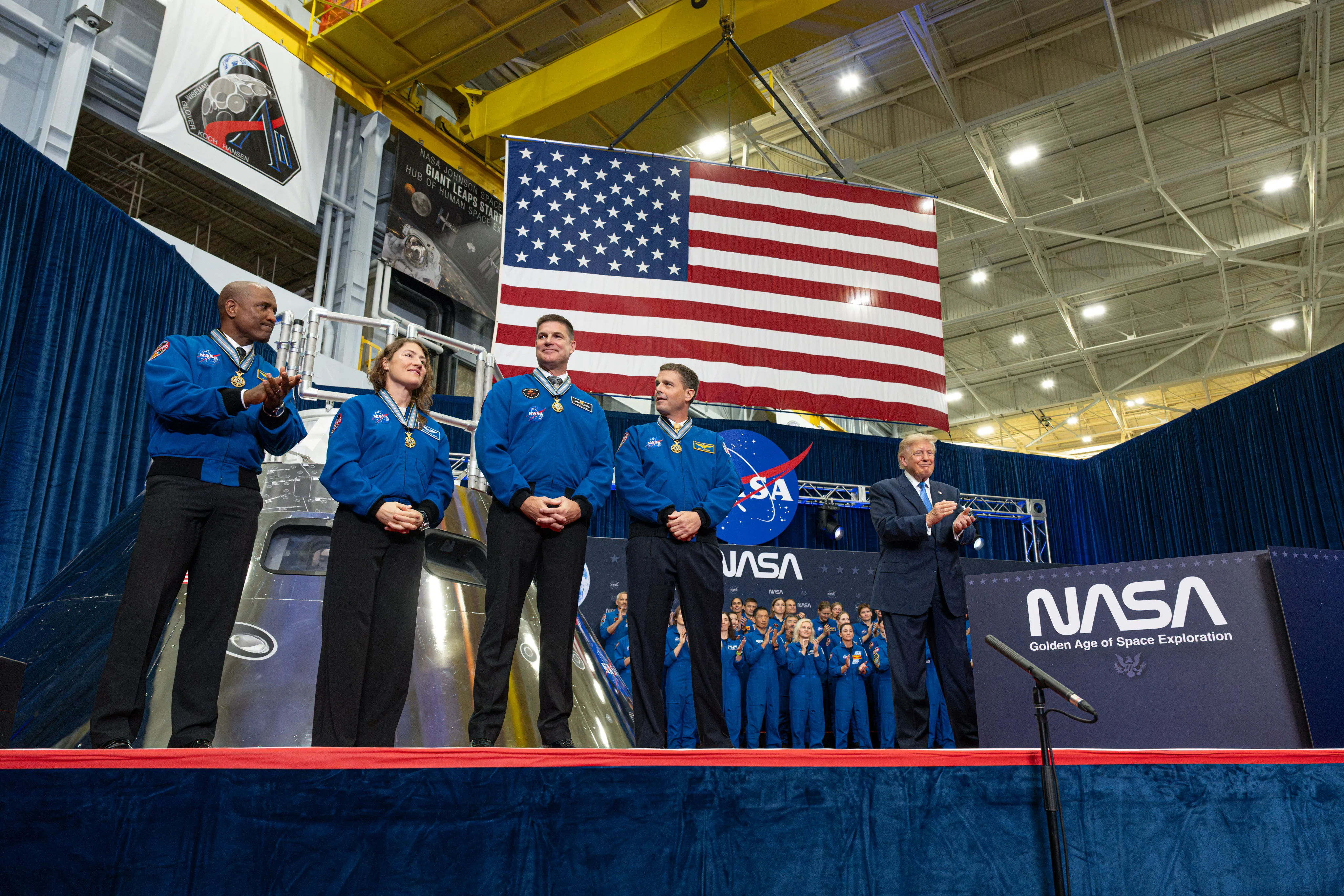
NASA’s Artemis II Crew Receives Congressional Space Medal of Honor: President Donald J. Trump awarded NASA astronauts Victor Glover and Christina Koch, CSA (Canadian Space Agency) astronaut Jeremy Hansen, and NASA astronaut Reid Wiseman with the Congressional Space Medal of Honor on Aug. 28, 2026, at NASA’s Johnson Space Center in Houston. NASA/John Kraus. Source: https://www.nasa.gov/image-article/nasas-artemis-ii-crew-receives-congressional-space-medal-of-honor/
Grok response:
10 Key Citations
- Moon to Mars | NASA’s Artemis Program (NASA official page). Authoritative resolution source describing current Artemis architecture. Published/updated August 17, 2026. The page states Artemis III is a demonstration mission in low Earth orbit, planned for 2027, to evaluate one or both commercial human landing systems from SpaceX and Blue Origin. It will launch crew aboard Orion on SLS to test rendezvous and docking operations needed for future lunar surface missions. Artemis IV remains targeted as the first lunar landing in 2028.[1]
- NASA Marches Toward Artemis III Mission in 2027, Names Crew Members (NASA news release). Official crew announcement and mission details. Published June 9, 2026. NASA named the four-person crew (Randy Bresnik commander, Luca Parmitano ESA pilot, Andre Douglas and Frank Rubio mission specialists) plus backup Bob Hines for the 2027 LEO test flight. The mission will involve docking Orion with Blue Origin then SpaceX test landers over about two weeks. Hardware progress includes Orion docking system integration and SLS stacking planned for summer 2026.[2]
- How NASA’s Artemis III Lander Test Will Pave Way for Moon Landings (NASA article). Details on commercial lander test articles. Published July 15, 2026. Both SpaceX (Starship V3 with docking adapter) and Blue Origin will fly test versions launched on commercial rockets, while crew launches on SLS/Orion. The mission includes two back-to-back rendezvous/docking sequences, possible astronaut entry into at least one lander, and tests of Axiom spacesuits. NASA calls it one of the most complex missions ever, involving three of the world’s most powerful rockets.[3]
- NASA Administrator ‘extremely confident’ in Artemis 3 mission in 2027 (Spaceflight Now). Administrator comments on timeline. Published August 14-20, 2026. Jared Isaacman stated he is “extremely confident” Artemis III will launch in 2027, citing SLS stacking operations underway and progress on landers. He noted SpaceX’s increasing Starship cadence (potentially every couple of weeks by end of 2026) and Blue Origin’s recovery. A wet dress rehearsal is planned for November 2026.[4]
- NASA says Artemis III mission on schedule as Blue Origin repairs launchpad (Reuters). Status update amid New Glenn issues. Published July 20, 2026. Isaacman confirmed NASA remains on track for 2027 despite Blue Origin’s May 2026 New Glenn pad explosion, with SLS and Orion “doing incredibly well.” Blue Origin aims to resume flights by end of 2026; NASA has contingencies if New Glenn delays further but views it as Plan A with a year of buffer.[5]
- Artemis III (Wikipedia). Comprehensive mission overview. Last updated August 29, 2026. Planned NET 2027 as a ~2-week LEO demonstration (~230 nmi circular orbit) using a non-propulsive spacer instead of ICPS. Sequence: Blue Origin test vehicle launches first (90-day loiter), then SLS/Orion crew, dock ~2 days, then Starship V3 docks ~1 day; crew remains in Orion for Starship test. Hardware includes refurbished Shuttle RS-25 engines and first Orion docking system.[6]
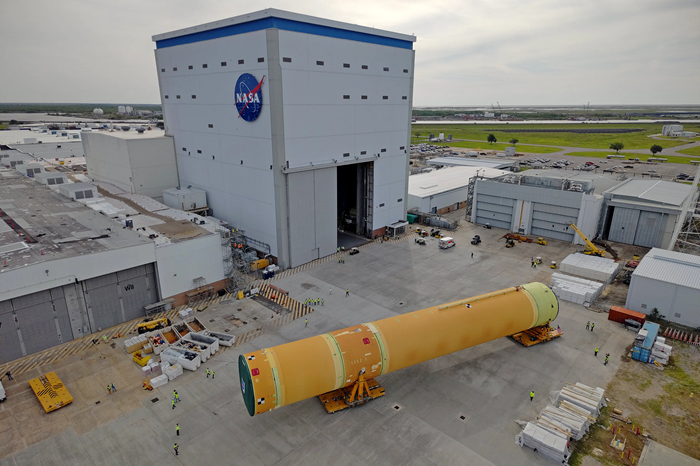
- NASA Starts Artemis III Engine Install; Boosters, Crew Training Advance (NASA blog). Latest hardware processing. Published August 27, 2026. Technicians began installing the four RS-25 engines on the SLS core stage on August 24, 2026, inside the VAB. SRB stacking (started early July) is more than halfway complete with streamlined processes from prior missions. Orion crew/service modules were joined July 30, 2026; crew training is advancing.[7]
- Inside NASA Marshall’s progress on Artemis III hardware, plans for new SLS upper stage (Aerospace America). Spacer and simulation updates. Published August 24, 2026. The non-propulsive spacer (replacing ICPS, reserved for Artemis IV) has a completed barrel with rings in work, targeting December 2026 flight hardware completion (8-month build). Launch simulations are running in the SLS Systems Integration Lab. Isaacman remained optimistic on lander development in mid-August comments.[8]
- Put it in pencil: NASA’s Artemis III mission will launch no earlier than late 2027 (Ars Technica). Vendor readiness and schedule refinement. Published April 28, 2026. Isaacman told lawmakers SpaceX and Blue Origin indicated they could meet a late-2027 rendezvous/docking test. This was a slight slip from earlier mid-2027 targets. Details on orbit altitude and SLS configuration were still under review at the time.[9]
- WATCH: SpaceX Successfully Launches Starship Flight 13, Deploys First Starlink V3 Satellites (Space Coast Daily / related reports). Starship V3 progress relevant to HLS pathfinder. Published July 25, 2026 (flight July 24). Flight 13 (second V3 flight) successfully deployed 20 Starlink V3 satellites, performed heatshield observations, and achieved intact splashdown after a landing flip. This supports SpaceX’s ability to provide a V3 Starship with docking adapter for the 2027 demo; next flights targeting orbital capability.[10]
Commercial lander test articles (the main schedule risk): NASA intends to fly both providers’ pathfinders if ready. Blue Origin’s Blue Moon Mark 2 test article (crew module with life support, possibly allowing astronauts to enter; 90-day loiter capability) launched first on New Glenn, followed by SLS/Orion docking (~2 days), then SpaceX Starship V3 pathfinder (docking adapter on nose, no full crew cabin so astronauts stay in Orion; ~1 day docked). Blue Origin’s New Glenn suffered a pad explosion May 28, 2026, destroying a vehicle and damaging LC-36.
Schedule evolution and expert views: Originally a 2027 lunar landing, Artemis III was redefined in February 2026 (after ASAP safety concerns and Artemis II delays) as this LEO Apollo 9 analog to reduce risk before 2028 landings (Artemis IV/V). Targets have been “mid-2027,” then “late 2027 at the earliest” (April 2026 vendor responses), then consistently 2027 with NASA targeting mid-to-late. Mission duration ~12-14 days / two weeks.
Extracted resolution criteria links:
[‘https://www.nasa.gov/humans-in-space/artemis/‘]
=== Forecast Result ===
=== Reasoning ===
The strongest evidence is the recent NASA hardware progress: SLS engine installation, booster stacking, Orion integration, crew training, and a planned wet-dress rehearsal. Artemis II’s successful completion also improves confidence in NASA’s crewed-flight operations. The mission has been simplified from a lunar landing to a low-Earth-orbit demonstration, and the resolution standard allows success with only one commercial lander provider, both of which materially improve the odds.
However, the schedule remains highly compressed. Artemis III is a first-of-its-kind integrated mission involving a crewed SLS/Orion launch, first Orion docking operations, and at least one newly developed commercial vehicle. The key risk is not primarily NASA’s already-progressing hardware, but commercial lander readiness. SpaceX still lacks a flown HLS-specific vehicle and has not demonstrated orbital propellant transfer; Blue Origin faces the more immediate New Glenn pad and launch-readiness setback. Although those tests may be simplified pathfinders, they still require multiple launches and successful rendezvous operations before the end of 2027.
I would weight the August NASA updates and official mission description most heavily for the current plan, but not treat NASA’s target date as an independent estimate of actual completion. The April reporting that characterized late 2027 as the earliest plausible timing is especially relevant because it reflects vendor schedule assessments rather than only agency messaging. Historical Artemis delays and the novelty of the mission argue for a substantial slip probability.
The main assumptions are:
- NASA can complete SLS, Orion, ground systems, and testing in time: failure or major schedule slippage probability about 25%.
- At least one commercial provider can deliver a suitable demonstrator and launch it in the required sequence: failure probability about 35%, with Blue Origin the larger individual risk but SpaceX also carrying significant technical uncertainty.
- The mission architecture remains stable and NASA accepts a one-provider demonstration if necessary: failure probability about 20%; a serious safety issue, funding change, or architectural revision could push the mission beyond the deadline.
These risks are correlated: a commercial delay could force NASA to redesign the sequence, while a late SLS or Orion issue would leave little schedule margin. Conversely, the “one or both” criterion and the lower complexity relative to a lunar landing provide meaningful mitigation.
My estimated completion likelihood would be roughly 15% by mid-2027, 30% by the end of September 2027, and 45% by the end of December 2027. If the deadline were extended into 2028, the probability would rise substantially, but not approach certainty because both commercial programs still have major technical milestones ahead.
Probability: 45%
End
About The Author