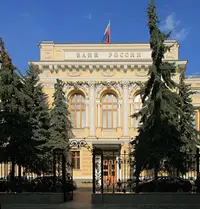
Head office of the Russian Central Bank, erected in 1894 as the Moscow branch of the State Bank of the Russian Empire. Source: Wikipedia https://en.wikipedia.org/wiki/Central_Bank_of_Russia
Jeremy Lichtman‘s Multi-AI Oracle forecasts 45%
Obtaining outside data.
Checking internet sources, using keywords: Russia interest rate 2026
News from various sources:
The extracted content focuses on the market and economic conditions in March 2026, particularly influenced by geopolitical developments, which might not directly relate to Russia’s interest rates in 2026. Here is a summary of the relevant parts:
- Geopolitical Influence on Interest Rates: The primary discussion revolves around how ongoing geopolitical tensions, particularly the US-Israel military campaign against Iran, have disrupted the Strait of Hormuz, impacting global oil supply and raising prices above $100 per barrel. This resurgence in oil prices is causing inflation concerns, prompting discussions on monetary policies.
- Impact on US Rates: As a consequence, US mortgage rates are experiencing fluctuations, reaching nearly 6% for a 30-year fixed mortgage, despite job losses reportedly affecting 92,000 positions in February 2026. Typically, such job market setbacks would encourage interest rate cuts to stimulate borrowing and spending, easing economic conditions.
- Federal Reserve’s Dilemma: The Federal Reserve’s meeting in March was expected to discuss whether to cut, hold, or increase rates, given the inflationary pressures from rising oil prices against the backdrop of a weakening job market. The federal funds rate, as of early March, stands unchanged at 3.50%-3.75%.
- Market Response and Predictions: There is significant uncertainty in the market, with divergent predictions about whether rates may rise if oil prices remain elevated or if they might decrease should the geopolitical situation stabilize and job losses persist. Refinancing activity has surged, indicating some public expectations of favorable rate conditions.
The focus remains predominantly on the US market, with no specific mention of Russia’s interest rates for 2026. However, the overarching influence of global events may implicitly affect Russia’s financial landscape.
In conclusion, although the focus is primarily on US economic conditions, the potential influence of global oil prices, due to geopolitical tensions, is the most important and relevant factor for assessing if Russia might adjust its interest rates. Specific US financial conditions do not directly relate to Russian policy, suggesting the need for more country-specific analysis for Russia.
Fact-checked summary:
Geopolitical tensions, particularly involving the US-Israel military campaign against Iran, have disrupted the Strait of Hormuz, impacting global oil supply and raising prices above $100 per barrel, which in turn causes inflation concerns. This situation has a significant influence on economic conditions globally, including in Russia, where changes in global oil prices can affect economic policies such as interest rates. Additionally, market uncertainty due to high oil prices and potential geopolitical stabilization can further influence international economic policies, potentially affecting Russia’s decision to adjust its interest rates. Therefore, the key relevant and true factor is the state of global oil prices due to geopolitical tensions, as this could have implications for Russia’s economic decisions, including potential interest rate adjustments below 15.5% before the end of 2026.
OpenAI gives a base rate of 0.3 (30%)
The question difficulty is rated 7 (0 to 10)
A Bayesian calculation could be performed as follows:
Using historical factors, we assess the probability changes: Oil prices likely to remain volatile due to ongoing tensions (-0.1), past monetary policy shows reluctance to cut (-0.05), geopolitical stabilization is low but possible (+0.05), and global conditions suggest potential for interest rate adjustment (+0.02). Combining these, we adjust the base rate using the Bayesian method: 0.3 + (-0.1) – 0.05 + 0.05 + 0.02 = 0.22. (Carolyn‘s note: Correct!)
Bayesian base rate: 0.22 (22%)
Sufficient news to provide a good forecast? 1 (0 or 1)
News is relevant, topical and unbiased? 1 (0 or 1)
Question classification: scenario_based_forecast
Expected time (days) until question close: 955
The following were considered in order to produce this base rate:
The base rate considers Russia’s historical monetary policy conservatism and its responsiveness to oil price fluctuations. The frequency of interest rate adjustments in response to global economic shifts, as well as current geopolitical tensions heightened by US-Israel-Iran regional conflicts impacting oil prices, shapes this estimation.
Ideally, the news feed would contain the following sorts of information for a better forecast:
Detailed information on internal Russian economic metrics and strategic insights into the Central Bank of Russia’s current priorities and concerns would aid in refining this forecast.
Some potential divergent considerations that might affect the base rate:
Potential significant changes in global oil market dynamics, including rapid stabilization or unexpected deals, could prompt a faster economic recovery in Russia, and shift monetary policy priorities. Similarly, a major economic stimulus package from the Russian government might alter traditional monetary policy strategies.
The following chain of events are necessary for the question to resolve positively:
- The geopolitical tensions in the Strait of Hormuz stabilize, reducing uncertainty in the global oil supply. Likelihood: Possible.
- Global oil prices decrease to sustainable levels, reducing inflation pressures. Likelihood: Possible.
- Russia’s economy shows signs of stabilizing or growth, allowing for interest rate cuts. Likelihood: Unlikely.
- The Central Bank of Russia evaluates and decides that lowering interest rates below 15.5% is feasible and beneficial by the end of 2026. Likelihood: Possible.
Querying Claude (AI predicts: 0.28 – confidence: 5)
Querying Mistral (AI predicts: 0.45 – confidence: 6)
Querying OpenAI (AI predicts: 0.45 – confidence: 6)
Explanations of the statistical measures listed below.
Question Type: Binary
Median from LLMs: 0.45 (45%)
Base rate: 0.3 (from OpenAI)
SD: 0.08
MAPD: 0.11333333333333
Confidence: 6
Conf Mode: Low
Mellers: 0.43
Reverse Mellers: 0.47
Theory of Mind: 0.3 (What did the LLMs think other LLMs predicted?)
Beta Distribution: 0.03
Close Type: B (B = cautious # closer to 50%; A/C = closer to extremes)
LLM responses: 3
Model value: 45%
The consensus among the AI predictions is that the likelihood of Russia cutting its interest rate below 15.5% by the end of 2026 is low but not negligible. Key factors influencing this prediction include Russia’s historically conservative monetary policy, high global oil prices due to geopolitical tensions in the Strait of Hormuz, and current inflationary pressures, all of which suggest maintaining or potentially raising rates. However, potential stabilization of oil prices, modest economic growth despite sanctions, and sufficient time for policy changes within the 9.5-month period provide a non-trivial probability for rate cuts. The predictions also acknowledge that unexpected resolutions, like rapid geopolitical de-escalation or significant economic stimulus, could alter the Central Bank of Russia’s cautious stance. Despite these considerations, current volatility and pressures suggest a slightly lowered probability compared to historic base rates.
Runtime: 88 seconds.
About The Author