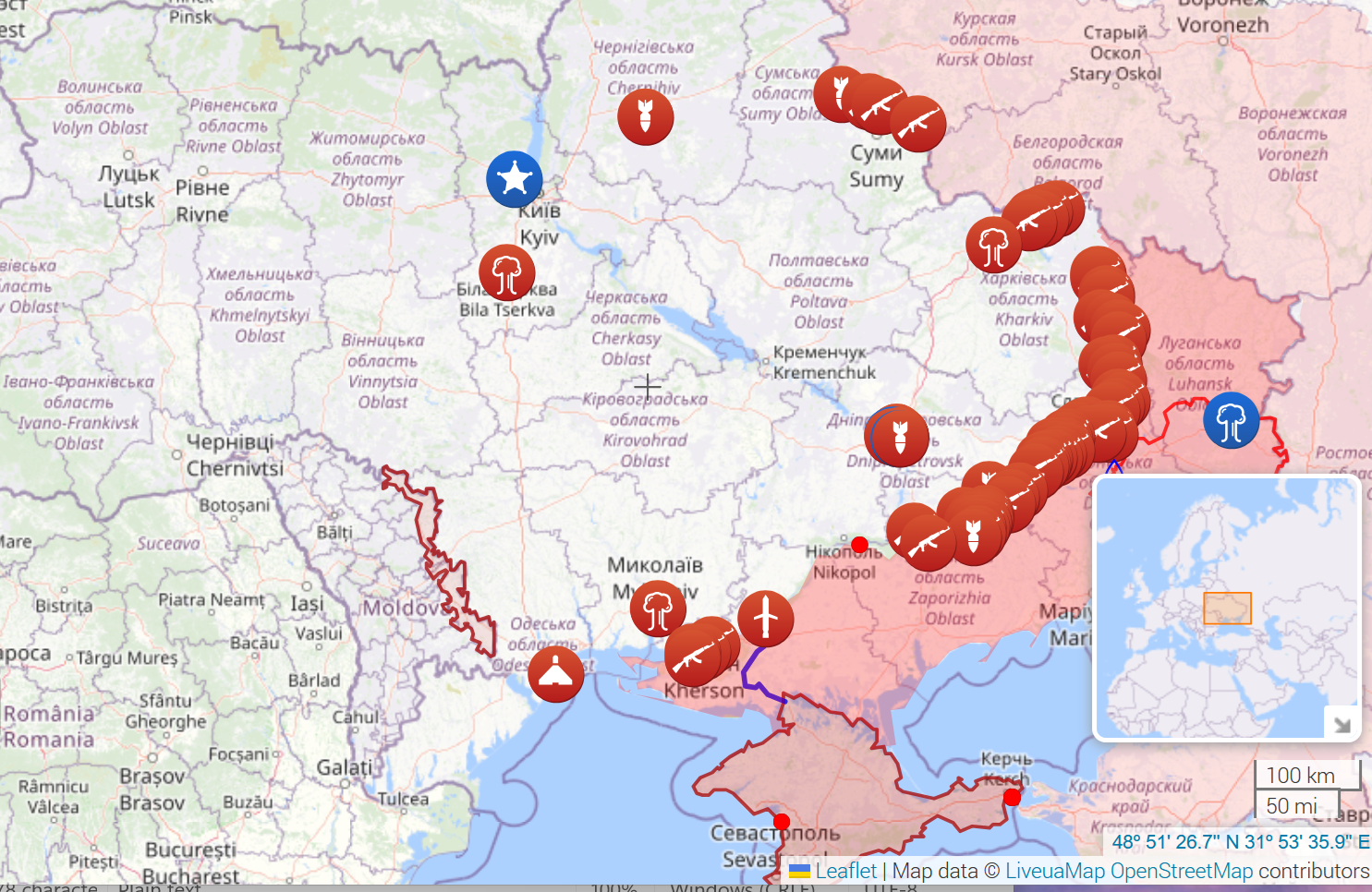
As of April 25, 2026, Live Ukraine map. Source: https://liveuamap.com/
Obtaining outside data.
Checking internet sources, using keywords: ceasefire armistice Ukraine 2026
News from various sources:
Ideally, the news feed would contain the following sorts of information for a better forecast:
Additional intelligence on political negotiations, statements from influential world leaders or key events which might trigger mediation efforts would be valuable.
Some potential divergent considerations that might affect the base rate:
Changes in political leadership, a dramatic escalation of conflict, or unexpected geopolitical events could deviate the outcome from historical trends.
The following chain of events are necessary for the question to resolve positively:
- Ukrainian government and Russian government both agree to terms for a ceasefire possible
- Involvement of international mediators to facilitate negotiations likely
- Reduction of hostilities on the ground preceding formal negotiations credible
- Political pressure from major powers or coalitions like the EU or NATO in support of a ceasefire probable
Querying Claude (AI predicts: 0.18 – confidence: 4)
Querying Mistral (AI predicts: 0.25 – confidence: 6)
Querying OpenAI (AI predicts: 0.25 – confidence: 4)
Explanations of the statistical measures listed below.
Question Type: Binary
Median from LLMs: 0.25
Base rate: 0.2 (from OpenAI)
SD: 0.03
MAPD: 0.046666666666667
Confidence: 4
Conf Mode: Low
Mellers: 0.17
Reverse Mellers: 0.33
Theory of Mind: 0.2 (What did the LLMs think other LLMs predicted?)
Beta Distribution: 0.07
Close Type: A (B = cautious # closer to 50%; A/C = closer to extremes)
LLM responses: 3
Model value: 25%
The assessment of the likelihood of a ceasefire or armistice in Ukraine in 2026 is informed by a combination of historical, geopolitical, and dynamic factors. A base rate of 0.2 is used, reflecting the historical patterns of prolonged conflicts rarely resolving within a specified timeframe. The status quo bias, where the conflict has persisted without a formal ceasefire since February 2022, reinforces a low probability of resolution within 2026. While diplomatic efforts under the Trump administration have increased negotiation attempts, the fundamental incompatibility of Ukraine and Russia’s positions—territorial concessions and security guarantees—hinders progress. The static military front lines further reduce pressure for resolution. However, geopolitical unpredictability could alter this forecast, with potential diplomatic breakthroughs, leadership changes, or significant battlefield developments altering current dynamics. Various scenarios, including third-party mediation or unexpected political shifts, could lead to negotiations, though such factors are speculative and carry inherent uncertainty.
Runtime: 70 seconds.
About The Author