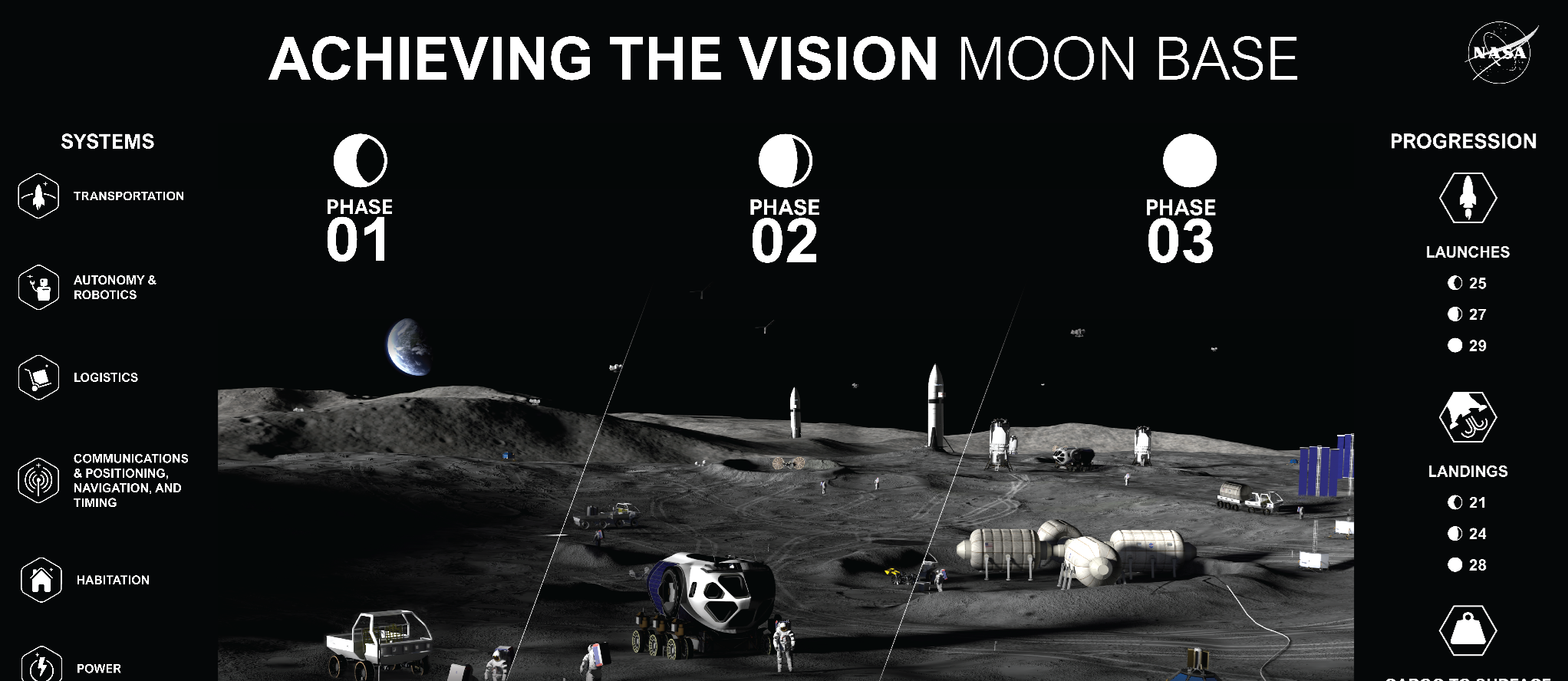
Moon Base Development Infographic illustrating a phased approach to Moon Base development near the lunar South Pole, showing the progression from early exploration and infrastructure deployment to sustained human presence on the Moon. Image Credit: NASA/Edmy S. Cruz Reyes
Obtaining outside data.
Checking internet sources, using keywords: Artemis III orbital demonstration 2027
News from various sources:
NASA’s Artemis III mission, scheduled for 2027, has been redefined from its original goal of landing humans on the Moon to conducting a complex orbital demonstration in low Earth orbit. This mission will involve the collaboration of multiple space organizations, including private companies like SpaceX and Blue Origin, and aims to prepare for future lunar missions.
Key Highlights of Artemis III:
Mission Objective:
- Artemis III will test the systems for future landings on the Moon, specifically focusing on docking maneuvers between the NASA Orion spacecraft and commercial lunar landers from SpaceX (Starship) and Blue Origin (Blue Moon).
Mission Execution:
- The mission requires the coordination of three major launches:
- Blue Origin’s New Glenn rocket will launch the Blue Moon lander.
- NASA’s Space Launch System (SLS) will carry the Orion spacecraft with the four astronauts onboard.
- SpaceX’s Starship will also be launched separately.
- The mission involves docking the Orion spacecraft with both the Blue Moon and the Starship landers in orbit, performing various tests and demonstrations during this process.
Crew Composition:
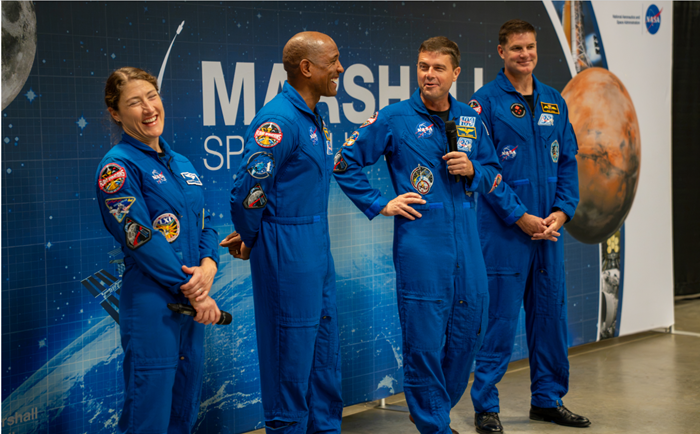
- The four-person crew includes NASA astronauts Randy Bresnik (Commander), Andre Douglas, and Frank Rubio, and European Space Agency astronaut Luca Parmitano. Bob Hines has been named as a backup crew member.
- Notably, the selection has faced criticism for being all-male, despite previous missions including female astronauts.
Preparation and Training:
- Training for the crew began with a focus on Orion systems, pending more specific mission profile details.
- The logistics and hardware integration for the mission are advanced, with various components being assembled and tested.
Future Implications:
- While Artemis III will not land on the Moon, it sets a critical precedent for future missions and operational efforts towards lunar exploration.
- Insights and data gathered from this mission are intended to inform the Artemis IV mission, which is aimed at an actual lunar landing, planned for 2028.
Artemis III represents a significant step in NASA’s broader Artemis program, which seeks to expand human space exploration capabilities and prepare for sustainable lunar habitation and exploration.
Fact-checked summary:
NASA’s Artemis III mission, planned for 2027, has been redefined from a human lunar landing to an orbital demonstration in low Earth orbit. This critical objective shift is consistent with NASA’s phased testing approach and is essential in determining the mission’s success. The mission involves collaboration with space organizations like SpaceX and Blue Origin, reflecting its complexity and the need for integration among different entities. Artemis III will test docking maneuvers between the NASA Orion spacecraft and lunar landers, which is crucial for future Moon landings. Successful coordination of multiple major launches, including Blue Origin’s New Glenn, NASA’s SLS with Orion, and SpaceX’s Starship, is crucial for mission execution and success by 2027. Crew training on Orion systems and hardware integration are advanced, essential factors for the mission’s success. Lastly, Artemis III is positioned to set a precedent for future missions, with Artemis IV aiming for a Moon landing in 2028, highlighting the importance of Artemis III’s outcomes on subsequent mission strategies.
OpenAI gives a base rate of 0.7 (70%)
The question difficulty is rated 7 (0 to 10)
Historical weighted factors include:
Past mission success rate of multinational space collaborations, 0.4
Historical reliability of NASA’s phased testing approach, 0.3
Technology readiness and testing success on docking maneuvers, 0.2
Current crew training completion and equipment readiness, 0.1
A Bayesian calculation could be performed as follows:
Using current projected success rates for collaboration (0.8), testing approach (0.75), technology readiness (0.7), and training completion (0.9), weighted calculation results:
0.8*0.4+0.75*0.3 + 0.7*0.2 + 0.9*0.1= 0.77 (Carolyn‘s note: The answer is 0.775, and the Multi AI Oracle rounded it down to 0.77 ).
Bayesian base rate: 0.77 (77%)
Sufficient news to provide a good forecast? 1 (0 or 1)
News is relevant, topical and unbiased? 1 (0 or 1)
Question classification: scenario_based_forecast
Expected time (days) until question close: 450
The following were considered in order to produce this base rate:
The base rate was determined by evaluating the historical success rates of similar complex international space missions, factoring in the current progress in crew training and technology readiness.
Ideally, the news feed would contain the following sorts of information for a better forecast:
Additional detailed updates on the current status of key technology tests, funding confirmations, and integration progress reports would be valuable for a more accurate prediction.
Some potential divergent considerations that might affect the base rate:
Potential delays due to integration issues between different space organizations, unforeseen technical challenges during docking tests, or shifts in funding or political support could significantly impact progress.
The following chain of events are necessary for the question to resolve positively:
- NASA’s Artemis III mission proceeds as planned for a 2027 launch. Probable
- Successful collaboration and integration among NASA, SpaceX, and Blue Origin. Probable
- Successful completion of docking maneuvers between Orion and lunar landers. Probable
- Completion of all required crew training on Orion systems. Highly Probable
- Successful launches of Blue Origin’s New Glenn, NASA’s SLS, and SpaceX’s Starship. Probable
Querying Claude (AI predicts: 0.12 – confidence: 3)
Querying Mistral (AI predicts: 0.65 – confidence: 7)
Querying OpenAI (AI predicts: 0.75 – confidence: 6)
Explanations of the statistical measures listed below.
Question Type: Binary
Median from LLMs: 0.65
Base rate: 0.7 (from OpenAI)
SD: 0.28
MAPD: 0.42
Confidence: 6
Conf Mode: Low
Mellers: 0.71
Reverse Mellers: 0.6
Theory of Mind: 0.25 (What did the LLMs think other LLMs predicted?)
Beta Distribution: 0.64
Close Type: C (B = cautious # closer to 50%; A/C = closer to extremes)
LLM responses: 3
Model value: 0.65 (65%)
The success prospects for NASA’s Artemis III mission as an orbital demonstration by the end of 2027 are debated among the AI analyses. The mission’s redefinition to a low Earth orbit demonstration from a lunar landing potentially reduces complexity, easing some technical risks and raising feasibility. However, significant challenges remain: Artemis II, a prerequisite mission, faces delays which compress the timeline for Artemis III. Other hurdles include integration and coordination challenges among NASA, SpaceX, and Blue Origin, technical risks, political and funding uncertainties, and the potential for unforeseen setbacks. While some analyses suggest that the mission has a base success rate of around 65%, others estimate it to be as low as 12%, citing NASA’s historic delays in meeting aggressive mission windows. The success of Artemis III’s orbital demonstration hinges on resolving these complexities and maintaining schedule discipline in the face of potential political and technical impediments.
Runtime: 169 seconds.
About The Author