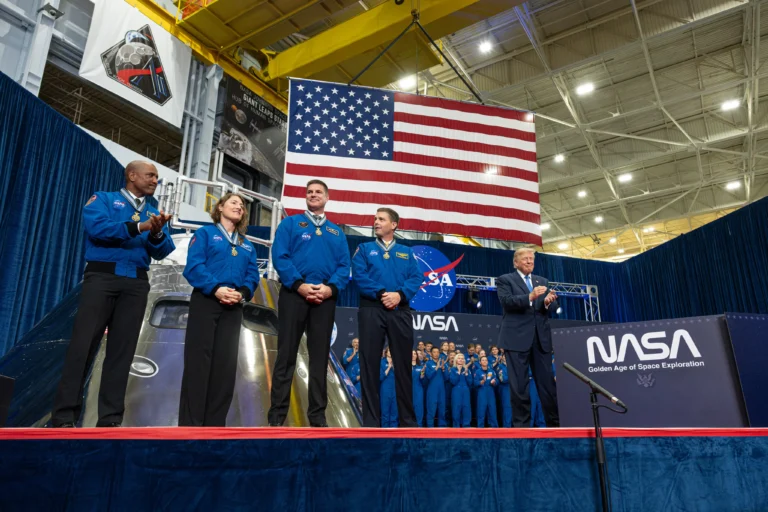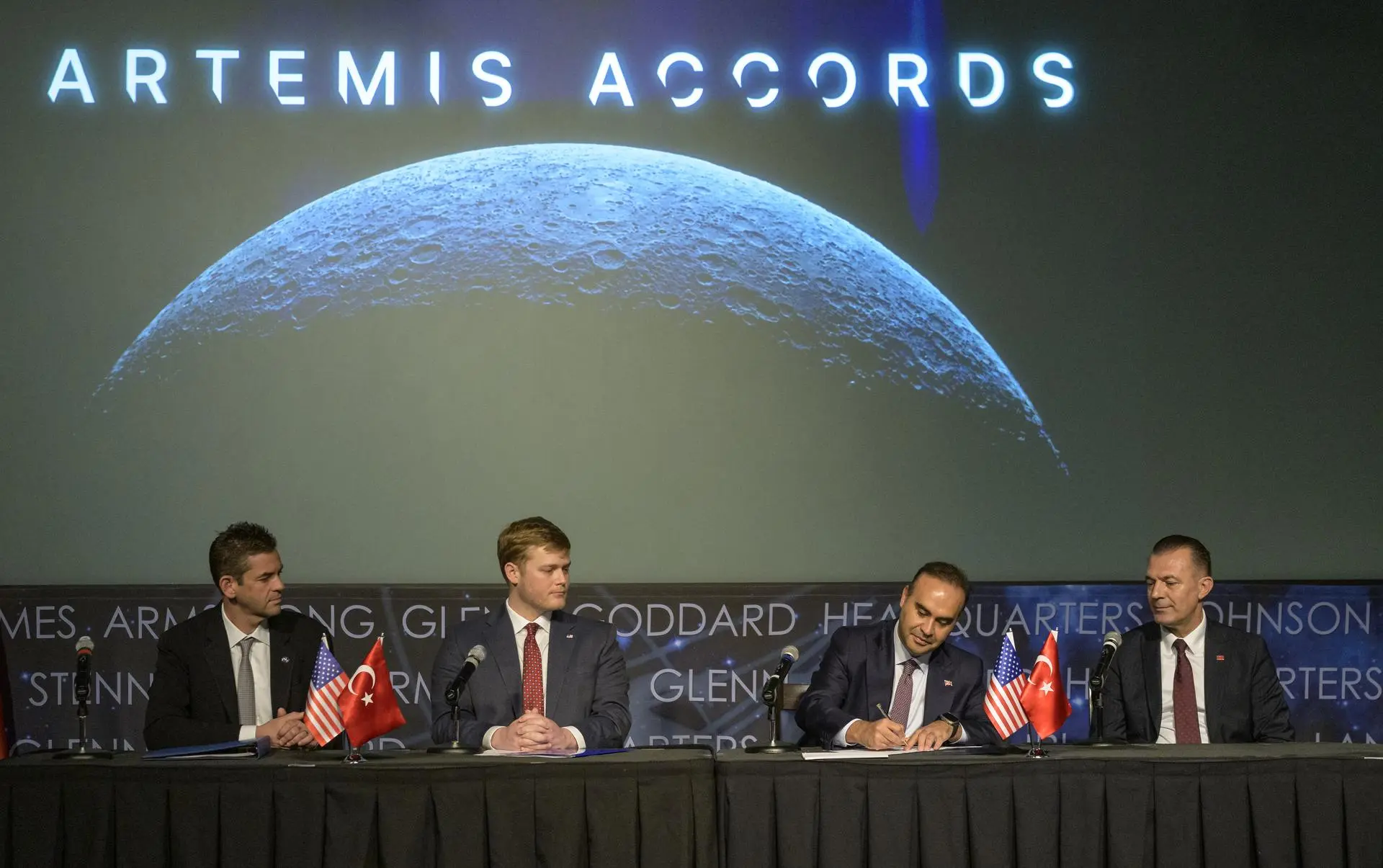
Turkish Minister of Industry and Technology, Mehmet Fatih Kacır, 3rd from left, signs the Artemis Accords for the Republic of Türkiye as NASA Administrator Jared Isaacman, left, U.S. Deputy Assistant Secretary of State for Space and Environment Connor Tomlinson, and Turkish Space Agency President, Yusuf Kıraç, right, look on, Monday, August 31, 2026, at the Mary W. Jackson NASA Headquarters building in Washington.NASA/Bill Ingalls. Source: https://www.nasa.gov/organizations/oiir/artemis-accords/nasa-welcomes-turkiye-as-newest-artemis-accords-signatory/
Grok response:
10 Citations
- Title: Moon to Mars | NASA’s Artemis Program
Description: Official NASA Artemis program overview page (resolution source).
Date: Page last updated August 17, 2026.
Summary: NASA describes Artemis III as a 2027 crewed demonstration mission in low Earth orbit to evaluate one or both commercial human landing systems from SpaceX and Blue Origin via rendezvous and docking tests with Orion. Artemis II successfully completed its crewed lunar flyby in April 2026. Artemis IV remains targeted for the first lunar landing in 2028.[1] - Title: NASA Marches Toward Artemis III Mission in 2027, Names Crew Members
Description: NASA news release announcing crew and mission details.
Date: June 9, 2026.
Summary: NASA named the four-person crew (Randy Bresnik commander, Luca Parmitano pilot, Andre Douglas and Frank Rubio specialists) for the 2027 LEO test. The mission involves sequential docking: Blue Origin pathfinder first (loiter up to weeks, ~2 days docked including possible crew entry), then SpaceX Starship pathfinder (~1 day connected). Hardware progress includes Orion docking system integration and SLS stacking planned for summer 2026.[2] - Title: NASA Joins Artemis III Orion Modules; Rocket Hardware Update
Description: NASA missions blog on spacecraft and rocket integration.
Date: August 5, 2026 (covering July 31 events).
Summary: Orion crew and service modules were joined on July 30, 2026, at Kennedy Space Center, with NASA stating progress is outpacing Artemis II timelines. SLS uses a non-propulsive spacer instead of ICPS; booster stacking began in early July, and all four RS-25 engines arrived by July 21. Reused Artemis II components accelerate the schedule.[3] - Title: NASA Starts Artemis III Engine Install; Boosters, Crew Training Advance
Description: NASA Artemis blog on latest hardware milestones.
Date: August 27, 2026.
Summary: Technicians began installing the four RS-25 engines into the SLS core stage on August 24, 2026, following engine section mating. Solid rocket booster stacking continued, and crew training advanced. NASA describes overall processing as accelerated compared to prior missions.[4] - Title: NASA says Artemis III mission on schedule as Blue Origin repairs launchpad
Description: Reuters interview with NASA Administrator Jared Isaacman at Farnborough Airshow.
Date: July 20, 2026.
Summary: Isaacman stated NASA is “still very much planning” for the 2027 timeline, with SLS and Orion “doing incredibly well.” He noted contingency plans if Blue Origin’s New Glenn faces further delays after the May explosion, expressing confidence they have a year to launch the lander test article. Some industry executives doubt lander readiness.[5] - Title: Artemis III – Wikipedia
Description: Comprehensive encyclopedia entry on the mission.
Date: September 6, 2026.
Summary: Mission planned NET June 2027 as a LEO demonstration (not lunar landing) with four astronauts on SLS/Orion testing docking with Blue Origin Blue Moon Mk2 and SpaceX Starship V3 pathfinders. SLS flies a non-propulsive spacer; Orion circularizes to ~230 nmi orbit. NASA OIG and analysts have flagged HLS schedule risks.[6] - Title: ‘Full steam ahead’: NASA ramps up prep for Artemis III astronaut launch in 2027
Description: Space.com report on Kennedy Space Center processing.
Date: July 15, 2026.
Summary: NASA is targeting mid-to-late 2027, with SLS core stage delivered April 2026, engines arriving, and stacking underway. Teams are running launch simulations. The article notes this as a dress rehearsal for 2028 landings using both commercial landers.[7] - Title: Put it in pencil: NASA’s Artemis III mission will launch no earlier than late 2027
Description: Ars Technica report on congressional testimony.
Date: April 28, 2026.
Summary: Isaacman told lawmakers SpaceX and Blue Origin indicated landers could be ready for late 2027 (later than initial mid-2027 target). The mission tests interoperability in Earth orbit ahead of 2028 landings. Details on orbit and SLS configuration were still under review at the time.[8] - Title: Starship’s Thirteenth Flight Test
Description: Official SpaceX recap of Starship V3 test.
Date: July 24, 2026 (flight date).
Summary: Second V3 flight succeeded in deploying 20 Starlink V3 satellites, in-space engine relight, and improved booster performance (though hard splashdown). This version underpins the Starship HLS pathfinder for Artemis III docking tests. Next flights aim for orbital capability and tower catch.[9] - Title: New Glenn Return to Flight
Description: Blue Origin CEO update on pad recovery.
Date: June 30, 2026.
Summary: After the May 28, 2026 explosion that destroyed a New Glenn and damaged LC-36, Blue Origin completed cleanup in 9 days and began reconstruction with a new hybrid CONOPS. CEO Dave Limp reiterated the goal of returning to flight by end of 2026 to support Artemis III lander launch. Investigation into the BE-4 valve issue continues.[10]
Detailed Rundown of Relevant News and Data
The resolution source (NASA’s Artemis page, last updated August 17, 2026) confirms Artemis III as a 2027 crewed low-Earth-orbit demonstration to test rendezvous and docking of Orion (launched on SLS) with one or both commercial HLS test articles from SpaceX (Starship V3 pathfinder) and Blue Origin (Blue Moon Mark 2 pathfinder). Success requires completing the mission (launch, operations including dockings, and safe crew return) by December 31, 2027. Artemis II flew successfully in April 2026 (crewed lunar flyby). No official launch date has been set beyond “2027” or “mid-to-late 2027,” with Wikipedia listing NET June 2027 as of September 6, 2026. Initial February 2026 plans targeted mid-2027; vendor feedback in April shifted it toward late 2027. NASA Administrator Jared Isaacman has repeatedly expressed high confidence in the 2027 window as recently as July 20, 2026, while noting the 2028 lunar landing (Artemis IV) remains the priority.[1]
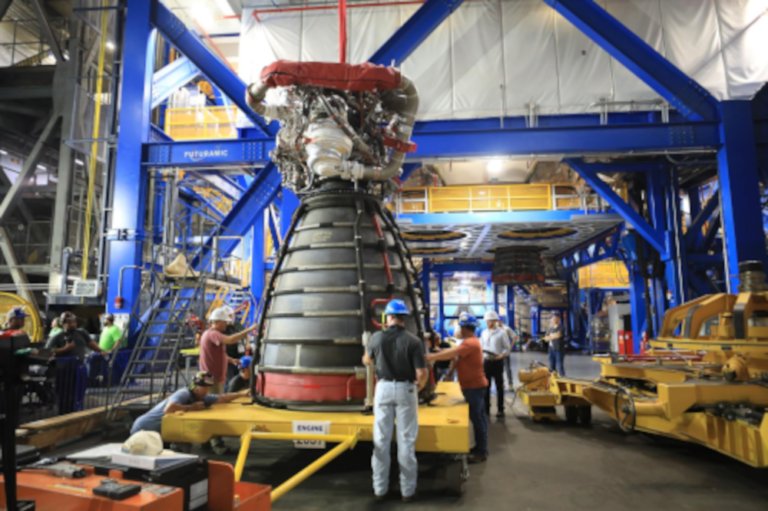
NASA-controlled hardware (SLS and Orion) shows strong recent progress and is described as outpacing Artemis II timelines. Key 2026 milestones include: SLS core stage arrival at Kennedy in late April; booster stacking starting early July; all four RS-25 engines delivered by July 21 and installation beginning August 24; Orion crew and service modules joined July 30; heat shield work and docking system integration advancing; spacer (non-propulsive upper stage stand-in) fabrication underway at Marshall. Crew training (including suited simulations in Orion mockups) is ongoing. NASA blogs through late August 2026 emphasize “full steam ahead” and accelerated processing, with reused Artemis II components saving months. This reduces some historical SLS/Orion delay risks seen in Artemis I and II (leaks, rollbacks). The mission uses a ~230 nmi circular LEO (Orion’s ESM circularizes after SLS insertion), avoiding translunar injection to simplify windows for the three-launch campaign.[3]
Commercial lander test articles introduce the primary schedule risk. NASA plans sequential operations: Blue Origin pathfinder launches first (capable of weeks-long loiter, ~2 days docked with possible crew entry and suit tests), followed by SpaceX Starship pathfinder (~1 day docked, crew remains in Orion). Both are uncrewed pathfinders missing full lunar systems. SpaceX Starship V3 (the HLS basis) has flown twice in 2026 (May and July 24), achieving satellite deployment, in-space relight, and improved performance; orbital flights and tower catches are next. Blue Origin’s New Glenn (needed to launch their pathfinder) suffered a May 28, 2026 pad explosion that destroyed a vehicle and damaged LC-36. Blue Origin completed debris clearance in 9 days, started reconstruction with a new hybrid CONOPS, and as of June 30, 2026, still targeted return-to-flight by end of 2026. NASA has contingencies (proceed with one provider or delays) and stated in July that Blue Origin has a year. A March 2026 NASA OIG report and CSIS analysis flagged ongoing HLS delays, technical challenges, and crew safety risks that could impact 2027/2028 dates. Some industry executives have expressed skepticism about lander readiness.[5]
Recent updates (through early September 2026) show no announced slips and continued hardware momentum, indicating movement toward a 2027 attempt. However, first-time crewed Orion docking, coordination of three heavy-lift launches in a short window, and lander readiness (especially Blue Origin pad recovery) remain execution risks. Historical Artemis delays (Artemis II slipped multiple times) and the compressed post-Artemis II cadence (aiming for annual missions) add uncertainty. Expert views diverge: NASA leadership (Isaacman) is “extremely confident”; independent analysts note the timeline is aggressive given HLS development status. No prediction markets or betting odds were identified in searches. If landers are not ready, NASA could fly a reduced demonstration (one provider) or delay, but official messaging remains 2027. The mission is a risk-reduction step explicitly added to support 2028 landings.
Extracted resolution criteria links:
[‘https://www.nasa.gov/humans-in-space/artemis/‘]
=== Forecast Result ===
=== Reasoning ===
The strongest evidence is mixed. NASA’s own hardware is making meaningful progress: Artemis II has completed successfully, Orion modules are joined, SLS stacking and engine installation are underway, and the LEO profile is materially simpler than a lunar landing. The mission has also been deliberately re-scoped so that either one or both commercial landers can potentially satisfy the demonstration objectiv
However, the schedule remains highly compressed. SpaceX’s Starship has not yet demonstrated a full orbital mission, while Blue Origin must recover from the New Glenn pad failure and mature its own lander pathfinder. Even if one provider is ready, NASA must complete launch preparations, crew training, rendezvous and docking validation, and safe crew return within a narrow late-2027 window. NASA’s public confidence is useful evidence of intent, but not strong evidence that the technical schedule will hold.
My rough timeline distribution is:
- Completion by mid-2027: low, because the current schedule has already drifted toward late 2027.
- Completion during the second half of 2027: the central case, but with substantial delay risk.
- Completion by the end of 2027: somewhat below even odds.
- Completion during 2028 or later, conditional on eventual continuation: more likely than completion by the end of 2027.
The main assumptions that could change the forecast are:
- SLS/Orion and launch-site processing stay sufficiently close to schedule. I assign about a one-in-three chance that a hardware, certification, or processing issue causes a slip beyond 2027.
- At least one commercial lander pathfinder becomes ready for crewed Orion rendezvous and docking. I assign roughly a two-in-five chance that neither provider reaches the required readiness in time. The “one or both” formulation materially reduces this risk, but does not eliminate it.
- The first integrated crewed docking mission proceeds without a safety-driven cancellation or major anomaly. Conditional on launch and lander readiness, I assign about a one-in-five chance of failure or deferral from this factor.
These risks are not independent, and the commercial-readiness risk is the dominant one. The simplified mission design and NASA’s ability to use only one provider prevent the probability from being very low, but the lack of a successful orbital Starship demonstration and Blue Origin’s launch-system setback make a probability above one-half too optimistic. I estimate the chance of successful completion by the resolution date at about two-fifths.
Data sufficiency: Sufficient
Probability: 42%
About The Author