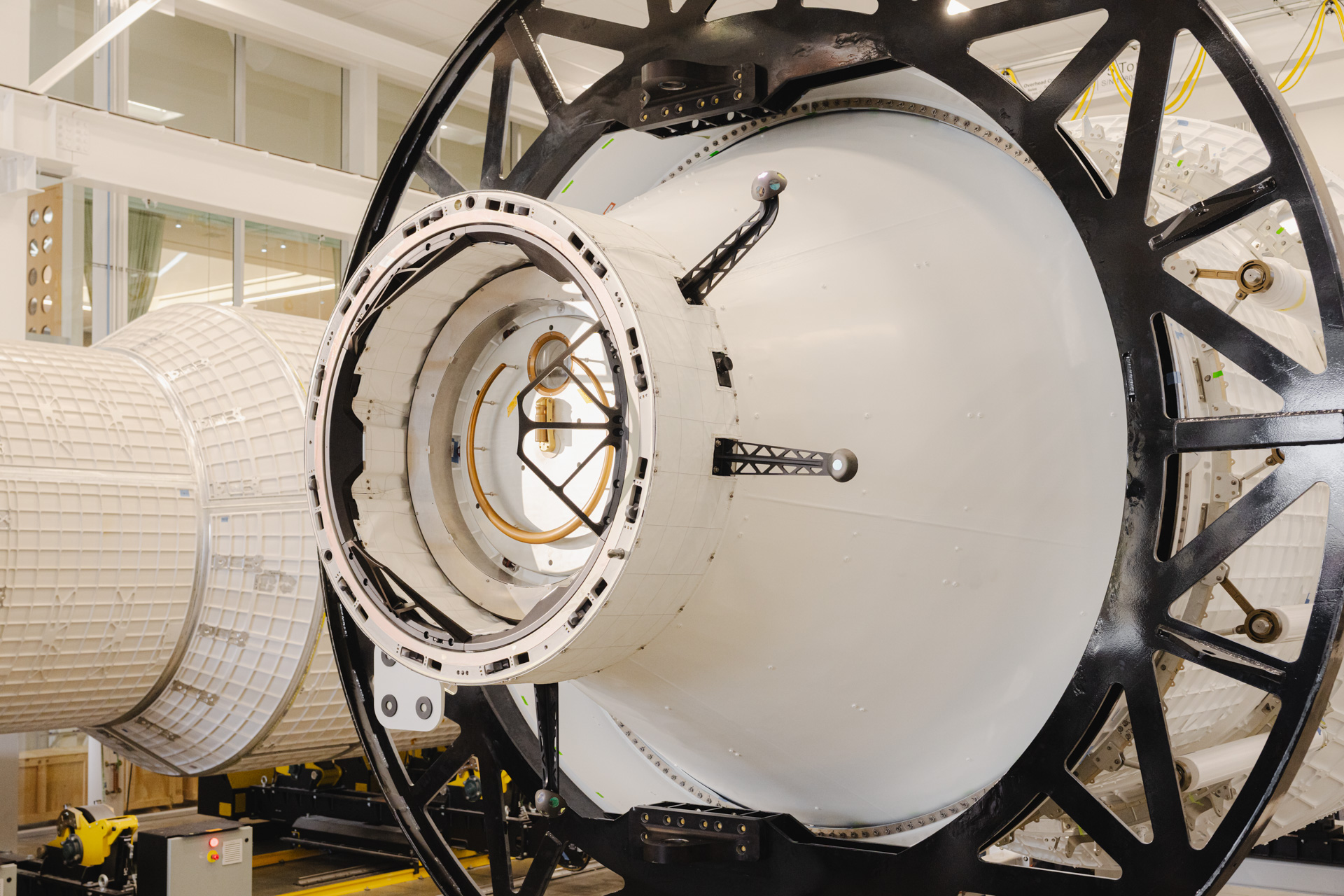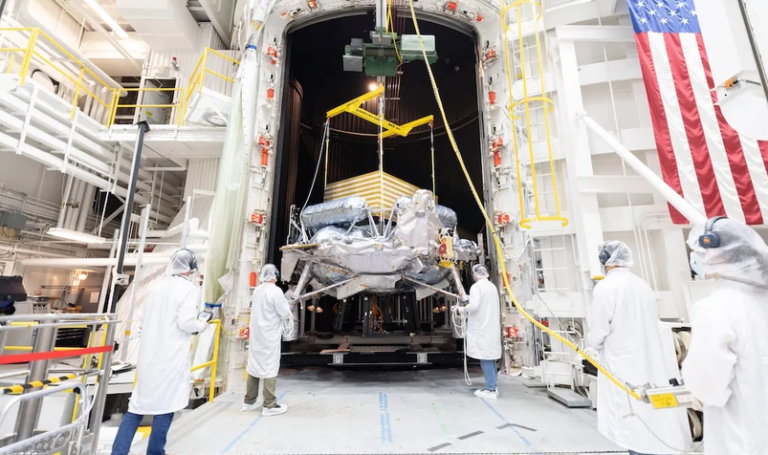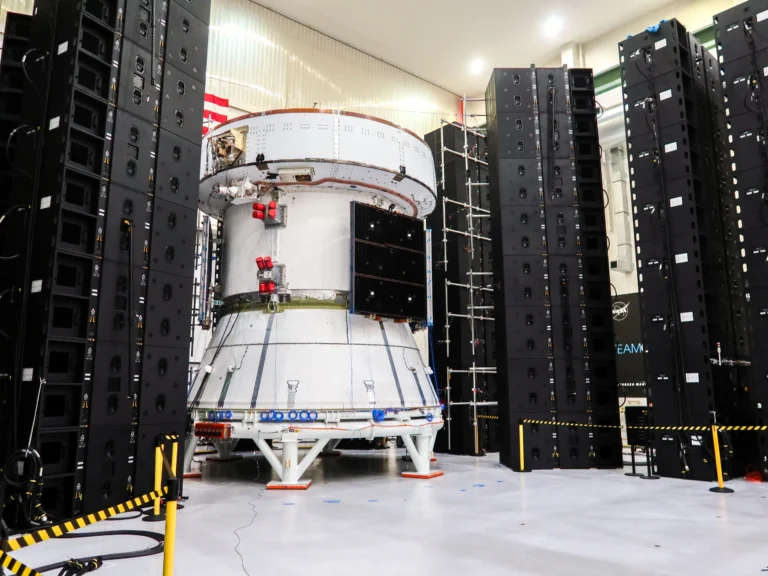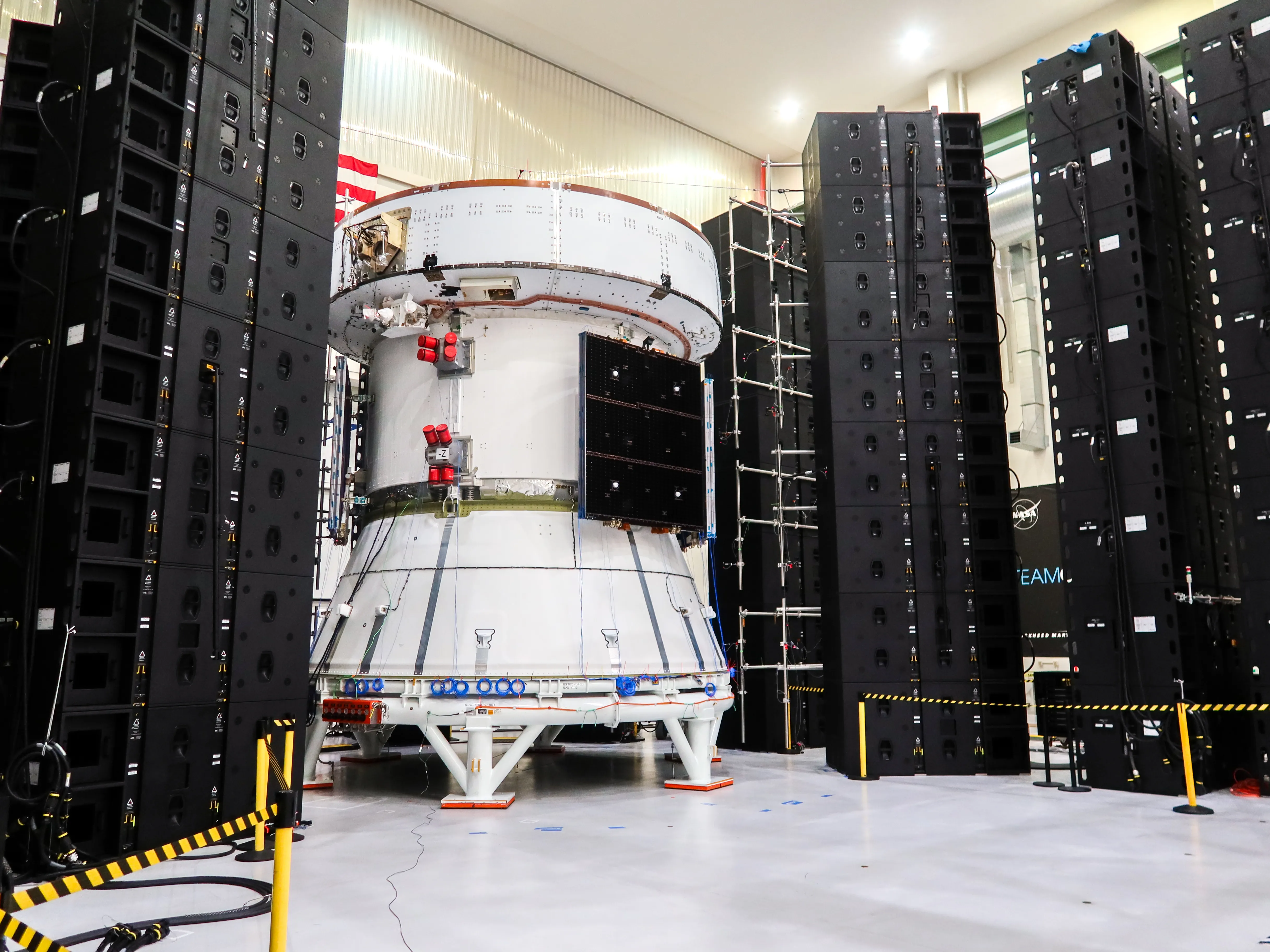
Photo: The Artemis III Orion service module is pictured ahead of acoustic testing in NASA’s Kennedy Space Center Operations and Checkout Facility on May 7, 2026. NASA/Jess Ruffa. Source: https://www.nasa.gov/missions/artemis/artemis-3/nasa-outlines-preliminary-artemis-iii-mission-plans/
DeepSeek research response:
Scope and approach
I focused on the resolution source, NASA’s current Artemis III mission design, the NASA-controlled SLS/Orion critical path, both commercial lander/launch-vehicle paths, and the latest oversight findings. The key distinction is that Artemis III is now a low-Earth-orbit test-article docking demonstration, not a lunar landing, and the resolution language allows one or both landers.
Citations
“NASA’s Artemis III Mission to Test Future Moon Lander Operations” — NASA, Oct. 22, 2026 (updated Oct. 23, 2026)
https://www.nasa.gov/missions/artemis/nasas-artemis-iii-mission-to-test-future-moon-lander-operations/
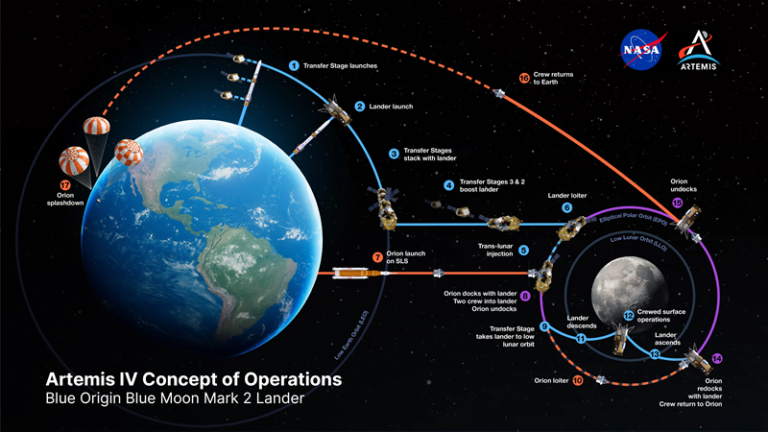
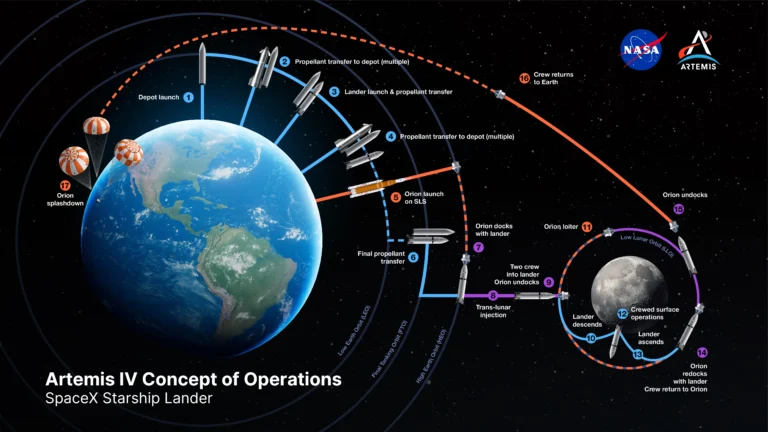
NASA says Artemis III will launch in 2027 for a roughly 14-day LEO demonstration, with Orion docking first to a Blue Origin Blue Moon Mk2 test article and later to a SpaceX Starship V3 test article. Blue Origin launches first and can loiter up to 30 days; Orion launches on SLS days later, and Starship launches later because of its shorter on-orbit life. The mission requires three heavy-lift launches and two dockings, with crew entering Blue Moon but not Starship, before Orion splashes down in the Pacific.
“NASA keeps summer target for Artemis III, 2028 for Artemis IV moon landing” — Orlando Sentinel, Oct. 23, 2026
https://www.orlandosentinel.com/2026/10/23/nasa-keeps-summer-target-for-artemis-iii-2028-for-artemis-iv-moon-landing/
Isaacman said Artemis III remains on target for summer 2027 despite “so many uncertain pieces,” and that the pathway to a 2028 Artemis IV landing is achievable. The article notes Blue Origin must repair LC-36 after the May 28 New Glenn explosion and says the company still aims to be launch-ready by end-2026. It also reports that Isaacman had earlier said in an internal memo that Artemis III was about 90 days behind schedule, driven by lander supply chains.
“NASA gives update to Artemis III mission” — Spectrum News, Oct. 23, 2026
https://spectrumlocalnews.com/us/snplus/space/2026/10/23/nasa-gives-update-to-artemis-iii-mission
Isaacman said NASA is working toward “a year-end tanking test and a summer 2027 Artemis III launch” and that the workforce had cut the assembly and integration schedule in half. Jeremy Parsons said the crew will enter Blue Moon for tests but will not enter Starship. NASA has not chosen which lander will carry the first Artemis IV crew.
“Artemis 3 Launch Date and NASA’s 2028 Moon Landing Plan” — ShiftDelete, Oct. 30, 2026
https://shiftdelete.net/en/artemis-3-launch-date
The article says NASA targeted summer 2027 at the Oct. 23 briefing, with no exact date because three launches must line up within days. It reports Starship reached orbit for the first time in September 2026 and that SpaceX has not yet demonstrated large-scale orbital refueling. It also notes Artemis IV is planned for early 2028 and that NASA has not chosen which lander will carry the first crew.
Official schedule
- Current public target: summer 2027, per NASA’s Oct. 23, 2026 Kennedy Space Center briefing.
- No exact launch date has been announced because the mission requires three heavy-lift launches—Blue Origin New Glenn/Blue Moon, NASA SLS/Orion, and SpaceX Starship—to line up within days.
- Mission duration: about 14 days, extendable to roughly 17 days.
- Practical resolution deadline: for a 14-day mission to finish by Dec. 31, 2027, launch would need to occur around Dec. 17, 2027 or earlier; a 17-day mission would need to launch around Dec. 14 or earlier.
- Schedule margin: NASA’s summer 2027 target gives roughly five to six months of buffer to the end of 2027. NASA has also acknowledged Artemis III was about 90 days behind schedule earlier in 2026; a 90-day slip from summer would still fall inside 2027, but further slippage into December would be problematic.
NASA-controlled critical path: SLS and Orion
- Artemis II succeeded in April 2026, flying four astronauts around the Moon for nearly 10 days and traveling 252,756 miles from Earth. That was the first crewed SLS/Orion flight and a major de-risking event.
- Artemis III Orion: crew and service modules were joined July 30, 2026; the spacecraft is in integrated testing. The Orion docking system will fly for the first time on Artemis III.
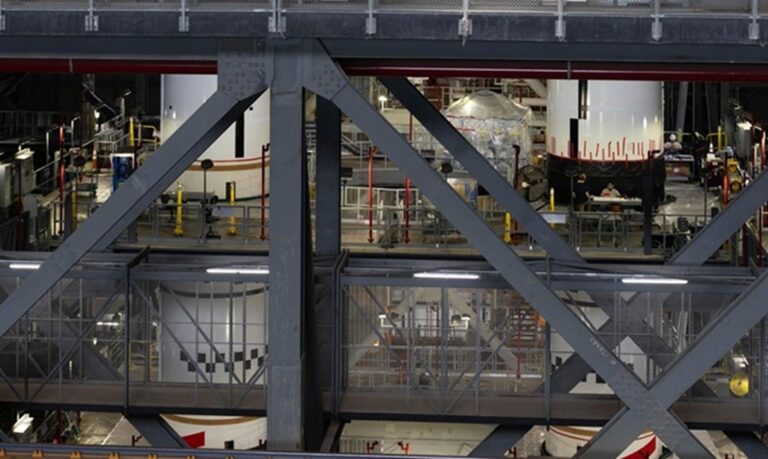
- Artemis III SLS: core stage arrived at Kennedy Space Center April 28, 2026; solid rocket booster stacking began in summer; all four RS-25 engines were being installed in August. NASA is using a non-propulsive spacer instead of the ICPS upper stage because the mission stays in LEO.
- Next major NASA gate: a year-end 2026 tanking test of the Artemis III SLS stack. Isaacman has pointed to this as the key near-term milestone before a summer 2027 launch.
- Positive signal: NASA officials say assembly and integration have been accelerated, and Isaacman has publicly said NASA does not intend to be the reason Artemis III slips.
Blue Origin: the largest launch-vehicle uncertainty
- New Glenn explosion: on May 28, 2026, a New Glenn rocket exploded during a static-fire test at LC-36, destroying the transporter-erector and damaging the pad. Blue Origin says propellant tanks, the water tower, and the main support tower survived; it is rebuilding and aiming to return to flight by the end of 2026.
- Blue Moon Mk2 test article: NASA’s Artemis III plan uses a Blue Moon Mk2 test article launched on New Glenn. Reporting indicates the Artemis III article is a crew-cabin/avionics/software/life-support prototype rather than a full lunar propulsion stack, which lowers technical scope but does not remove the launch-vehicle dependency.
- Blue Origin manifest pressure: Blue Origin also plans an uncrewed Blue Moon Mk1 “Endurance” landing in early 2027 and a second Mk1 with NASA’s VIPER rover later in 2027. A single repaired pad and a crowded manifest create bottleneck risk.
- Mitigation: NASA has studied decoupling Blue Moon from New Glenn and using an alternative heavy-lift rocket, with Vulcan and Falcon Heavy mentioned. That could preserve the lander path, but re-integration on a new rocket is not instantaneous.
SpaceX: lower technical scope for this specific test, but still new operational territory
- Starship V3 test article: NASA plans a Starship V3 test article with an added forward docking system. The crew will not enter Starship; the docking test is expected to last up to about two hours.
- No orbital refueling required for this Artemis III test article. That is a major risk reduction compared with the original lunar-landing plan, which depended on cryogenic propellant transfer.
- Recent progress: Starship reportedly reached orbit for the first time in September 2026; SpaceX is moving toward further V3 flights and is completing the LC-39A tower in Florida.
- Remaining risk: Orion-Starship rendezvous and docking is new, and the V3 test article must be ready on the same tight campaign timeline as SLS and New Glenn.
Official NASA Plan
The current plan is consistent with a Yes resolution: a 2027 LEO demonstration, summer 2027 target, and a resolution window extending to Dec. 31, 2027. The main swing factors are whether the year-end 2026 SLS tanking test stays on track, whether New Glenn returns to flight and supports a Blue Moon test article in 2027, and whether Starship V3 and its docking adapter are ready for the tightly sequenced three-launch campaign. The “one or both” provision is a meaningful hedge, but the campaign still has little margin for a launch slip into late December 2027.
Extracted resolution criteria links:
[‘https://www.nasa.gov/humans-in-space/artemis/‘]
=== Forecast Result ===
=== Reasoning ===
Positive factors
- NASA’s late-October/November updates show physical progress: the SLS core stage has joined its boosters, Orion is undergoing integration and testing, and a crew is assigned. These are stronger indicators than an announced mission date alone.
- Artemis II’s reported April 2026 success de-risks SLS and Orion, although Artemis III introduces docking equipment and new operations.
- The simplified mission avoids lunar landing and orbital-refueling requirements. Consequently, the March oversight reports about full lunar-lander development deserve less weight than current, mission-specific evidence.
- A summer launch target provides several months of potential slippage before the resolution deadline.
Negative factors
- Neither commercial docking demonstration is already proven. Readiness includes flight software, docking interfaces, safety approval, and integrated operational testing—not just producing a vehicle.
- Blue Origin faces launch-pad recovery and manifest pressure, while Starship has only recently demonstrated orbital flight according to the supplied reporting.
- First-of-kind spaceflight programs frequently miss announced schedules. Accelerated assembly does not eliminate downstream testing discoveries.
- For the planned two-week mission, launch would ordinarily need to occur by approximately mid-December to finish within 2027.
For a transparent calculation, conditional on NASA readiness, I assign:
- Both commercial options ready: 40%
- Exactly one ready: 40%
- Neither ready: 20%
Allowing an 85% chance of proceeding when only one is ready gives an acceptable commercial configuration probability of:
[
0.40 + 0.40(0.85)=0.74. (Carolyn‘s note: Error in the left hand side of this equation. The operator (examples: *,+, /) between 0.40 and (0.85) is missing. Also, either the parentheses around 0.85 are redundant or else one or more elements of its contents are missing.)
]
Combining that with 75% NASA readiness (Carolyn‘s note, according to the above, this should be 74%) and 92% conditional operational success produces:
[
0.75 \times 0.74 \times 0.92 \approx 0.511.
]
The operational-success allowance covers remaining launch, rendezvous, docking, and return risks. The dominant downside remains a slip into 2028, not necessarily permanent mission failure.
Timing cross-check
My cumulative estimates are:
| Successful completion by | Probability |
|---|---|
| June 30, 2027 | 10% |
| September 30, 2027 | 30% |
| December 31, 2028 | 80% |
The timing distribution is not uniform: most near-term probability is concentrated around the announced summer window and subsequent recovery opportunities. Substantial probability lies beyond the question’s deadline.
Data sufficiency: Sufficient
Probability: 51%
End
About The Author