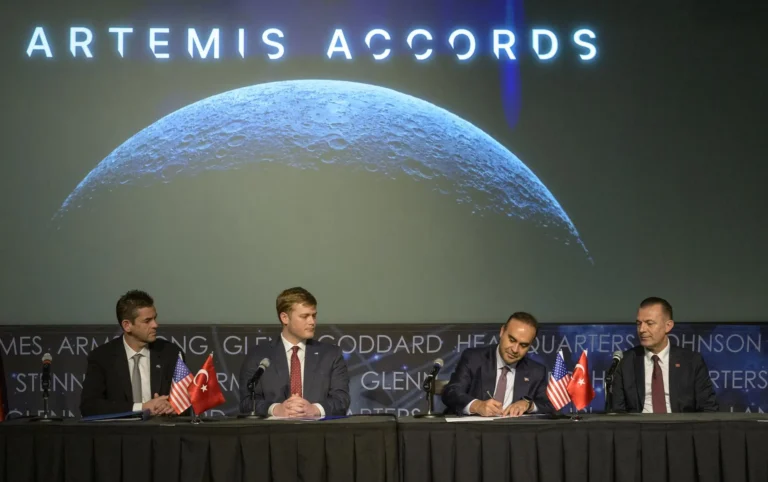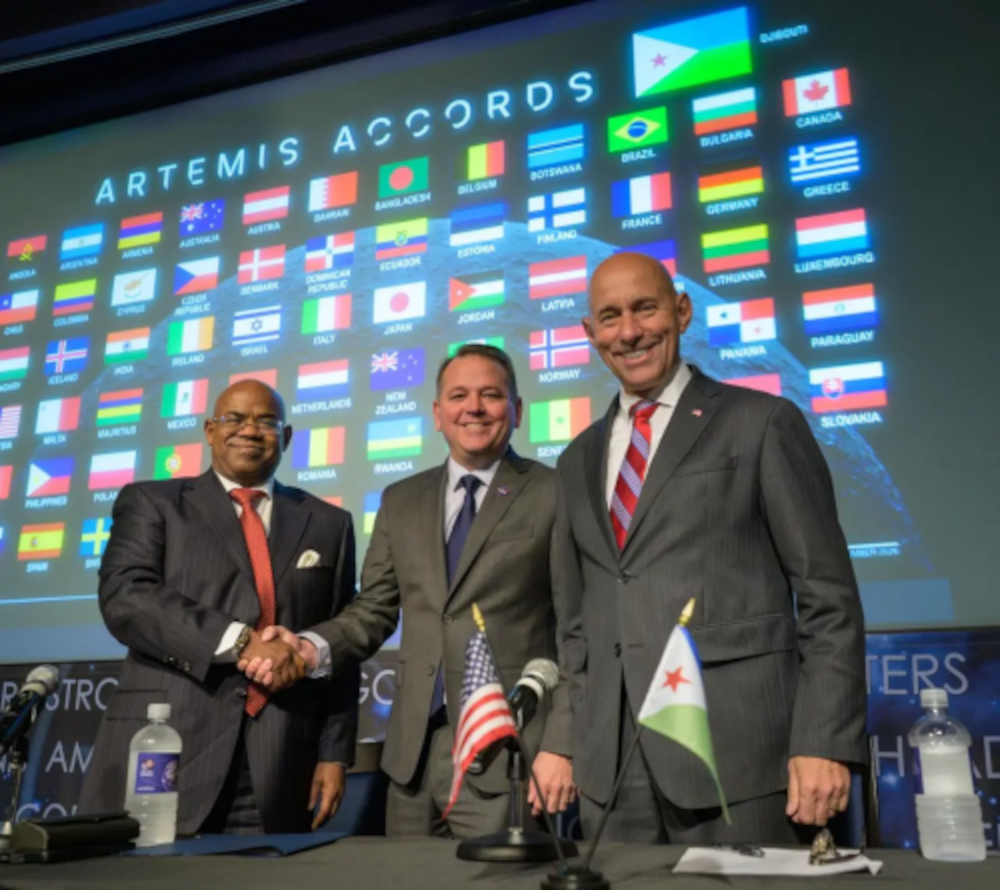
NASA Welcomes Djibouti as Newest Artemis Accords Signatory. NASA Deputy Administrator Matt Anderson, center, Ambassador of Djibouti to the United States, Mohamed Siad Douale, left, and Assistant Secretary of State for African Affairs, Frank Garcia, right, pose for a group photograph after the Artemis Accord signing, Monday, September 14, 2026, at the Mary W. Jackson NASA Headquarters building in Washington. NASA/Bill Ingalls. Source: https://www.nasa.gov/organizations/oiir/artemis-accords/nasa-welcomes-djibouti-as-newest-artemis-accords-signatory/
Obtaining outside data.
Checking internet sources, using keywords: Artemis III orbital demonstration 2027
News from various sources:
The content discusses several key updates and details about NASA’s Artemis III mission, slated for launch as early as June 2027 from Kennedy Space Center. Artemis III will be a significant mission intended to demonstrate docking procedures with lunar landers in low Earth orbit before attempting a crewed lunar landing in subsequent missions.
Key points include:
Launch Details: Artemis III involves three separate launches to get all components into low Earth orbit:
- Blue Origin’s New Glenn will launch a test version of the Blue Moon Mark 2 lander.
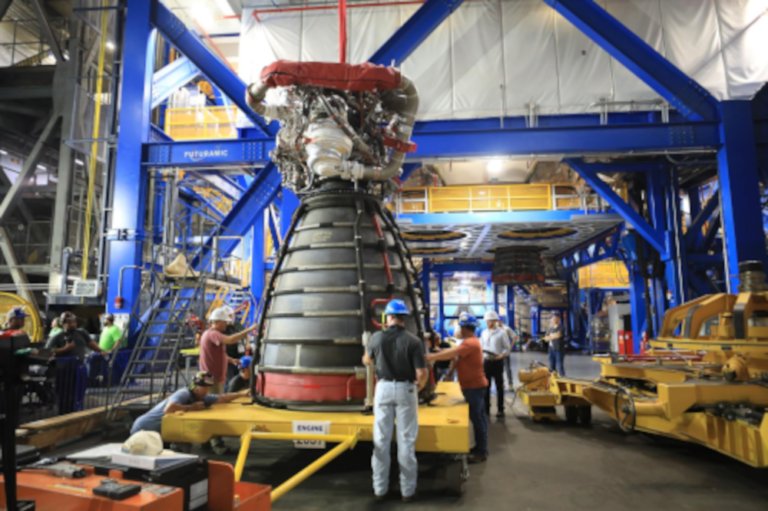
- NASA’s Space Launch System (SLS) will launch the Orion spacecraft with a four-person crew.
- SpaceX’s Starship will launch separately and dock with Orion.
Mission Focus: Unlike initially planned, Artemis III will not include a lunar landing. Instead, it will serve as a testing ground for docking processes between Orion and the lunar landers from SpaceX and Blue Origin, a critical step before attempting lunar landings with Artemis IV, now targeted for no earlier than 2028.
Development Challenges: Key components such as SpaceX’s Starship and Blue Origin’s lander face significant developmental and testing milestones. There are risks concerning schedules due to Blue Origin’s New Glenn launchpad recovery after a recent explosion and the readiness of these landers for docking procedures.
Strategic Changes: The mission has been restructured due to the risks associated with attempting an initial lunar landing without providing for contingencies during docking operations. NASA opted for a lower-risk sequence of operations in LEO, allowing for better recovery options and providing a critical demonstration of the new technology before committing to a lunar trajectory.
Future Implications: Successful completion of Artemis III will validate the complexities involved in docking and interoperability of different spacecraft, essential for the lunar missions planned with Artemis IV and beyond.
Preparations and Testing: The SLS rocket components are being assembled at Kennedy Space Center, and other mission elements are undergoing rigorous testing processes to ensure readiness.
Long-Term Goals: Ultimately, the Artemis program aims to establish a sustainable lunar presence, with Artemis III set as a foundational mission to validate the necessary technologies and strategies.
Additional events and announcements related to NASA were also mentioned, such as the upcoming Max Power air and space expo, funded by private sponsors, to be held in November 2026, aimed at promoting space technology and public engagement.
Fact-checked summary:
Artemis III is scheduled for launch no earlier than June 2027 from Kennedy Space Center, though this timeline needs external confirmation. The mission will involve three separate launches: NASA’s SLS for the Orion spacecraft, Blue Origin’s New Glenn for a test version of the Blue Moon Mark 2 lander, and SpaceX’s Starship to dock with Orion. This complexity is critical to mission success. Despite being critical, the mission is not intended to include a lunar landing, focusing instead on testing docking processes. Development challenges exist, notably with SpaceX’s Starship and Blue Origin’s lander, impacting the mission’s timeline. The mission’s restructuring to reduce lunar landing risks increases its chances of success by making the operations lower-risk. Artemis III will validate docking complexities needed for future missions like Artemis IV, essential for broader program objectives but not solely critical for a successful 2027 outcome. The assembly of SLS components and testing at Kennedy Space Center are ongoing and crucial for mission preparation. The Artemis program’s long-term goal is establishing a sustainable lunar presence, with Artemis III laying foundational work.
OpenAI gives a base rate of 0.6 (60%)
The question difficulty is rated 8 (0 to 10)
A Bayesian calculation could be performed as follows:
To calculate Bayesian probability, I start with the base rate of a successful NASA mission given historical success. Then adjust upwards or downwards based on the historical factors weighted averages (NASA = 8, Private = 6, Complexity = 4) along with development news affecting Orion, Starship, and Blue Origin vehicles.
Bayesian base rate: 0.65 (65%)
Sufficient news to provide a good forecast? 1 (0 or 1)
News is relevant, topical and unbiased? 1 (0 or 1)
Question classification: scenario_based_forecast
Expected time (days) until question close: 288
The following were considered in order to produce this base rate:
The base rate is derived from analyzing the historical success rates of NASA missions, which are generally high. However, incorporating the complexities and challenges associated with integrating various private company technologies reduces this likelihood slightly. Scheduled testing and developments in 2026 support a favorable but cautious outlook.
Ideally, the news feed would contain the following sorts of information for a better forecast:
Additional information such as specific technical challenges currently being addressed, more detailed timelines, and internal NASA and partner company assessments would enhance the forecast quality.
Some potential divergent considerations that might affect the base rate:
Potential delays or technical failures in any of the three coordinated launches, improvements in SLS testing, or expedited resolution of spaceship development challenges could alter the resolution. External factors like budget changes or policy redirection could also impact success.
The following chain of events are necessary for the question to resolve positively:
- Successful launch of NASA’s SLS for the Orion spacecraft. High likelihood
- Successful launch of Blue Origin’s New Glenn for a test version of the Blue Moon Mark 2 lander. Moderate likelihood
- Successful launch of SpaceX’s Starship and docking with Orion. Moderate likelihood
- Successful assembly and testing of SLS components at Kennedy Space Center. High likelihood
- Resolution of development challenges with SpaceX’s Starship and Blue Origin’s lander. Moderate likelihood
Querying Claude (AI predicts: 0.08 – confidence: 4)
Querying OpenAI (AI predicts: 0.65 – confidence: 6)
Guide to Jeremy Lichtman’s Multi-AI Oracle Reports
Question Type: Binary
Median from LLMs: 0.37
Base rate: 0.6 (from OpenAI)
SD: 0.29
MAPD: 0
Confidence: 5
Conf Mode: Low
Mellers: 0.31
Reverse Mellers: 0.41
Theory of Mind: 0.375 (What did the LLMs think other LLMs predicted?)
Beta Distribution: 0.87
Close Type: C (B = cautious # closer to 50%; A/C = closer to extremes)
LLM responses: 2
Model value: 0.37 (37%)
The success of the Artemis III orbital demonstration mission by the end of 2027 faces numerous challenges, primarily due to its complexity and tight timeline. The mission involves three coordinated launches from NASA’s SLS/Orion, Blue Origin’s New Glenn, and SpaceX’s Starship, with significant probability and development hurdles across these platforms. Historical delays within the Artemis program, ongoing development issues with New Glenn and Starship, and bureaucratic and budgetary constraints all contribute to skepticism about meeting the December 2027 deadline. However, the mission’s focus on an orbital demonstration rather than a full lunar landing partially mitigates the risk, potentially increasing success likelihood. Despite these considerations, the chances remain low due to compounded technical, logistical, and scheduling challenges.
Runtime: 91 seconds.
About The Author