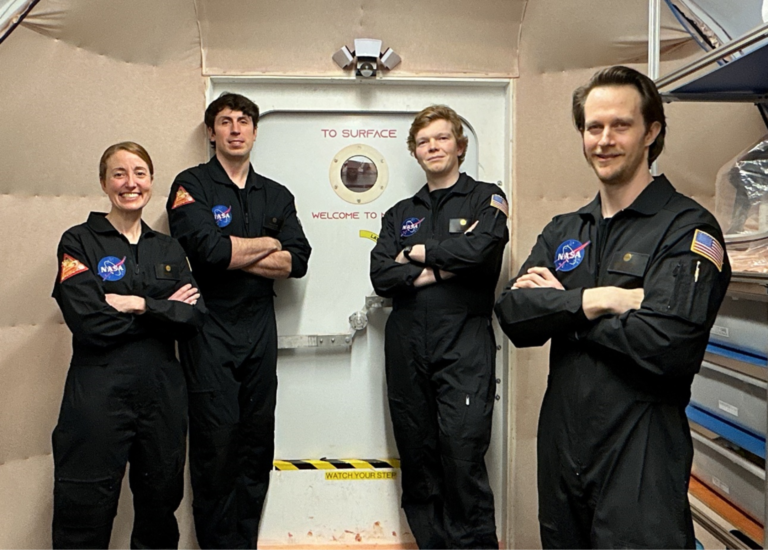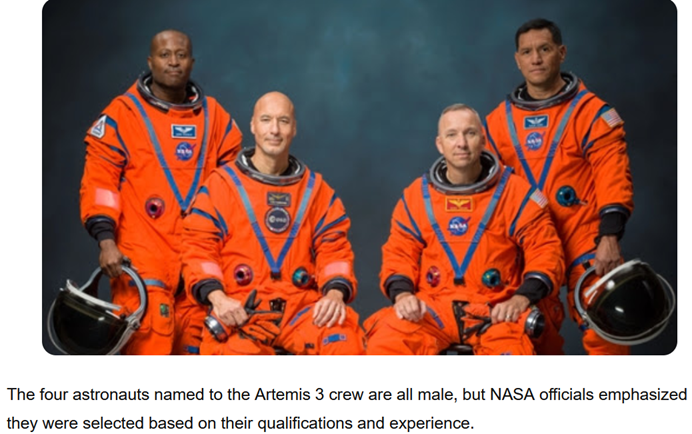
Artemis III Crew
Obtaining outside data.
Checking internet sources, using keywords: Artemis III orbital demonstration 2027
News from various sources:
Artemis III, originally planned as a lunar landing mission, is now scheduled for late 2027 as an orbital demonstration focused on preparing for future Moon missions under NASA’s Artemis program. This mission will not land on the Moon but instead will serve as a rehearsal to test and validate critical systems necessary for lunar landings. The key focus will be on low-Earth orbit tests like spacecraft docking with landers being developed by partners including SpaceX and Blue Origin.
Key highlights of the mission include:
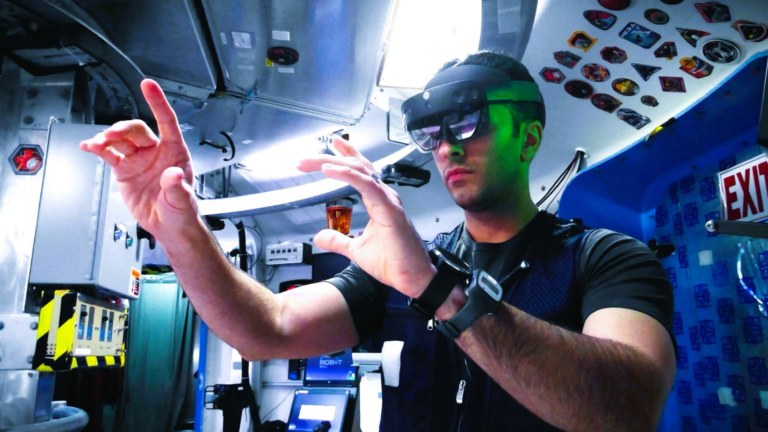
- Development and Crew: The Artemis III mission involves four astronauts, including Randy Bresnik from NASA, Luca Parmitano from the European Space Agency, and mission specialists Frank Rubio and Andre Douglas. They will conduct a two-week-long mission aboard the Orion spacecraft.
- Mission Objectives: The mission aims to test spacecraft systems, conduct docking operations, and validate new spacesuits. It will involve rendezvousing and docking with versions of lunar landers by SpaceX and Blue Origin.
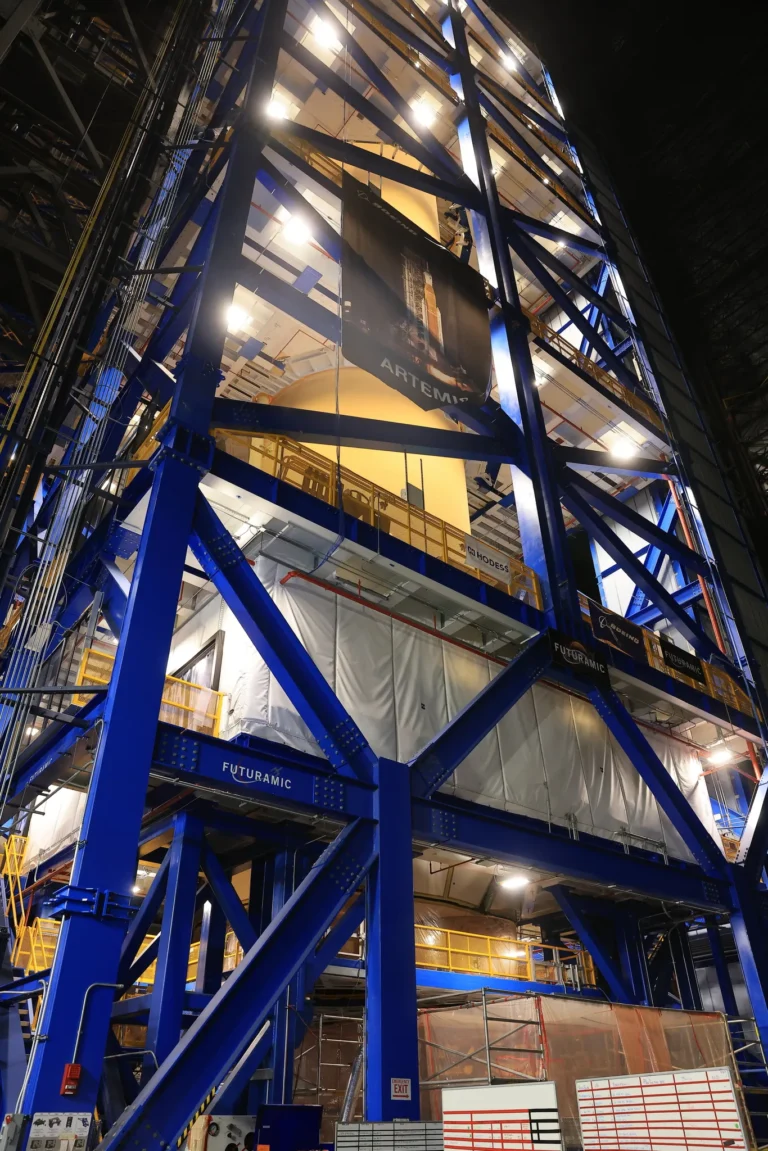
- Equipment and Technology: The crew will launch using NASA’s Space Launch System (SLS) without its usual upper stage, instead using a “spacer” for testing purposes. The mission will test an enhanced heat shield on Orion and explore interfaces for future lunar spacesuits.
- Collaborations and Risk Management: The mission marks a significant collaboration among NASA, international partners, and commercial space companies, aiming to reduce the risk before attempting crewed Moon landings. The dual focus on SpaceX’s Starship and Blue Origin’s lander includes both system testing and crew transfer exercises.
- Strategic Importance: Although it won’t land on the Moon, Artemis III is a strategic step towards establishing a sustained human presence on the Moon and eventually facilitating crewed missions to Mars. The mission is regarded as crucial to validate technologies and operations pivotal for future space exploration milestones.
NASA’s decision to reconfigure Artemis III emphasizes testing critical technologies in a controlled environment to mitigate risks associated with lunar landings and to foster international collaboration in space exploration.
Fact-checked summary:
Artemis III, previously envisioned as a lunar landing mission, has been restructured into an orbital demonstration mission set for late 2027. This shift directly influences the mission’s likelihood of success by focusing on orbital tests rather than a lunar landing. Critical to its success are tests of spacecraft systems, docking operations, and new spacesuits, all of which are integral for ensuring future lunar landing missions succeed. Additionally, NASA’s reconfiguration of Artemis III underscores the prioritization of technology testing to reduce lunar landing risks and promote collaboration. This mission includes partnerships with SpaceX and Blue Origin for system testing and crew transfer operations, highlighting the importance of commercial partnerships in advancing lunar exploration technologies. Artemis III acts as a strategic step in NASA’s broader goals of establishing human presence on the Moon and conducting crewed missions to Mars, emphasizing its significance beyond immediate outcomes.
OpenAI gives a base rate of 0.75 (75%)
The question difficulty is rated 6 (0 to 10)
Historical weighted factors include:
Past success rate of NASA missions, 0.4
Experiences from Artemis I and II missions, 0.3
Stability of NASA budget and funding, 0.2
Achievement of milestones in commercial partnerships, 0.1
A Bayesian calculation could be performed as follows:
Using historical factors, assume 80% success for NASA missions, 90% derived success from Artemis I and II, stable budget with a 90% likelihood of continued support, and 85% chance of achieving commercial partnership milestones. Calculating Bayesian probability: P(Success) = (80% * 0.4) + (90% * 0.3) + (90% * 0.2) + (85% * 0.1) = 84%.
Bayesian base rate: 0.84 (84%)
Sufficient news to provide a good forecast? 1 (0 or 1)
News is relevant, topical and unbiased? 1 (0 or 1)
Question classification: scenario_based_forecast
Expected time (days) until question close: 892
The following were considered in order to produce this base rate:
The base rate considers NASA’s historical mission success rates, recent achievements from the Artemis program, budget consistency, and partnered efforts with commercial entities. Reduction in lunar landing risks to focus on orbital demonstrations increases the probability of mission success.
Ideally, the news feed would contain the following sorts of information for a better forecast:
Additional insights into NASA’s internal assessments of their technological readiness, result analysis of current orbital demonstration simulations, and a clear roadmap of the Artemis program beyond Artemis III would enhance the quality of the forecast.
Some potential divergent considerations that might affect the base rate:
Unpredictable delays or technological setbacks, unexpected budget cuts, or breakdowns in commercial partnerships could significantly lower the success probability. Furthermore, global geopolitical shifts or technical challenges unforeseen at this time could alter the mission timeline or scope.
The following chain of events are necessary for the question to resolve positively:
- Successful launch of Artemis III with all systems functioning properly (Likely)
- Successful execution of orbital demonstration mission objectives, including spacecraft systems tests, docking operations, and spacesuit tests (Likely)
- Collaboration with SpaceX and Blue Origin proceeding smoothly for system testing and crew transfer operations (Likely)
- Sufficient funding and resources allocated to Artemis III and its objectives (Likely)
- No major technical failures or delays in the testing phases between now and late 2027 (Moderate Likelihood)
Querying Claude (AI predicts: 0.42 – confidence: 4)
Querying Mistral (AI predicts: 0.68 – confidence: 7)
Querying OpenAI (AI predicts: 0.85 – confidence: 7)
Explanations of the statistical measures listed below.
Question Type: Binary
Median from LLMs: 0.68
Base rate: 0.75 (from OpenAI)
SD: 0.18
MAPD: 0.28666666666667
Confidence: 7
Conf Mode: Low
Mellers: 0.75
Reverse Mellers: 0.62
Theory of Mind: 0.55 (What did the LLMs think other LLMs predicted?)
Beta Distribution: 0.72
Close Type: C (B = cautious # closer to 50%; A/C = closer to extremes)
LLM responses: 3
Model value: 68%
The consensus among different AIs is that while the restructuring of the Artemis III mission into an orbital demonstration reduces some technical risks, significant challenges and uncertainties remain. Historical patterns of NASA’s Artemis program delays, current production and readiness issues with SLS and Orion, and the status of commercial partners like SpaceX and Blue Origin are critical factors. Although the mission’s risks are lowered compared to a lunar landing, the compressed schedule presents a formidable challenge, especially since Artemis II has yet to launch as of mid-2026. Budget constraints and potential political or global disruptions add further jeopardy. Despite these concerns, successful partnerships and strategic management of timelines could possibly offset some risks, but skepticism remains about meeting the target end of 2027 timeframe.
Runtime: 132 seconds.
About The Author