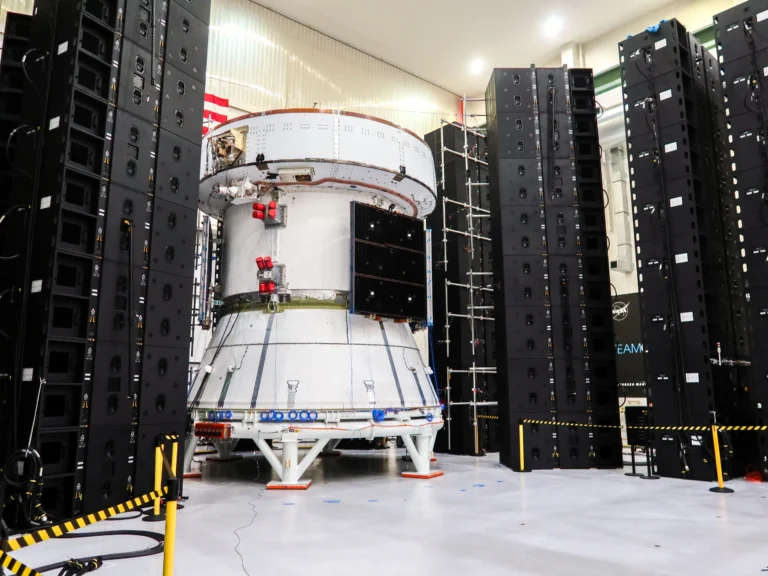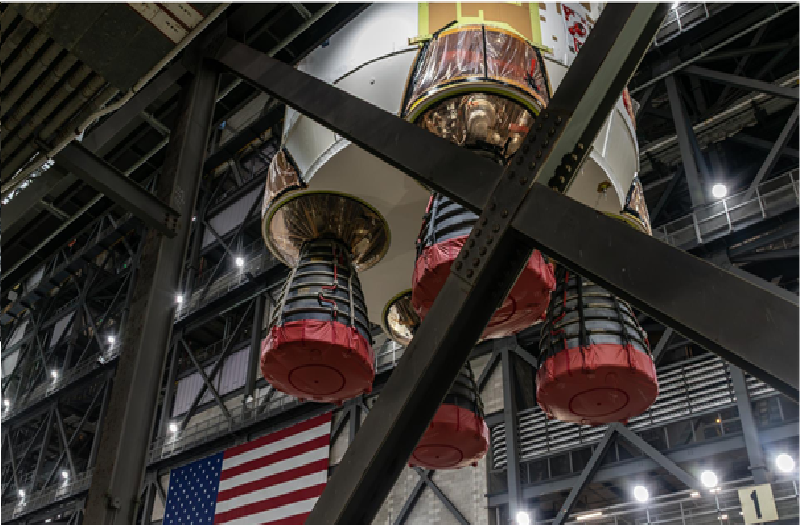
Photo: NASA’s Artemis III SLS (Space Launch System) core stage is integrated alongside the twin solid rocket boosters on Oct. 28 inside the Vehicle Assembly Building’s High Bay 3 at NASA’s Kennedy Space Center in Florida. Source: https://www.nasa.gov/image-article/artemis-iii-sls-core-stage-joins-boosters-at-kennedy/
DeepSeek research response:
I focused on five things: (1) NASA’s designated resolution page, (2) NASA’s current Artemis III mission design and schedule, (3) Blue Origin/New Glenn and SpaceX/Starship readiness, (4) independent schedule-risk assessments from NASA OIG/GAO, and (5) recent expert/crew commentary. The key distinction is that the question requires successful completion by Dec. 31, 2027, not merely a launch in 2027.
Citations
“NASA’s Artemis III Mission to Test Future Moon Lander Operations” — NASA — Oct. 22, 2026
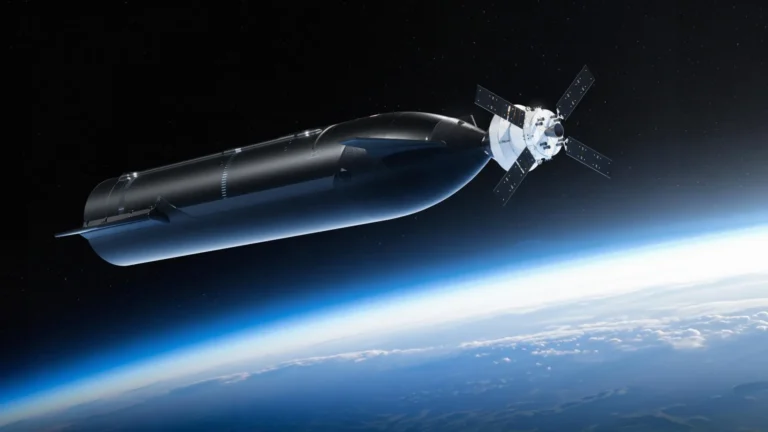
NASA’s mission feature says the planned 14-day flight will launch in 2027 and sequentially dock Orion with Blue Moon and Starship test articles. Blue Moon launches first and can loiter up to 30 days; Orion launches days later; Starship launches later for a roughly two-hour docking. The mission ends with Pacific splashdown and includes up to five extra days of test objectives, making it a multi-launch, multi-provider demonstration.
“NASA eyeing year-end tanking test and summer 2027 launch for Artemis III” — Aerospace America — Oct. 22, 2026
At an Oct. 22 press conference, NASA officials said Artemis III remained on track for a mid-2027 launch, with a chart showing a May–September 2027 window. Isaacman said NASA was preparing for a year-end tanking test and summer 2027 launch; Parsons said Blue Origin was targeting pad operations in November and SpaceX a November Starship flight. This is the clearest recent official schedule statement and gives a window rather than a fixed date.
“NASA sets mid-2027 Artemis III launch goal, updates plan for permanent moon base” — WESH — Oct. 23, 2026
NASA Administrator Jared Isaacman called a mid-2027 Artemis III launch “a very achievable road” and said the mission was about 90 days behind schedule, mainly because of supply-chain issues. NASA said SLS/Orion hardware was being assembled in the Vehicle Assembly Building and a tanking test was expected by the end of 2026. The report also noted Blue Origin was then aiming to relaunch New Glenn by the end of 2026, a target that subsequently slipped to January 2027.
“NASA says it’s on track to launch Artemis III astronauts in summer 2027” — USA Today network / Sacramento Bee — Oct. 25–26, 2026
NASA told reporters it remained on track to launch four Artemis III astronauts in summer 2027 on a 14-day LEO mission using SLS/Orion, New Glenn and Starship. The sequence has Blue Moon launching first and waiting up to a month, Orion docking on flight day 3, and Starship launching around day 6 for a roughly two-hour docking on day 8. Blue Origin was progressing its Blue Moon test article toward integration early next year, while SpaceX was preparing a propellant-transfer demo in early 2027.
“When will SpaceX and Blue Origin fly to the moon? NASA reveals lunar lander timelines (and an Artemis III update)” — Yahoo Tech — Oct. 20, 2026
NASA’s IAC presentation put Artemis III in Q3 2027 and listed SpaceX’s remaining milestones, including V3 Starship catch/reflight work, an early-2027 propellant-transfer demo, and delivery of the Artemis III Starship docking test article. It said the Artemis III Starship does not need orbital refueling for its LEO docking, materially lowering the bar versus a lunar landing. SpaceX still had to complete a crew cabin, docking system, and multiple V3 test flights, leaving substantial integration work.
“Blue Origin pushes launch to January 2027 as it races to rebuild damaged launchpad” — CNBC — Nov. 4–5, 2026
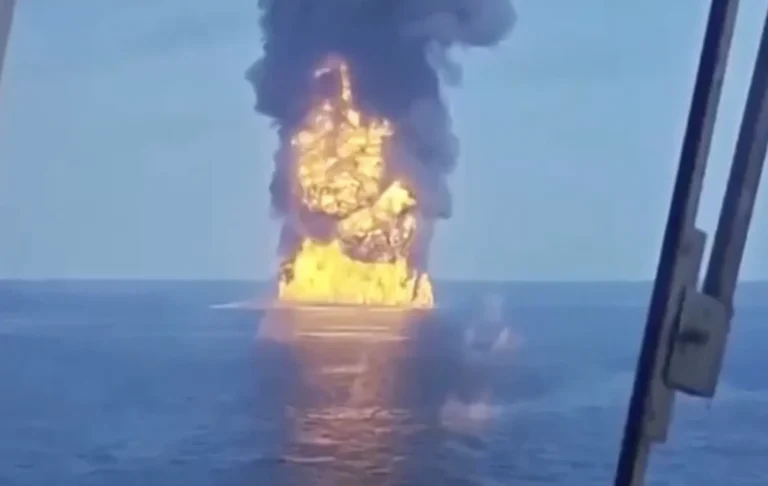
Blue Origin delayed New Glenn’s return to flight to January 2027 after the May 2026 pad explosion and a slower-than-planned rebuild. New Glenn is slated to launch Blue Origin’s Blue Moon test article first in the Artemis III sequence, so the delay directly compresses the mission’s schedule. The slip is only about 10 days versus the prior target, but it leaves less margin for pad testing and the Blue Moon launch.
What has recently moved toward “Yes”
- Artemis II flew in April 2026, reducing some SLS/Orion integration risk and keeping the program moving toward Artemis III. NASA’s page describes Artemis II as a nearly 10-day crewed lunar flyby and a record-distance human spaceflight.
- NASA has named the Artemis III crew and published a detailed mission sequence: Blue Moon first, Orion second, Starship later, two dockings, 14 days, Pacific splashdown. That is more concrete than a paper study.
- NASA officials in October repeatedly said the mission remained on track for summer/mid-2027, with a May–September launch window and a year-end 2026 tanking test.
- The Artemis III Starship test article does not need orbital propellant transfer for its LEO docking, so one of the biggest long-term Starship hurdles is not a direct prerequisite for this mission.
What has recently moved toward “No” or raised risk
- The end-2027 deadline is looser than NASA’s current summer target. A launch in May–September 2027 leaves months of buffer before Dec. 31. Even a fall 2027 slip could still allow completion in time.
- But “successfully completes” is not the same as “launches.” A 14-day mission launched after roughly mid-December 2027 would not finish by Dec. 31. Operationally, the effective cutoff is around mid-December, not Dec. 31.
- The resolution source does not define the minimum success threshold. NASA’s current plan uses both landers, but the February 2026 announcement allowed “one or both.” If NASA flies only one lander and completes that demonstration, the wording may still permit a “Yes,” though the current public plan describes both dockings.
- Watch items: successful New Glenn return to flight in January 2027; on-time Blue Moon test-article delivery and launch; SLS tanking test by end-2026; Starship V3 flight and docking-article progress; and NASA’s formal launch-date announcement after readiness reviews.
Extracted resolution criteria links:
[‘https://www.nasa.gov/humans-in-space/artemis/’]
=== Forecast Result ===
=== Reasoning ===
Assessment
I put successful completion slightly below an even chance. The main risk is that Artemis III slips into 2028, rather than that an otherwise flight-ready mission suffers a catastrophic failure.
The resolution requires a completed crewed demonstration—not merely an SLS launch or an uncrewed commercial test. A roughly 14-day mission would need to launch by approximately mid-December 2027 to finish before the deadline.
Evidence supporting success
- The mission is substantially easier than a lunar landing. Low-Earth-orbit docking does not require lunar descent, ascent, or the complete lunar transportation architecture. Importantly, the supplied reporting says the Artemis III Starship article does not require orbital refueling.
- SLS and Orion have demonstrated crewed flight. Artemis II’s April 2026 completion reduces uncertainty, and Artemis III hardware is already being integrated at Kennedy.
- There is meaningful schedule margin. NASA’s summer target leaves several months for delays before successful completion becomes impossible within 2027.
- The original scope permits one or both providers. If NASA can proceed with one ready commercial vehicle, the mission is less vulnerable than a strict three-launch, two-docking requirement would imply.
Evidence against success
- Commercial-vehicle readiness remains unproven. Producing an orbital test article is not equivalent to obtaining approval for close-proximity operations and docking with a crewed Orion. Interfaces, flight software, verification, and safety reviews can become late schedule bottlenecks.
- Blue Origin has a concrete infrastructure setback. New Glenn’s return-to-flight target has slipped to January 2027 following the pad explosion. That leaves limited time to demonstrate reliable operations and prepare the Blue Moon launch.
- NASA has already acknowledged schedule erosion. The reported 90-day delay matters more than repeated statements that the mission remains “on track.”
- Launch coordination adds risk. Hardware readiness alone does not guarantee that the required vehicles can launch and complete docking operations within the available orbital and crew-duration windows.
I give the greatest weight to NASA for mission definition and hardware status, and to the supplied Reuters, CNBC, GAO, and OIG reporting for execution risks. Multiple articles repeating NASA’s announcement are not independent confirmations of readiness. Conversely, older findings about lunar-landing readiness should not be treated as direct prerequisites for this simpler demonstration.
Key assumptions and uncertainty
These are judgmental estimates, not measured failure frequencies.
| Assumption | Estimated probability it fails | Treatment in the forecast |
|---|---|---|
| SLS/Orion becomes available early enough to complete the mission during 2027 | 20% | Leaves an estimated 80% chance of timely NASA-side readiness. |
| Given timely NASA-side readiness, at least one commercial target and its integration/launch sequence are ready in time | 35% | Leaves a conditional readiness estimate of 65%. |
| A NASA-declared successful one-provider demonstration satisfies the question | 15% | In this stricter branch, I reduce commercial readiness to 40%, reflecting the need for both providers. |
I additionally allow approximately a 10% operational failure risk, conditional on achieving a workable, flight-ready mission schedule.
An illustrative calculation is:
[
0.80 \times [(0.85 \times 0.65)+(0.15 \times 0.40)] \times 0.90
\approx 0.44. (Carolyn’s note: Correct)
]
This separates schedule readiness from flight execution and avoids treating the providers’ development risks as fully independent.
Timing distribution
My cumulative estimates for successful completion are:
| Completion deadline | Probability |
|---|---|
| June 30, 2027 | 10% |
| September 30, 2027 | 28% |
| December 31, 2027 | 44% |
| December 31, 2028 | 75% |
That allocates an additional 18 percentage points to July–September 2027, 16 points to the final quarter, and 31 points to 2028. The likelihood is therefore concentrated around the planned mission window and subsequent delays—not distributed uniformly across months.
Overall, the simplified mission and existing hardware justify a substantial chance of success, but the combination of new docking systems, commercial readiness, and coordinated launches keeps timely completion below my central expectation.
Data sufficiency: Sufficient
Probability: 44%
End
About The Author