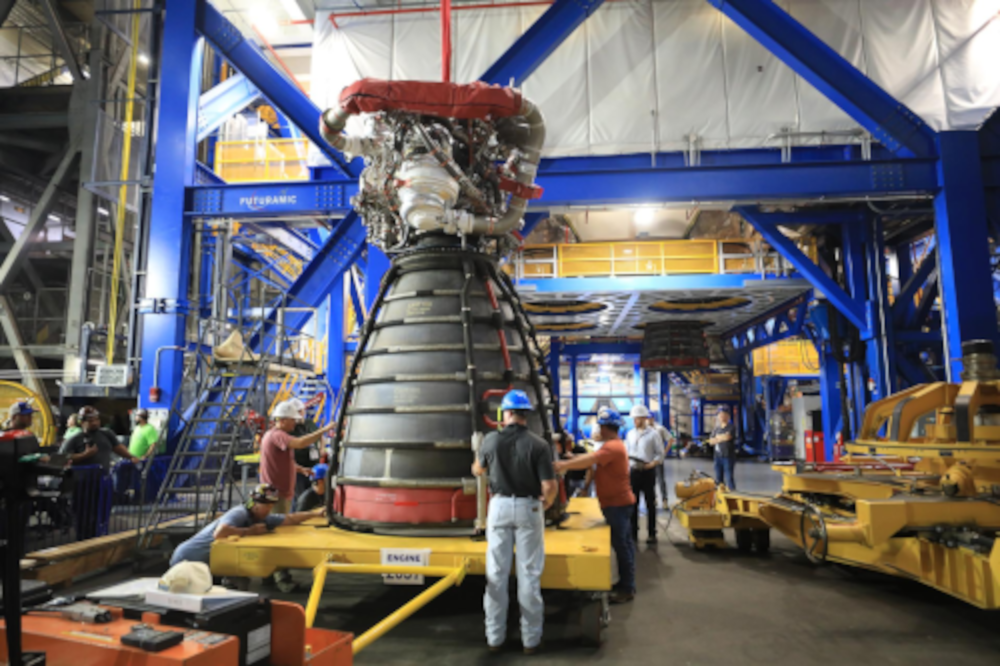
NASA Starts Artemis III Engine Install. Boosters, Crew Training Advance. Technicians prepare to transfer the #2 RS-25 SLS (Space Launch System) rocket engine (front) to the work stand with the #3 engine (back) for integration with the Artemis III core stage rocket on Tuesday, Aug. 25, 2026, inside the Vehicle Assembly Building at NASA’s Kennedy Space Center in Florida. NASA/Clayton Rougelot.
Grok response:
10 Citations
- Title: Moon to Mars | NASA’s Artemis Program – NASA. Description: Official NASA Artemis program overview page. Date: Page last updated August 17, 2026. Summary: Describes Artemis III as a 2027 low Earth orbit demonstration mission to test one or both commercial human landing systems from SpaceX and Blue Origin via crew launch on SLS/Orion for rendezvous and docking. Notes Artemis IV as the first lunar landing targeted for 2028. Includes links to crew and news on hardware progress.[1]
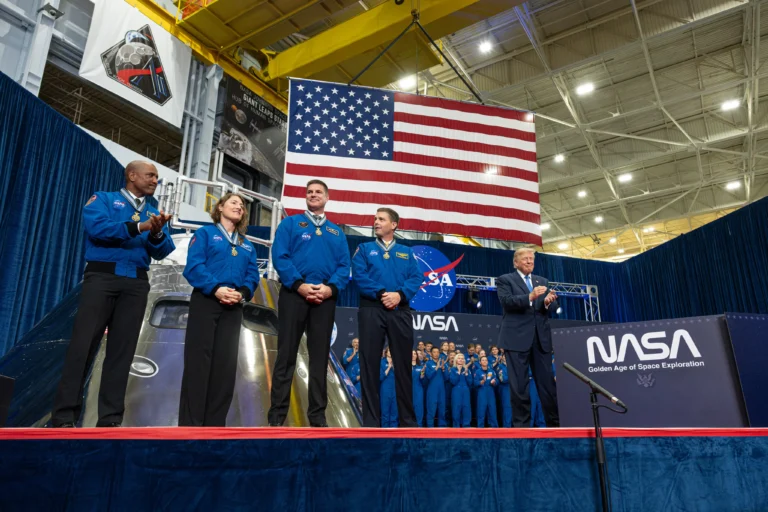
- Title: NASA Marches Toward Artemis III Mission in 2027, Names Crew Members. Description: NASA news release announcing crew and mission details. Date: June 9, 2026. Summary: Names crew as commander Randy Bresnik, pilot Luca Parmitano (ESA), and mission specialists Andre Douglas and Frank Rubio, with Bob Hines as backup. Outlines the 2027 LEO tests of rendezvous/docking with Blue Origin and SpaceX lander test articles, lasting about two weeks with sequential dockings. Reports progress on Orion integration and SLS processing.[2]
- Title: How NASA’s Artemis III Lander Test Will Pave Way for Moon Landings. Description: NASA article on HLS demonstration plans. Date: July 15, 2026. Summary: Details both SpaceX (Starship V3 with docking adapter) and Blue Origin (Blue Moon Mark 2 crew cabin) flying test articles launched commercially, with SLS/Orion crew docking sequentially in LEO. Crew may enter Blue Origin vehicle; Starship docking is nose-to-nose without crew transfer. Emphasizes risk reduction for 2028 landing via interoperability tests.[3]
- Title: Artemis III SLS stacking advances as Orion results confirm trajectory fix. Description: NASASpaceFlight.com report on hardware processing. Date: September 7, 2026. Summary: Reports four of five SLS solid rocket booster segments stacked in the VAB, with all four RS-25 engines installed on Core Stage-3. Notes continued progress on Artemis III hardware alongside early Artemis IV work. Confirms post-Artemis II Orion heat shield analysis supports modified reentry.[4]
- Title: NASA says Artemis III mission on schedule as Blue Origin repairs launchpad. Description: Reuters report quoting NASA Administrator. Date: July 20, 2026. Summary: Jared Isaacman states NASA is “still very much planning” for 2027 despite Blue Origin’s May explosion, with contingency plans if New Glenn delays further. Notes both HLS providers have faced delays but NASA remains confident. Highlights three-rocket launch campaign complexity.[5]
- Title: Blue Origin pivots to redesigned launchpad after New Glenn explosion. Description: CNBC coverage of Blue Origin recovery. Date: June 30, 2026. Summary: CEO Dave Limp says company will return New Glenn to flight by end of 2026 using a redesigned pad configuration (crane/hybrid, not rebuilding the destroyed transporter-erector). NASA’s Isaacman calls recovery “great progress” and New Glenn still Plan A. Explosion occurred May 28 during hot-fire test.[6]
- Title: Put it in pencil: NASA’s Artemis III mission will launch no earlier than late 2027. Description: Ars Technica analysis of schedule. Date: April 28, 2026. Summary: SpaceX and Blue Origin told NASA they can meet late 2027 for LEO rendezvous/docking tests. This slipped from earlier mid-2027 target. Isaacman received vendor commitments for interoperability tests ahead of 2028 landing. Notes remaining questions on orbit altitude and SLS configuration.[7]
- Title: Artemis III – Wikipedia. Description: Encyclopedia entry on the mission. Date: September 12, 2026. Summary: Confirms 2027 LEO demonstration (not lunar landing) with four astronauts on SLS/Orion testing docking with Blue Origin and SpaceX pathfinder vehicles. Notes SLS will use a non-propulsive spacer instead of upper stage. Describes sequential dockings, possible crew entry into Blue Origin vehicle, and risk-reduction for Artemis IV.[8]
- Title: NASA Joins Artemis III Orion Modules; Rocket Hardware Update. Description: NASA missions blog on integration. Date: July 16, 2026 (content from July 31 joining). Summary: Orion crew and service modules joined July 30-31, 2026, outpacing Artemis II timelines. SLS booster stacking began early July; all RS-25 engines delivered. Uses spacer instead of ICPS; reuses some Artemis II components for acceleration. Teams applying lessons learned for faster processing.[9]
- Title: ‘Full steam ahead’: NASA ramps up prep for Artemis III astronaut launch in 2027. Description: Space.com report on processing. Date: July 15, 2026. Summary: NASA targeting mid-to-late 2027; SLS core stage arrived April, engines installing, booster stacking underway. Simulations beginning in mission control. Calls it “full steam ahead” after successful Artemis II in April 2026. Hardware arriving at KSC for integration.[10]
NASA’s official Artemis page (last updated August 17, 2026) and related NASA articles consistently describe Artemis III as a crewed low-Earth-orbit demonstration in 2027 to test rendezvous and docking between Orion/SLS and test articles of commercial Human Landing Systems from SpaceX (Starship V3 with docking adapter) and/or Blue Origin (Blue Moon Mark 2-based pathfinder). The mission involves three launches (Blue Origin lander first, then SLS/Orion crew, then SpaceX Starship), sequential dockings (Blue Origin ~2 days with possible crew entry; SpaceX ~1 day nose-to-nose without crew transfer), and splashdown, lasting 12-14 days. This is a risk-reduction step before Artemis IV’s targeted 2028 lunar landing. Crew was named June 9, 2026: Randy Bresnik (commander), Luca Parmitano (pilot, ESA), Andre Douglas and Frank Rubio (mission specialists).[1]
Hardware is advancing as of September 2026: Orion modules joined in late July, SLS Core Stage-3 has all four RS-25 engines installed, and four of five booster segments stacked in the VAB, with processing accelerated relative to Artemis II using lessons learned and some reused components. NASA officials, including Administrator Jared Isaacman, have repeatedly expressed confidence in the 2027 timeline (shifted from mid-2027 to late 2027 based on vendor input in April), even after Blue Origin’s May 28, 2026 New Glenn explosion that damaged its only launchpad. Isaacman stated in July that NASA is “still very much planning” for 2027 with contingencies (e.g., possibly launching the Blue Origin lander on another vehicle). Blue Origin aims to return New Glenn to flight by end of 2026 via a redesigned pad using a crane/hybrid configuration and has cleared debris quickly. SpaceX is using an off-the-line Starship V3. No official delay beyond 2027 has been announced; Wikipedia and NASA sources as of mid-September 2026 still list 2027.[4]
Recent updates show continued progress without major slips since the February 2026 architecture change (which added this LEO demo after Artemis II delays). Artemis II succeeded in April 2026 (crewed lunar flyby). Expert/NASA views: Officials call it one of NASA’s most complex missions due to multi-vehicle choreography but emphasize it is simpler/safer than a lunar attempt.
Extracted resolution criteria links:
[‘https://www.nasa.gov/humans-in-space/artemis/‘]
GPT Binary response:
The three assumptions most affecting the forecast are:
- NASA and its contractors maintain the late-2027 schedule. I assign roughly a 45% chance that this assumption fails through a hardware, testing, launch-campaign, or administrative delay.
- At least one commercial lander is ready and available for the demonstration. I assign roughly a 35% chance that this fails. NASA’s willingness to fly with one provider is an important mitigation.
- The integrated rendezvous, docking, and crewed mission operates successfully on its first attempt. I assign roughly a 25% chance that this assumption fails, reflecting the novelty and complexity of the multi-vehicle mission.
These risks overlap, so multiplying them mechanically would overstate the downside.
Deepseek Binary response:
The mission is currently planned for 2027, but sources indicate the working target is late 2027, not early or mid-2027. That leaves little margin: for the mission to “succeed by the end of 2027,” it must launch early enough to complete a roughly two-week LEO demonstration before December 31.
Positive indicators are real: Artemis II succeeded in April 2026, Artemis III SLS booster stacking is underway, core-stage engines are installed, Orion modules have been joined, and NASA has named a crew. The mission was also simplified from a lunar landing to a LEO rendezvous/docking demonstration, and NASA can proceed with one or both commercial landers, reducing dependency on a single provider.
However, major schedule and execution risks remain:
- NASA’s large-mission schedules have historically slipped repeatedly.
- The target is late 2027, so even a modest delay pushes completion into 2028.
- The mission requires multi-vehicle coordination involving SLS/Orion plus commercial landers.
- Blue Origin’s New Glenn launchpad was damaged by a May 2026 explosion, and recovery by end-2026 is ambitious.
- SpaceX’s Starship V3 docking test article may still need maturation.
- Political/budget uncertainty could slow work.
- Success requires launch, rendezvous, docking, demonstrations, and safe return—not merely a launch.
A rough decomposition suggests:
- P(SLS/Orion ready in time) ≈ 65–75%
- P(at least one commercial lander ready) ≈ 75–85%
- P(launch early enough in 2027 to complete by Dec 31 | readiness) ≈ 65–75%
- P(mission success given launch) ≈ 80–85%
Multiplying these gives a central estimate around 30%, with substantial uncertainty. Given the strict end-of-2027 deadline and historical NASA schedule slippage, I would not put this above the mid-30s.
Data sufficiency: Sufficient
Probability: 30%
=== Forecast Result ===
Analysis
Mission Definition & Current Status:
Artemis III has been redefined (as of Feb 2026) as a LEO crewed docking demonstration between Orion/SLS and one or both commercial lunar lander test vehicles (SpaceX Starship V3, Blue Origin Blue Moon), rather than an actual lunar landing. This is a significantly reduced technical scope compared to the original mission, which is a positive factor for feasibility within the timeframe.
Positive indicators:
- SLS/Orion hardware is progressing well and ahead of Artemis II’s pace: Orion crew/service modules joined July 2026 (faster than Artemis II timeline), all RS-25 engines installed on Core Stage-3, booster segment stacking >50-80% complete as of Sept 2026.
- Artemis II succeeded on schedule in April 2026, demonstrating NASA’s improved recent execution capability on SLS/Orion hardware.
- Crew was named far in advance (June 2026), indicating serious program commitment.
- Mission design allows flexibility (“one or both” landers), meaning success doesn’t require both SpaceX and Blue Origin to be ready — just one, which reduces single-point dependency risk.
- NASA leadership (Isaacman) publicly reaffirms “still very much planning” for 2027 despite setbacks.
Negative/risk indicators:
- Target schedule is explicitly “late 2027” (per vendor commitments reported in April 2026), leaving essentially zero schedule margin against the Dec 31, 2027 resolution deadline — any slip at all risks pushing into 2028.
- Blue Origin’s New Glenn explosion (May 2026) significantly damaged its only launchpad and introduces material uncertainty into its lander test-vehicle readiness.
- SpaceX’s Starship V3 (with docking adapter) is a new, largely unflown configuration as of these reports; Starship development has a history of test failures.
- This is a complex three-launch, sequential-docking mission (Blue Origin lander, SLS/Orion crew, SpaceX Starship) — high coordination complexity increases the chance that at least one element slips.
- Historical base rates for SLS/Orion-era NASA human spaceflight missions consistently show schedule slippage of 6+ months to years relative to announced targets, even when framed with confidence 12-18 months out.
- Political/budgetary uncertainty was flagged as an added, non-technical risk factor.
Key uncertain assumptions:
- That current SLS/Orion hardware pace continues without disruption (~80-85% likely).
- That at least one commercial lander test vehicle achieves flight readiness and successful docking objectives within the 2027 window (~60-70% likely, given “one or both” flexibility but real recent setbacks).
- That no catastrophic anomaly prevents mission completion once attempted (~90% likely, given LEO-only, lower-risk profile).
Multiplying these together (roughly 0.82 × 0.65 × 0.90 ≈ 0.48) suggests a base combined estimate, but given historical NASA schedule slippage patterns and the fact that the target itself is already “late 2027” with essentially no margin, I adjust downward to account for compounding schedule risk across three independent launch vehicles/providers.
Data sufficiency: Sufficient
Probability: 35%
About The Author