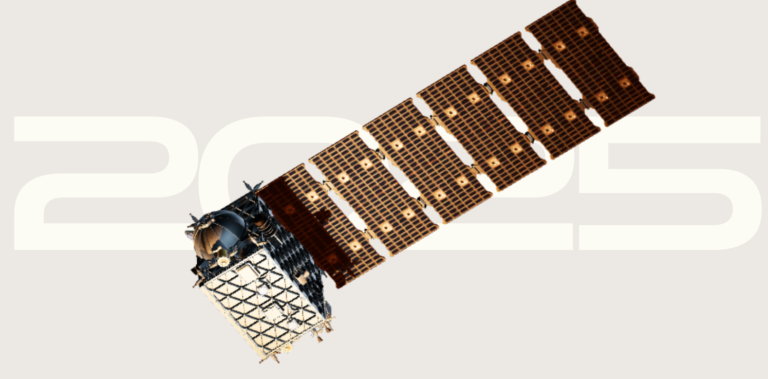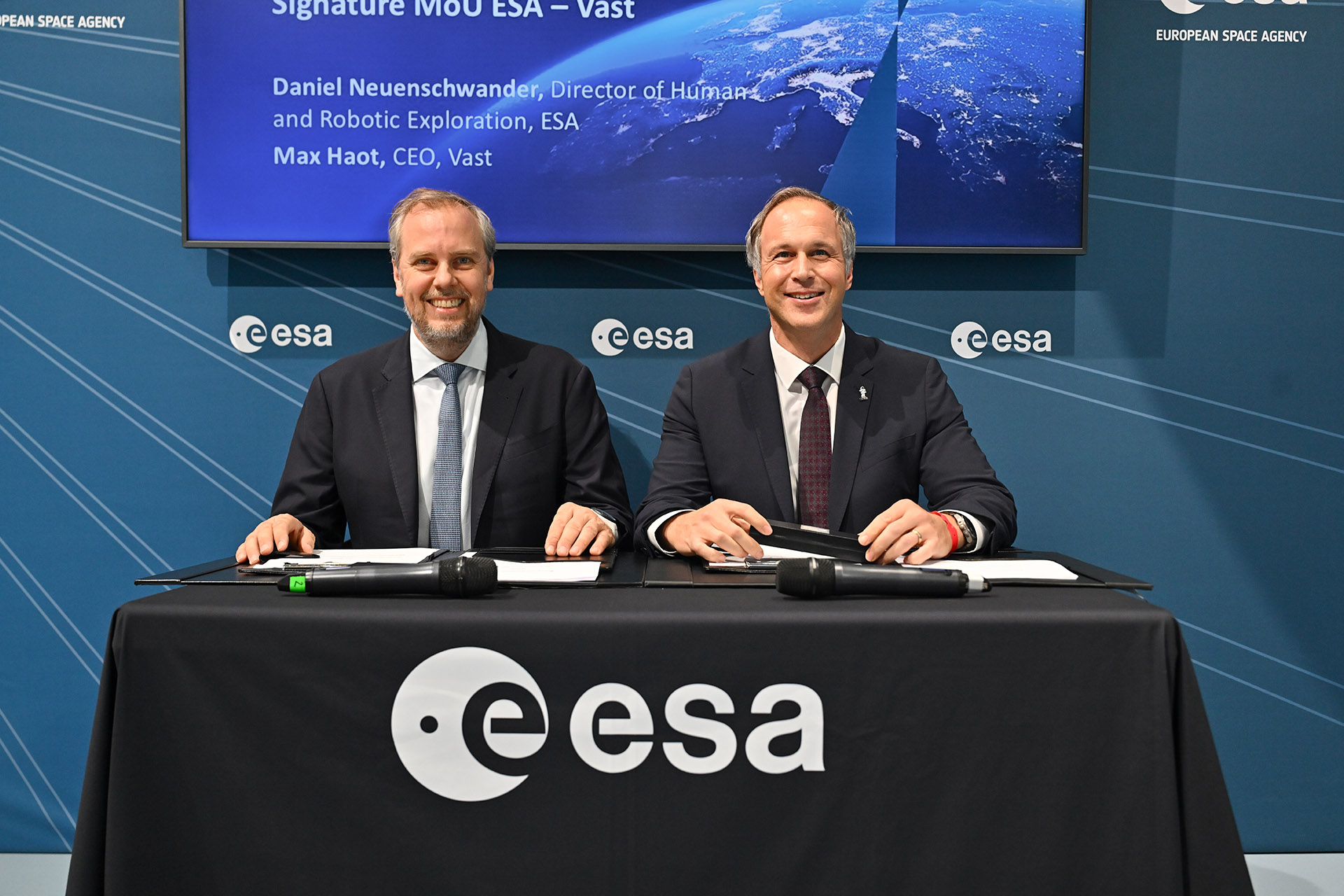
Photo: During the 77th International Astronautical Congress, the European Space Agency (ESA) and Vast, a company developing next-generation space infrastructure, signed a Memorandum of Understanding (MoU) regarding collaboration between the two parties and development of a framework to work together ahead of the upcoming end of service of the International Space Station (ISS). Credit: ©jonasphotto. Source: https://www.vastspace.com/updates/esa-vast-mou-post-iss-cooperation
Perplexity response:
Current state of each candidate
| Habitat | Latest reported launch timing | Human-visit timing relevant to resolution | Assessment |
|---|---|---|---|
| Haven-1 | No earlier than Q1 2027 | Vast-1 is intended to follow launch, but the arrival could be about two weeks later or much later depending on docking approval. [22] | Only plausible qualifying candidate |
| Orbital Reef | No earlier than 2030 | No visit before the end of 2027 is indicated. [35] | Not a credible 2027 candidate |
| Starlab | No earlier than 2029 | Voyager’s related private astronaut mission is targeted for no earlier than 2028. [43] | Not a credible 2027 candidate |
| SpaceX Starship station concept | No operational station schedule before 2028 is identified | Starship remains in flight-test and lunar-development phases; no scheduled human visit to a Starship habitat is reported. [16] | Not a credible 2027 candidate |
| Other new habitats | No additional candidate with a reported pre-2028 crew-visit schedule found in the reviewed sources | No qualifying human visit identified | No evidence of an alternative route |
Resolution-relevant update
The key recent movement is Haven-1’s shift to a Q1 2027 launch target and continuing hardware integration. That is meaningful progress toward a qualifying event, but it does not itself satisfy the resolution: humans must visit the habitat, and the available reporting explicitly warns that the crew mission could occur substantially later than the module launch. [18][19]
The other named possibilities have schedules outside the window: Orbital Reef is reported no earlier than 2030, Starlab no earlier than 2029, and Voyager’s associated astronaut mission no earlier than 2028. [35][32][43]
Bottom line: The evidence points to Haven-1/Vast-1 as the decisive path. A human visit before December 31, 2027 remains technically scheduled as a possibility, but the most important uncertainty is the gap between Haven-1’s planned Q1 2027 launch and SpaceX’s approval and execution of the subsequent Dragon docking.
DeepSeek research response:
Citations
“Starlab Space Station” — Voyager Technologies (official Starlab page), accessed November 11, 2026; page undated.
Voyager says Starlab will be launched on a single SpaceX Starship flight “prior to ISS decommissioning,” with a fully outfitted science park and no additional assembly flights. The page lists Voyager, Airbus, Mitsubishi, MDA Space, Hilton, Palantir and Northrop Grumman as partners, but it gives no specific launch date or crewed-visit date. The absence of a dated 2027 milestone is significant for the resolution.
“Hull 3 Haven-1: Vast completa la struttura in cinque mesi” — Economia dello Spazio Magazine, October 29, 2026.
Vast completed its third Haven-1 primary structure, “Hull 3,” a qualification article built, inspected and pressure-tested in five months, versus nine months for Hull 2, the flight structure. The article stresses that Hull 3 is not the flight vehicle and that completion of qualification hardware does not equal overall station qualification or flight readiness. It reiterates the current schedule of Q1 2027 and notes that Haven-1 must still complete environmental testing before launch.
“You Might Be Able to Invest in the Starlab Space Station — but Should You?” — The Motley Fool, October 24, 2026.
The Motley Fool reports that Starlab “won’t launch — or generate revenue — before 2029,” and that launch cannot happen until SpaceX makes a Starship available. It also describes a reported $300 million private fundraising round and estimated build-and-launch costs of $2.8–$3.3 billion. This independently confirms that Starlab is not a credible candidate for a human visit before the end of 2027.
“Orbital Reef” — Off Earth Data, October 17–18, 2026.
Off Earth Data describes Orbital Reef, led by Blue Origin with Sierra Space, as the “slowest-advancing” of the four major U.S. commercial-station programs. Its near-term gate is NASA’s Commercial LEO Destinations Phase 2 bid, with proposals expected after the final RFP and an award targeted for spring 2027, rather than a dated crewed station milestone. A late-2026 standalone Sierra Space LIFE pathfinder launch could not be re-confirmed, leaving full station operations in the 2028–2030 period.
“The European Space Agency and Vast Build on Existing Mission Collaborations and Strengthen Cooperation for Post-ISS Era” — Vast/ESA, October 6, 2026.
ESA and Vast signed an expanded MoU covering four crewed missions planned for 2027, including “the first crewed mission to Haven-1.” Vast CEO Max Haot explicitly said ESA and Vast are collaborating on missions “to the International Space Station and Haven-1, planned for 2027, including the first crewed mission to Haven-1.” French astronaut Arnaud Prost was confirmed for a Haven-1 mission, giving the program a named crew member and a public 2027 target.
“Vast — Company Profile, Milestones & Funding” — VentureAtlas, October 6, 2026 (status as of October 4, 2026).
This tracker states that Haven-1 remained in final integration in Long Beach for a targeted Q1 2027 Falcon 9 launch, but that there was no public evidence the flight vehicle had shipped to NASA’s Neil Armstrong Test Facility for its environmental campaign. It also notes that Vast had hit “0/2” previously announced launch dates, both of which slipped, and that crew timing depends on SpaceX verifying Haven-1 is safe for Dragon docking — a process Haot has said could take from two weeks to much longer. This is the most direct available evidence that the pre-launch test campaign was not yet publicly confirmed complete in early October.
=== Forecast Result ===
=== Reasoning ===
Looking at this question, I need to assess the probability that Haven-1 (the clear leading candidate) will both launch AND receive a crewed visit before December 31, 2027.
Key factors:
- Launch timing risk: Haven-1 has already slipped twice (from 2025 target → May 2026 → Q1 2027). The track record shows “0 of 2” previously announced dates were hit. As of October 2026, there was no public confirmation that the flight vehicle had shipped to NASA’s Neil Armstrong Test Facility for environmental testing — a typically multi-month process that normally precedes launch by several months. This creates real tension with a Q1 2027 launch target.
- Crew visit dependency: Even if Haven-1 launches on schedule, CEO Max Haot has stated the crewed mission could follow “as early as two weeks” or “as late as any time within three years” after launch, since SpaceX must independently certify Dragon docking safety. This is a critical bottleneck outside Vast’s direct control.
- Positive signals: ESA signed an MoU in October 2026 explicitly referencing “the first crewed mission to Haven-1, planned for 2027,” and named astronaut Arnaud Prost has been confirmed. Continued hardware progress (Hull 3 qualification structure completed) suggests genuine program momentum, not mere conceptual planning.
- Other candidates (Orbital Reef, Starlab, Starship-station): All have reported timelines of 2028-2030 or later, making them non-contributors to this question’s resolution.
Probabilistic modeling: Treating this as a compound probability — P(launch by various 2027 quarters) × P(crew visit by EOY 2027 | launch timing) — and accounting for:
- Historical slippage pattern (2 prior delays)
- Uncertain test campaign status as of Oct 2026
- Wide uncertainty band on crew certification timing
- Strong official commitments (ESA MoU, named astronaut) supporting intent
I arrive at a moderate probability, weighted below 50% given the compounding risks of (a) another launch slip and (b) extended docking certification timeline, but reflecting genuine viability given concrete hardware progress and stated 2027 commitments.
Key assumptions that could overturn this forecast:
- If the environmental test campaign is confirmed completed/underway soon, launch odds improve significantly (~15% probability this resolves positively faster than modeled)
- If SpaceX grants rapid docking certification (precedent-setting but plausible given Dragon’s flight heritage), crew visit could follow launch quickly (~20% chance this assumption fails favorably)
- If Haven-1 suffers a third significant delay (beyond just quarter-slip, e.g., into 2028), this collapses to near-zero (~15-20% chance of this failure mode)
Data sufficiency: Sufficient
Probability: 42%
End
About The Author