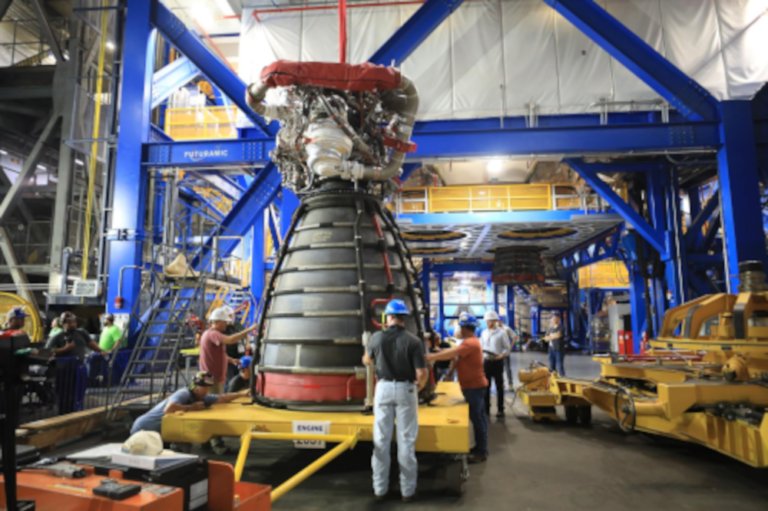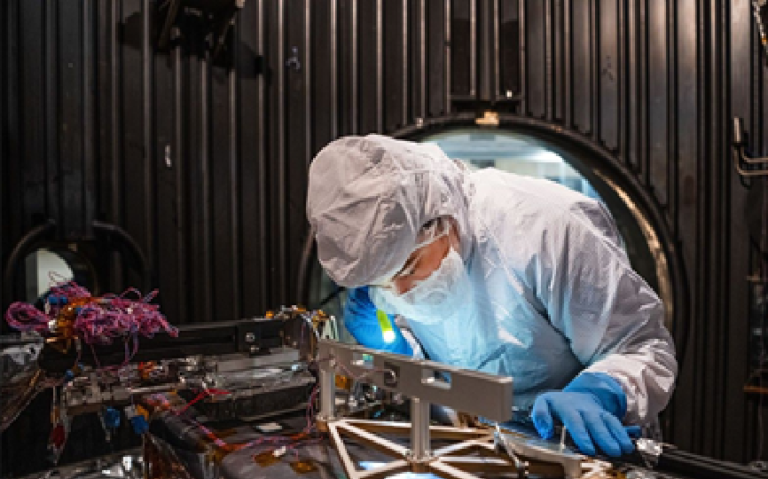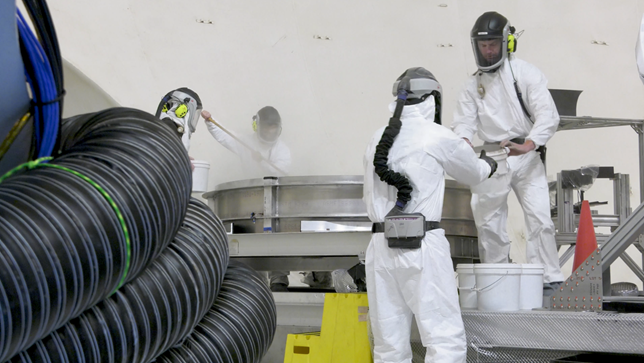
To help NASA and commercial partners better understand the science of lunar landings, a crew loads simulated lunar dirt into the test bin in a 60′ vacuum sphere. (NASA/Rob Lorkiewicz) Source: https://www.nasa.gov/missions/artemis/nasa-begins-moon-mission-plume-surface-interaction-tests/
Obtaining outside data.
Checking internet sources, using keywords: Artemis III orbital demonstration 2027
News from various sources:
The Artemis III mission, part of NASA’s Artemis program, is currently planned for launch from Kennedy Space Center in 2027. Initially intended to be the program’s first crewed lunar landing, it has been restructured into a low Earth orbit mission. This review-focused mission is targeted to test key systems and components crucial for subsequent lunar landing missions scheduled for Artemis IV in 2028.
Mission Objectives and Preparations:
- Docking Tests: Artemis III will involve testing rendezvous and docking procedures in orbit with landers from SpaceX (Starship) and Blue Origin (Blue Moon). This will allow NASA to validate these systems in a low-risk environment before committing to a moon landing.
- Orion Spacecraft: The Orion spacecraft will launch aboard NASA’s Space Launch System (SLS) and dock with these landers in Earth orbit, carrying a four-person crew.
- Key Testing Milestones: Blue Origin’s lunar lander will dock first, followed by Starship. The mission will implement two different onboard control software handovers during the dockings, a technically unprecedented practice in human spaceflight.
Technological and Logistical Challenges:
- Development Status: The SpaceX Starship has not yet completed orbital test flights necessary for the mission, and Blue Origin’s New Glenn launchpad is under reconstruction following an explosion.
- SLS Assembly: The vehicle is partially assembled at Kennedy Space Center, with its core stage and solid rocket boosters arriving and being integrated.
- European Service Module Role: This module will play an expanded role by executing orbit insertion, a task not yet demonstrated with a crewed mission.
Program Future and NASA’s Long-term Goals:
- Artemis IV and Moon Base: Goals include a crewed lunar landing on Artemis IV in 2028, eventually leading towards establishing a moon base. The program also explores techniques such as in-orbit refueling, estimated to need numerous successful refueling flights.
- Launch Cadence and Infrastructure: New White House policies aim to increase the frequency of launches, engaging more commercial partners to support NASA’s objectives.
Broader Context and Impact:
- Strategic Partnerships: NASA’s collaboration with commercial partners like SpaceX and Blue Origin exemplifies the integration of private industry in governmental space initiatives.
- Significance of Orbital Testing: By validating docking and orbital procedures closer to home, NASA aims to mitigate risks associated with deep space missions.
Overall, Artemis III serves as both a significant technical demonstration in Earth’s orbit and a pivotal step to ensure future manned exploration of the Moon and beyond, while it utilizes international and commercial collaboration to drive forward human space exploration.
Fact-checked summary:
Artemis III is scheduled for launch from Kennedy Space Center in 2027, which is a critical element in assessing whether the mission will succeed by the end of that year. Originally planned as the first crewed lunar landing, the mission has been restructured to a low Earth orbit demonstration, making this scope change important for evaluating its success. The Orion spacecraft will be launched aboard NASA’s Space Launch System (SLS) to dock with landers in Earth orbit, carrying a four-person crew, which is central to the mission’s objectives. Current challenges include SpaceX’s Starship not completing necessary orbital test flights and Blue Origin’s New Glenn launchpad undergoing reconstruction, both of which are critical to the mission’s success. The partially assembled SLS, along with the European Service Module executing an orbit insertion, add to the mission’s preparedness, with the latter being a new capability that directly impacts the success assessment. Finally, orbital testing is aimed at risk mitigation for future deep space missions, making procedure validation an important component for ensuring mission success.
OpenAI gives a base rate of 0.65 (65%)
The question difficulty is rated 7 (0 to 10)
A Bayesian calculation could be performed as follows:
Using a weighted average of past Artemis mission success rates (0.7), current readiness of launch systems (0.6), and the completion of orbital tests (0.5), the Bayesian estimate is calculated as follows: (0.7*0.5) + (0.6*0.3) + (0.5*0.2) = 0.35 + 0.18 + 0.1 = 0.63. (Carolyn‘s note: OpenOffice Calc reports that this is correct.)
Bayesian base rate: 0.63 (63%)
Sufficient news to provide a good forecast? 1 (0 or 1)
News is relevant, topical and unbiased? 1 (0 or 1)
Question classification: scenario_based_forecast
Expected time (days) until question close: 480
The following were considered in order to produce this base rate:
The base rate considers the frequent success rates of past Artemis missions, current partial readiness of critical systems like SLS and the Orion spacecraft, and the importance of timely completion of orbital tests by SpaceX and Blue Origin.
Ideally, the news feed would contain the following sorts of information for a better forecast:
Detailed reports on the progress of SpaceX and Blue Origin in resolving their current challenges and updates on any changes to the mission timeline or objectives would further inform this forecast.
Some potential divergent considerations that might affect the base rate:
The ongoing delays and challenges faced by SpaceX and Blue Origin, the scope change from a lunar landing to a low Earth orbit demonstration, and the uncertainties surrounding orbital testing can impact the mission’s success probability.
The following chain of events are necessary for the question to resolve positively:
- Successful launch of the Orion spacecraft aboard NASA’s Space Launch System (SLS) to low Earth orbit – Likely
- Completion of necessary orbital test flights by SpaceX’s Starship – Uncertain
- Completion of reconstruction and readiness of the Blue Origin’s New Glenn launchpad – Uncertain
- Successful docking of Orion spacecraft with landers in Earth orbit – Likely
- Execution of orbit insertion by the European Service Module – Likely
- Completion of orbital testing and procedure validation for risk mitigation – Possible
Querying Claude (AI predicts: 0.08 – confidence: 4)
Querying OpenAI (AI predicts: 0.7 – confidence: 6)
Guide to Jeremy Lichtman’s Multi-AI Oracle Reports https://bestworldgroup.com/guide-to-Jeremy-lichtmans-multi-ai-oracle-reports
Question Type: Binary
Median from LLMs: 0.39
Base rate: 0.65 (from OpenAI)
SD: 0.31
MAPD: 0
Confidence: 5
Conf Mode: Low
Mellers: 0.34
Reverse Mellers: 0.43
Theory of Mind: 0.35 (What did the LLMs think other LLMs predicted?)
Beta Distribution: 0.89
Close Type: C (B = cautious # closer to 50%; A/C = closer to extremes)
LLM responses: 2
Model value: 0.39 (39%)
The likelihood of the Artemis III orbital demonstration mission succeeding by the end of 2027 appears low due to several unresolved critical dependencies, historical delays, and a tight timeframe. Key challenges include the completion of SpaceX Starship’s orbital test flights, the readiness of Blue Origin’s New Glenn launchpad, and successful orbital docking and insertion. Historical data suggests a low base rate for complex crewed NASA missions launching as planned, with skepticism heightened by the Artemis program’s track record of delays and recent mission scope change from a lunar landing to an Earth orbit demonstration. Some arguments suggest the descoped mission might face fewer hurdles and could benefit from potential political pressures or rapid advancements by SpaceX, but the uncertainty around critical path items like the Starship remains significant, contributing to an overall cautious outlook.
Runtime: 124 seconds.
About The Author