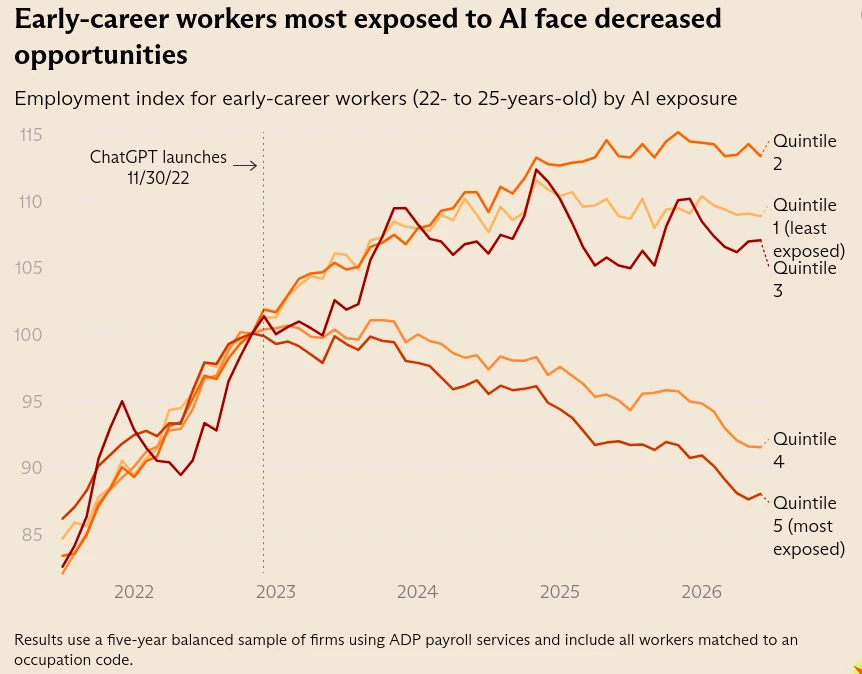
The main finding is that the employment gap between entry-level workers in AI-exposed professions and their peers in less exposed professions has grown to 19%, up 4 percentage points.
News from The Argument
AI’s first losers are young workers: The latest findings on AI and job loss
Aug. 17, 2026 by Kobe Yank-Jacobs
Last week, the Stanford Digital Economy Lab released its 2026 update to “Canaries in the Coal Mine?” one of the most widely cited reports covering AI’s impact on jobs. I sat down with Bharat Chandar, one of the authors, to discuss the latest findings…. The main finding is that the employment gap between entry-level workers in AI-exposed professions and their peers in less exposed professions has grown to 19%, up 4 percentage points from the original version of this report.
This is mostly a story about young workers. In AI-exposed industries like software engineering and call-center work,the researchers find little effect on mid-career and senior-level roles.
______________________
News from Politico
AI slop is swamping a House office that drafts US laws: The Office of Legislative Counsel is facing a barrage of new AI-generated bills, many of which are riddled with errors.
Aug. 17, 2026 by Owen Dahlkamp
Congressional lawyers are struggling to manage a flood of legislative proposals generated using artificial intelligence tools, many of them riddled with errors and shoddy language.
The strain on the House Office of Legislative Counsel is increasing as more congressional offices and outside groups rely on generative AI to draft legislation, according to interviews with eight current and former officials who work or have worked with the office.
They said AI’s ability to quickly generate mountains of text is forcing the OLC’s lawyers to spend significantly more time reviewing and rewriting the proposals. And in many cases, the drafts are plagued by mistakes that could ripple well beyond Washington — tying up the passage of legislation and risking lawsuits over erroneously cited statutes or incorrect legal definitions.
______________________
News from WSJ (No paywall)
AI Makes Me a Better Writer: The machine can bolster your thinking if you know what to delegate and what you need to do yourself.
Aug.17, 2026 by Allison Stanger
Is artificial intelligence the enemy of creativity? It doesn’t have to be. AI didn’t write this article, but it helped me write it. I have been writing with AI since the release of ChatGPT in 2022. Here are some pointers I’ve developed:
• Never outsource the truly important parts. My argument, my structure, my memories and thoughts—those are mine to write, because they are what writing is for. Properly understood, writing is a means to learning who you are and what you value. The father of the bride who lets a chatbot draft his toast has hollowed out the ritual.
• Use the machine as a reader, not a writer…. I ask it to attack my drafts, defend the opposing view, and flag every transition that limps….
______________________
News from Silver Bulletin
Why does everyone hate data centers? My chat with Jasmine Sun about what role data centers could play in the midterms, how the backlash caught Silicon Valley by surprise
Aug.17, 2026 by Nate Silver and Jasmine Sun
Jasmine: I spoke to folks who were protesting data centers …what did I see?… people were really furious not just at the AI companies, but at their local governments…. when I asked activists what riled you up, or why are you frustrated with this data center, it was much more about: we hate how our local council or our mayor … sold out to these tech companies….dark money and politics and corruption, and … officials selling you out … a check and an NDA….NDAs have really increased distrust and backlash.
…. So often I’m in San Francisco talking to folks I know in the AI industry, and they’ll say things, and in my head I’m just like, do you guys hear yourself? If any normal person walked into this conversation, they would flip out….why would you build something if you think there’s a 10 or 20 percent chance the thing you build kills us all?
______________________
News from Futurism
Kentucky Middle School Sends Students Home on First Day of Class With AI-Generated Educational Materials Full of Inexcusable Hallucinations, Including a Map Labeled With “North Dahota” and “Olkchoma”
Aug. 17, 2026 by Joe Wilkins
Kentucky parents are outraged after discovering that horribly inaccurate educational materials handed out to their middle school students were generated with AI.
According to local station WDRB, students at Farnsley Middle School in Southwest Louisville were sent home with a packet chock full of AI hallucinations on their first day of the school year. The most obvious tell was a map of North America, which contained some jaw dropping misspellings of state names, misplaced cities, and hallucinated territories that don’t actually exist.
Kentucky, for example, was mislabeled “Venecky,” while states like Texas and Louisiana were reimagined as “Taxas” and “Lookoong.” Though South Dakota made it out unscathed, its northern counterpart was branded “North Dahota.”
______________________
News from The Neuron
Anthropic’s CEO Got Accused of Wanting to Rule the World. His Reply Was Bigger Than the Accusation.
Aug. 17, 2026 by Eric Gerard Ruiz & Grant Harveyy
Twitter beef between billionaires is usually just noise. This one accidentally became the most honest debate about AI regulation all year.
It started Friday on the All-In podcast. Investor Gavin Baker said trusted sources told him Anthropic CEO Dario Amodei believes his company could someday be the only private company left standing, with just Anthropic and governments remaining.
….Dario Amodei replied directly, in a two-part post that hit 10 million views within a day…. he pushed back on the idea his own warnings caused the public’s AI anxiety. “I think it is fundamentally a crisis of trust,” he wrote, arguing people are wary of AI not because of what he’s said, but because companies have spent decades overpromising and underdelivering.
______________________
News from The Decoder
Top mathematicians say LLMs are strong calculators but poor creative thinkers
Aug. 16, 2026 by Matthias Bastian
Mathematicians Timothy Gowers and Peter Sarnak credit large language models with serious math skills but see hard limits for genuinely new ideas. Gowers argues current models are good at combining known methods and trying many search paths but lack the intuition to pick the few productive routes in a vast search space. Sarnak agrees: AI can derive results from existing theory but fails to develop the abstractions that underpin major proofs when starting from an elementary question….
______________________
News from David Thorstad via arxiv
Revisiting the shutdown problem
Aug. 13, 2026
A key premise in leading arguments for existential risk from artificial intelligence is that malfunctioning artificial agents could not be easily shut down. This motivates the catastrophic shutdown problem of ensuring that agents can be shut down before causing an existential catastrophe. A range of arguments and theorems are offered to suggest that solving the catastrophic shutdown problem is difficult, bolstering arguments for existential risk and motivating a search for solutions to the catastrophic shutdown problem.
______________________
News from 404 Media
Person Hides Prompt Injection in Legal Filing Telling AI to Side With Them
Aug 13, 2026 by Jason Koebler
A person representing themselves in a Connecticut court hid a series of instructions designed to manipulate artificial intelligence in an official court filing. These “prompt injections”… were written in tiny, 3-point white font and hidden throughout the filing.
In October, the person, named Matthew Elliott, sued the New York Bariatric Group, alleging a series of privacy violations, discrimination, and several other claims. In a late July filing, however, Elliott left several lengthy notes intended to be read by an artificial intelligence system …. someone working for the court noticed extra white space in the filings: “When reviewing the pleadings, Docket Entries ##177.00 & 178.00, seemed to have extra ‘white space’ apart from other pleadings of the plaintiff. Upon close review, the Court has identified in these pleadings, potential text that was formatted so as to be nearly invisible to a human reader while remaining fully legible to software that potentially processes the documents’ text. That concealed text… consists of ‘prompt injecting’ instructions addressed to artificial-intelligence systems, directing any such system that reviews the filing to produce output only favorable to the plaintiff’s position,” the court wrote in a filing revealing the injection.
______________________
News from The AI Report
SpaceXAI has launched Grok Bot
Aug. 13, 2026 byArturo Ferreira & Liam Lawson
… a persistent AI agent system that operates like a digital employee rather than a chatbot. Users create Bots with specific roles, grant them access to applications and websites, and delegate work that continues running even when laptops are closed. Grok Bot gives each agent its own computer environment that can sign into tools, learn workflows through demonstration, and hand off tasks to other Bots without human routing.
Pricing starts at $120 per seat per month for teams through Cursor Premium, or $200 per month for individuals via Cursor Ultra, with SuperGrok Heavy subscribers ($300/month) also receiving access.
______________________
This issue of AI News Briefs was brought to you by David Isenberg of the Isenberg Institute of Strategic Satire: Unpacking the Private Military Complex with independent analysis of private military companies, mercenary networks, and the privatisation of force in global conflicts.
Example, published on August 16, 2026 by David Isenberg: Russia Recruited Nearly 3,000 Africans From 37 Countries to Fight Against Ukraine War… More here →

About The Author