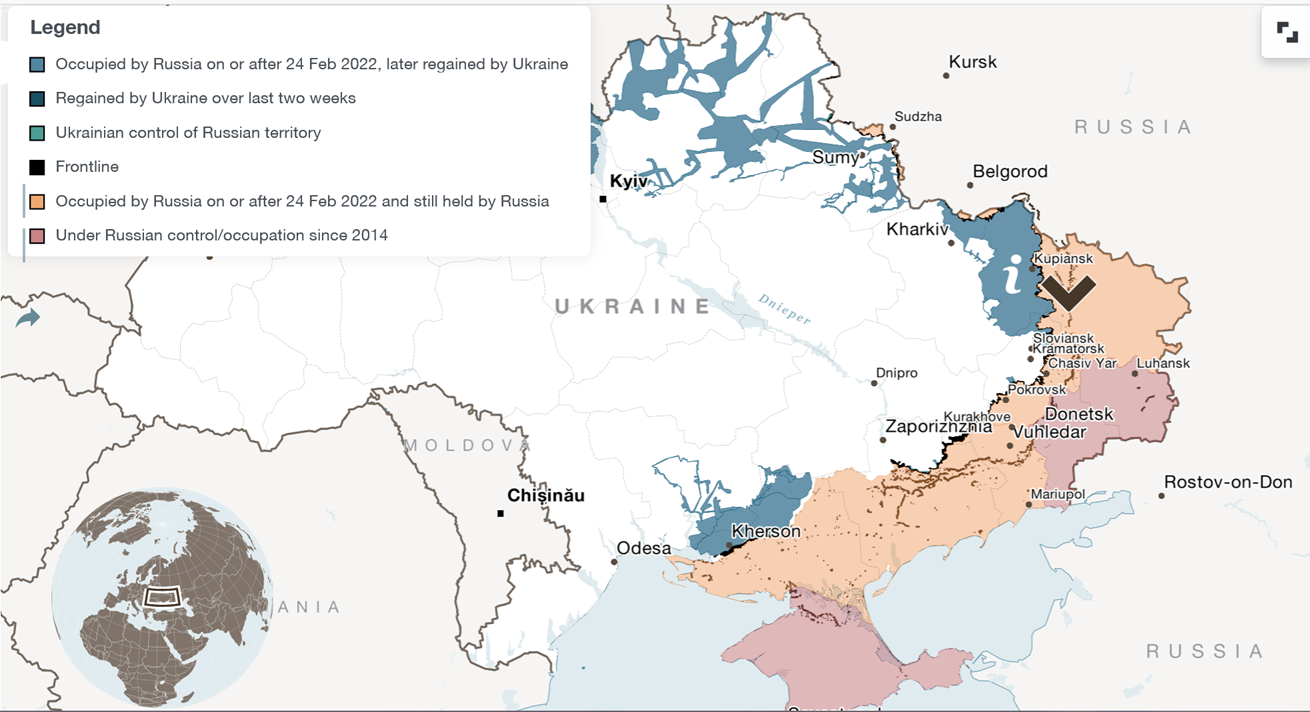
This interactive map shows the shifting front lines in the Russo-Ukrainian war. Users can zoom in to conflict zones to view daily changes in troop movements and battlefield dynamics. Data for this map is taken from the Ukrainian OSINT DeepState project, a live map of Russian and Ukrainian military operations maintained since April 2022. The data is automatically updated here. Source: https://www.crisisgroup.org/visual-explainers/ukraine-war-map-tracking-frontlines
Obtaining outside data.
Checking internet sources, using keywords: Ukraine ceasefire 2026
News from various sources:
In June 2026, discussions surrounding a potential Ukraine ceasefire and peace negotiations have been taking place within the global community. European leaders debated representation for the EU in future talks to end the ongoing war in Ukraine, with European Council president António Costa being suggested as the ideal candidate to represent Europe’s interests.
Despite consensus on the need for peace, there is skepticism about Russia’s readiness to end the war, which commenced in February 2022. Moscow and Kyiv have been embroiled in conflicts where current ceasefires have failed, perpetuated by mutual accusations of violations.
The U.S. had brokered a temporary ceasefire for Victory Day on May 9, 2026, which was set to include a prisoner exchange between Russia and Ukraine. However, both sides continued experiencing attacks and accused each other of noncompliance.
Simultaneously, Ukraine has reportedly been making tactical advances, having restructured its military to improve training and effectiveness. This restructuring, coupled with their drone technology, has given them some advantages on the battlefield. Meanwhile, Russia faces logistical and structural military challenges, presenting a possible opening for ceasefire discussions.
The G7 summit in June 2026, which included Ukraine’s President Volodymyr Zelensky, focused on reaffirming international support for Ukraine. It highlighted Ukraine’s push for more anti-ballistic capabilities to counter Russian-drone and missile strikes. President Donald Trump signaled intentions to shift diplomatic focus back towards Ukraine, suggesting sanctions might be reimposed on Russian oil as part of broader geopolitical strategies.
The discussions underline a global recognition of a need for a strategic ceasefire, amid Ukraine’s improved stance and Russia’s ongoing challenges. Yet, achieving a genuine, lasting peace remains complex, as geopolitical interests and military realities continue to unfold.
Fact-checked summary:
As of October 2023, there is skepticism about Russia’s readiness to end the war in Ukraine, which has been ongoing since February 2022. Both Moscow and Kyiv have experienced conflicts where previous ceasefires failed due to mutual accusations of violations, highlighting the persistent challenges in achieving a sustainable peace agreement. Additionally, Russia is facing logistical and structural military challenges, which could impact its ability to sustain prolonged conflict. These facts are important because they provide context for the difficulties in negotiating a ceasefire or armistice by 2026 in Ukraine, emphasizing ongoing skepticism and military challenges as critical factors influencing the likelihood of achieving peace.
OpenAI gives a base rate of 0.15 (15%)
The question difficulty is rated 9 (0 to 10)
A Bayesian calculation could be performed as follows:
The base prior of 0.15 from historical conflict resolutions is adjusted with a pessimistic view due to historical failures and moderate international pressure. Using the Bayesian formula: ((Previous ceasefire success rate * 0.2) + (Conflict history impact * 0.5) + (Diplomatic intervention effectiveness * 0.3)) around current conflict likelihood. Assuming pessimistic overall likelihood only slightly improves to 0.17.
Bayesian base rate: 0.17 (17%)
Sufficient news to provide a good forecast? 1 (0 or 1)
News is relevant, topical and unbiased? 1 (0 or 1)
Question classification: scenario_based_forecast
Expected time (days) until question close: 195
The following were considered in order to produce this base rate:
The base rate was chosen by examining historical conflict resolution probabilities similar to the Russia-Ukraine war. The historical success of ceasefires and armistices is low, especially given repeated failures between the two nations and current military tensions.
Ideally, the news feed would contain the following sorts of information for a better forecast:
Additional information on the current internal political climate in Russia and Ukraine, intelligence on military strategy changes, and shifts in global diplomatic efforts would enhance this forecast.
Some potential divergent considerations that might affect the base rate:
Factors that could diverge from the base rate include increased pressure from influential international stakeholders, changes in leadership or strategy within Russia or Ukraine, or significant changes in the economic or military situation affecting the sustainability of the conflict.
The following chain of events are necessary for the question to resolve positively:
- Successful negotiations between Russia and Ukraine leading to a ceasefire or armistice – Low likelihood.
- Both nations, and potentially their allies, agree on terms acceptable to all parties – Low likelihood.
- Effective enforcement mechanisms for any agreement to ensure compliance – Low likelihood.
- Resolution or significant de-escalation of current military challenges faced by both Russia and Ukraine – Moderate likelihood.
- International diplomatic intervention resulting in pressure on both parties to reach an agreement – Moderate likelihood.
Querying Claude (AI predicts: 0.22 – confidence: 3)
Querying Mistral (AI predicts: 0.22 – confidence: 6)
Querying OpenAI (AI predicts: 0.2 – confidence: 4)
Explanations of the statistical measures listed below.
Question Type: Binary
Median from LLMs: 0.22
Base rate: 0.15 (from OpenAI)
SD: 0.01
MAPD: 0.013333333333333
Confidence: 4
Conf Mode: Low
Mellers: 0.14
Reverse Mellers: 0.31
Theory of Mind: 0 (What did the LLMs think other LLMs predicted?)
Beta Distribution: 0.001
Close Type: A (B = cautious # closer to 50%; A/C = closer to extremes)
LLM responses: 3
Model value: 22%
The reasoning across the AI predictions suggests a 22% likelihood of a ceasefire or armistice in Ukraine by the end of 2026, considering a range of historical, diplomatic, and military factors. The base probability draws from historical data on ceasefires in similar prolonged conflicts, which is generally low due to mutual distrust and repeated breakdowns of past agreements. The current military stalemate, with Russia facing logistical constraints and Ukraine maintaining its defenses amidst dwindling Western support, creates a context where neither side has a clear path to victory, yet neither is inclined to concede. Diplomatic pressures have intensified, particularly from the Trump administration, but these efforts have yet to translate into meaningful negotiations, thus slightly elevating the probability from the historical base rate but not significantly. Various scenarios could alter this prediction: effective diplomatic interventions, sudden changes in military fortunes, shifts in political leadership, or increased economic pressures could either increase the likelihood of a ceasefire or validate continued conflict, reflecting a complex and unpredictable geopolitical landscape.
Runtime: 121 seconds.
About The Author