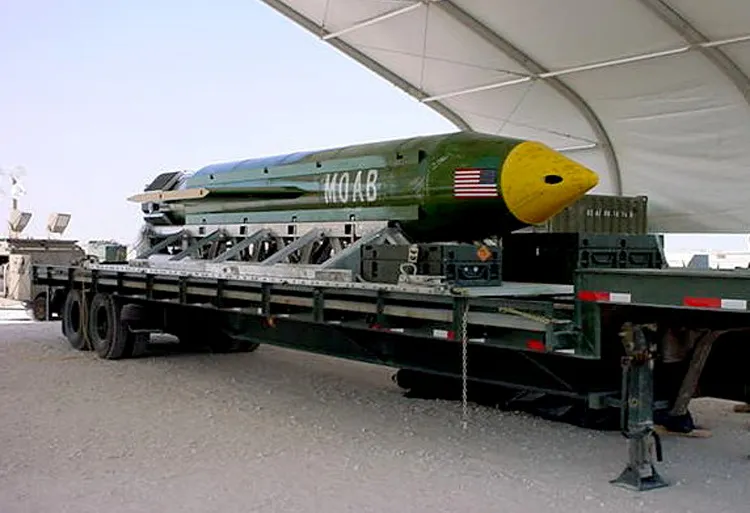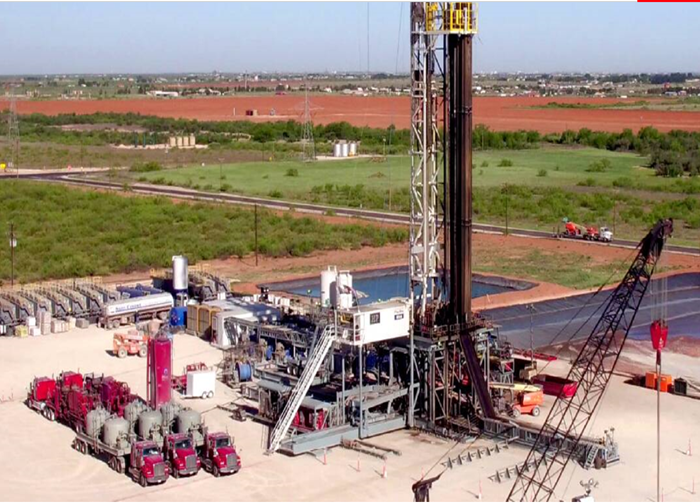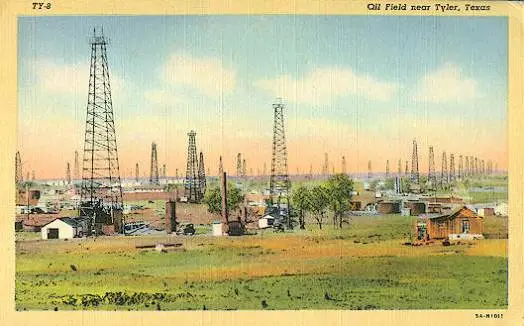
Old postcard of a West Texas oilfield.
Obtaining outside data.
Checking internet sources, using keywords: Brent Crude price 2026
News from various sources:
The content about Brent Crude price in 2026 offers various perspectives, driven by geopolitical tensions, particularly the US-Iran conflict:
- Current Price Movements: As of the early months of 2026, Brent crude prices have experienced volatility due to geopolitical tensions, especially the US-Israel conflict with Iran. Brent crude rose to nearly $112 before slight reversals to $108.62. WTI crude saw similar fluctuations, indicating market sensitivity to regional instability.
- Geopolitical Influence: The US-Iran tensions have significantly influenced oil prices. The conflict has led to strategic threats, such as the potential closure of the Strait of Hormuz by Iran, through which a significant portion of the world’s oil passes. This has caused disruptions in oil supply and contributed to price surges.
- Future Outlook by EIA: The US Energy Information Administration (EIA) predicts that Brent crude will remain high in the short term but may decline significantly in the second half of 2026, falling below $80 per barrel in the third quarter and easing to around $70 by year-end. The ongoing Middle East conflicts and their resolutions are critical factors for these projections.
- Market Expectations and Strategies: Analysts suggest that geopolitical tensions embed a risk premium in oil prices. There is an expected effort to maintain Brent crude at or above the $70 benchmark to ensure fiscal stability across oil-producing states. OPEC+ is likely to play a vital role in stabilizing prices.
- Continuing Conflict Impact: Escalating tensions could lead to sustained high prices, especially if the conflict spreads, affecting other regional oil infrastructure and supply. The probability of a longer confrontation keeps risk premiums high, contributing to price fluctuations.
- Economic and Political Ramifications: The conflict’s potential to escalate into broader regional unrest poses risks to energy infrastructures and economic stability. High energy costs could become a political liability for governments, especially seen in the US with upcoming mid-term elections.
Overall, the Brent crude price in 2026 is highly sensitive to geopolitical developments, particularly in the Middle East, with analysts projecting significant fluctuations depending on conflict resolution and regional stability.
Fact-checked summary:
In early 2026, Brent crude prices experienced significant fluctuations, rising to nearly $112 before reversing to $108.62 per barrel. Geopolitical tensions, particularly US-Iran tensions leading to potential closure threats of the Strait of Hormuz, have played a critical role in oil supply disruptions and price surges, embedding a risk premium in oil prices. (Carolyn‘s note: Surprisingly, while the Mullti-AI Oracle cites the recent March 30 data on oil prices [1], it claims that there is only a risk of closure of the Strait of Hormuz, despite it having been closed since March 2, 2026. [2] ) The US Energy Information Administration (EIA) forecasts that Brent crude will fall below $80 per barrel in Q3 2026 and ease to around $70 by the end of the year. However, there are efforts to maintain Brent crude at or above $70 for fiscal stability, and OPEC+ is likely to play a vital role in stabilizing prices. Escalating tensions could sustain high prices, as conflicts that affect regional infrastructure could exacerbate risk premiums. These facts collectively suggest that the price of Brent crude is unlikely to fall below $50 per barrel in 2026, given the current economic and geopolitical conditions.
OpenAI gives a base rate of 0.05 (5%)
The question difficulty is rated 7 (0 to 10)
Historical weighted factors include:
Geopolitical Tensions, 0.3
OPEC+ Influence, 0.3
Global Economic Growth, 0.2
Technological Advances in Oil Production, 0.1
Market Speculation and Financial Influence, 0.1
A Bayesian calculation could be performed as follows:
Using historical factors, current tensions are high but offset by OPEC+ management and moderate economic growth. Initial estimate that prices fall below $50 is low. Updating likelihoods with moderate economic stability and regional tension resolution, result is low 0.05.
Bayesian base rate: 0.05
Sufficient news to provide a good forecast? 1 (0 or 1)
News is relevant, topical and unbiased? 1 (0 or 1)
Question classification: reference_class
Expected time (days) until question close: 270
The following were considered in order to produce this base rate:
The base rate considers historical incidents of Brent crude falling below $50, which are rare given current economic and geopolitical factors. OPEC+ has historically acted to prevent drastic price drops.
Ideally, the news feed would contain the following sorts of information for a better forecast:
Additional details on potential geopolitical resolutions and updated forecasts from major financial institutions could help forecast more accurately.
Some potential divergent considerations that might affect the base rate:
Any unexpected geopolitical resolving or major economic downturn could cause prices to drop significantly, differing from current base rate assumptions.
The following chain of events are necessary for the question to resolve positively:
- OPEC+ does not intervene to stabilize prices (unlikely)
- Global recession significantly reduces oil demand (moderately likely)
- Resolution of US-Iran tensions leads to more stable geopolitics (moderately unlikely)
- Significant new oil supply sources become available (unlikely)
Querying Claude (AI predicts: 0.07 – confidence: 6)
Querying Mistral (AI predicts: 0.15 – confidence: 7)
Querying OpenAI (AI predicts: 0.1 – confidence: 6)
Explanations of the statistical measures listed below.
Question Type: Binary
Median from LLMs: 0.1
Base rate: 0.05 (from OpenAI)
SD: 0.03
MAPD: 0.053333333333333
Confidence: 6
Conf Mode: Normal
Mellers: 0.04
Reverse Mellers: 0.19
Theory of Mind: 0.05 (What did the LLMs think other LLMs predicted?)
Beta Distribution: 0.08
Close Type: A (B = cautious # closer to 50%; A/C = closer to extremes)
LLM responses: 3
Model value: 10%
The consensus among the AIs is that it is highly unlikely for Brent crude oil prices to fall below $50 per barrel in 2026, considering the numerous factors at play. Historically, prices have rarely fallen to such lows due to consistent OPEC+ interventions and the presence of a geopolitical risk premium, influenced by tensions such as those with Iran and concerns around the Strait of Hormuz. As of early April 2026, Brent crude is trading around $108, significantly above the $50 mark. The EIA projects prices to remain above $70 by the end of 2026, reinforced by historical patterns that suggest rapid price declines require extraordinary conditions. However, potential factors that could invalidate this prediction include an unexpected global economic downturn, a resolution of geopolitical tensions that diminishes the risk premium, OPEC+ failing to uphold production cuts, or disruptive technological advances in energy. Nonetheless, given the short timeframe and the current geopolitical and economic environment, such drastic changes appear improbable.
Runtime: 139 seconds.
About The Author