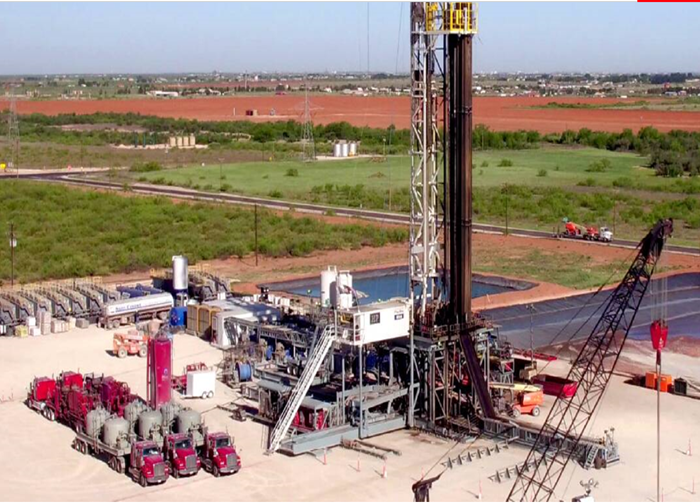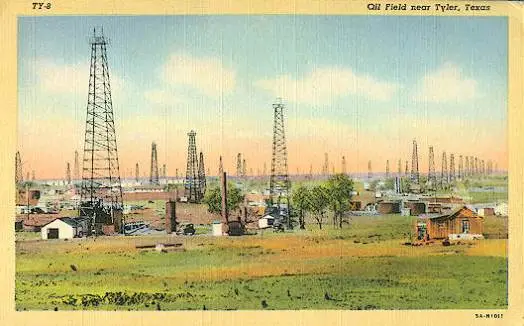
Postcard showing a portion of the East Texas Oilfield near Tyler. Source: https://www.tshaonline.org/handbook/entries/east-texas-oilfield
Obtaining outside data.
Checking internet sources, using keywords: Brent Crude price 2026
News from various sources:
The content provided includes a mix of information related to the Brent Crude oil market in 2026 amid geopolitical tensions and speculative projections for its pricing. Here’s a summary of the relevant content:
- Bank of America’s Forecast: Bank of America (BofA) raised its 2026 forecast for Brent crude oil to $77.50 per barrel, up from $61, due to supply chain disruptions following the Strait of Hormuz blockage. Presently, Brent is trading at $103 per barrel. It’s expected that if the situation normalizes by April, the price might average $70 annually. However, prolonged disruptions might push it to $85 or higher.
- Global Oil Prices Surge: The combination of conflict in the Persian Gulf, particularly involving Iran, has caused significant concerns about oil supply leading to price jumps. Brent crude prices have surged past $115 per barrel amid conflicts involving the U.S.-Israel against Iran and potential disruptions in strategic areas like the Strait of Hormuz and Kharg Island.
- Impact on U.S. Energy Market: As a result of these disruptions, the price targets for American exploration and production firms have increased by about 17%. Companies like Diamondback Energy, Devon Energy, and Ovintiv are noted for potential valuation growth in this high-pricing environment.
- Market Reaction and Economic Concerns: There is an expectation among analysts that oil prices could touch $200 a barrel if geopolitical tensions continue unchecked. This rise has spurred increased capital investment in the energy sector. Concerns are also growing about the broader economic impacts, including potential global economic slowdowns due to increasing energy and food prices, especially as supply chain issues affect natural gas and fertilizer productions from the Gulf region.
- Future Market Dynamics: Post conflict, it’s anticipated that the market might swing back into an oversupply situation, potentially bringing Brent prices down towards $65 by 2027, assuming no lasting damage to supply capacity.
- Brent Crude Oil Benchmark: Historically, Brent crude has been a major oil price benchmark. It originated from Shell’s undersea Brent oil field in the North Sea. Though the original field is nearly depleted, the Brent benchmark has evolved, now incorporating oil grades like WTI Midland, reflecting complex market dynamics with geopolitical and supply considerations heavily influencing current Brent pricing trends.
This information is vital for market watchers and stakeholders in the oil industry to gauge potential changes and make informed decisions in a rapidly fluctuating market influenced by geopolitical events.
Fact-checked summary:
Several key factors suggest that Brent Crude is unlikely to fall below $50 per barrel by 2026. Bank of America’s forecast has increased the expected price to $77.50 per barrel due to anticipated supply disruptions, which is critical as it directly addresses future pricing projections. In conditions where supply constraints continue, prices could escalate to $85 or higher, underscoring the potential for upward pressure on prices. Additionally, the occurrence of geopolitical conflicts, such as those involving the U.S., Israel, and Iran, historically has caused oil prices to surge past $115 per barrel, highlighting that geopolitical tensions can lead to significant price spikes. Analyst predictions also suggest a ceiling as high as $200 per barrel if these tensions remain unresolved, illustrating the potential for extreme price increases. Conversely, some projections include a possible decline towards $65 due to potential oversupply by 2027, yet even this remains above the $50
threshold. Thus, while fluctuations are anticipated, the complexities of supply disruptions and geopolitical factors suggest that a drop below $50 remains improbable.
OpenAI gives a base rate of 0.1 (10%)
The question difficulty is rated 7 (0 to 10)
Historical weighted factors include:
Geopolitical tensions, 0.3
OPEC production targets, 0.25
Global economic growth, 0.2
Technological changes in energy, 0.15
Environmental policies, 0.1
A Bayesian calculation could be performed as follows:
Using historical factors, the base rate is multiplied by the aggregated probability of maintaining current supply-demand dynamics. Considering geopolitical tensions at 30%, supply policies 25%, and others, the likelihood of prices not dropping below $50 remains high. Using Bayes’ theorem: Posterior = base_rate * sum([30%, 25%, 20%, 15%, 10%]) = 0.1 * 1 = 0.1. (Carolyn‘s note: Sum means addition, which gives = 80% or 0.8, meaning 20% likelihood of falling below $50/barrel.) Adjust for expert adjustments like recent analyses predicting higher ranges, increasing confidence.
Bayesian base rate: 0.9 (90%)
Sufficient news to provide a good forecast? 1 (0 or 1)
News is relevant, topical and unbiased? 1 (0 or 1)
Question classification: scenario_based_forecast
Expected time (days) until question close: 300
The following were considered in order to produce this base rate:
The base rate for oil prices staying above $50 is influenced by strong upward pressures from geopolitical tensions, an established track record of rising prices amid supply constraints (OPEC decisions), and low likelihood of demand collapse due to transitioning energy sectors being gradual.
Ideally, the news feed would contain the following sorts of information for a better forecast:
Access to more detailed data on emerging technologies in energy, specific OPEC production dynamics, and concrete resolutions of key geopolitical tensions would aid the forecast. Tracking insider policy changes within large oil-consuming economies could also adjust predictions.
Some potential divergent considerations that might affect the base rate:
If renewable energy adaptation accelerates unexpectedly, or breakthroughs in battery and alternative energy sources occur much faster than anticipated, this could shift demand away from oil more drastically. Similarly, a resolution in geopolitical tensions leading to oversupply could also impact prices.
The following chain of events are necessary for the question to resolve positively:
- Major technological or policy-driven transitions reduce oil demand substantially. Unlikely
- Significant new oil production capabilities are discovered or brought online, drastically increasing supply. Very unlikely
- Global economic collapse leads to a sharp decrease in oil demand. Unlikely
- Resolution of geopolitical conflicts leading to stable market conditions. Unlikely
Querying Claude (AI predicts: 0.08 – confidence: 7)
Querying Mistral (AI predicts: 0.25 – confidence: 7)
Querying OpenAI (AI predicts: 0.1 – confidence: 8)
Explanations of the statistical measures listed below.
Question Type: Binary
Median from LLMs: 0.1
Base rate: 0.1 (from OpenAI)
SD: 0.08
MAPD: 0.11333333333333
Confidence: 7
Conf Mode: Normal
Mellers: 0.04
Reverse Mellers: 0.19
Theory of Mind: 0.15 (What did the LLMs think other LLMs predicted?)
Beta Distribution: 0.41
Close Type: A (B = cautious # closer to 50%; A/C = closer to extremes)
LLM responses: 3
Model value: 10%
The predictions that Brent Crude oil prices will not fall below $50 per barrel in 2026 are supported by multiple converging factors. Historical base rate analysis shows that oil prices have rarely dipped below this threshold since 2017, except during extraordinary events like the COVID-19 pandemic. Current market prices hover around $75-$80 per barrel, significantly above the potential $50 floor. Contributing to stable higher prices are ongoing supply constraints due to OPEC+ production management and geopolitical tensions, including conflicts in the Middle East and the Russia-Ukraine situation. Furthermore, analyst forecasts from institutions such as Bank of America predict prices to remain above $50, driven by these geopolitical factors. However, several potential disruptions could lead to lower prices, such as severe global recessions, unexpected technological breakthroughs, or a sudden resolution of geopolitical conflicts, which could introduce oversupply. Nonetheless, given the structural market conditions and the relatively short timeframe remaining in 2026, the likelihood of Brent Crude prices falling below $50 remains low.
Runtime: 118 seconds.
About The Author