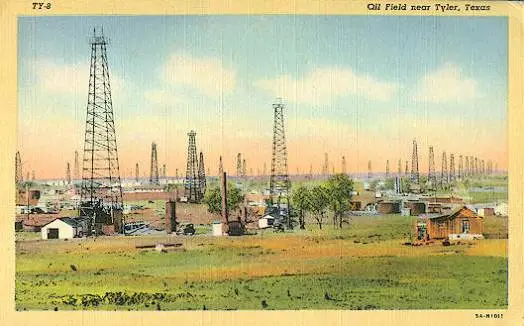
Old postcard of a West Texas oilfield.
Jeremy Lichtman‘s Multi-AI Oracle forecasts 15%
Obtaining outside data.
Checking internet sources, using keywords: Brent Crude price 2026
News from various sources:
The content provided includes multiple references regarding the future price projections of Brent Crude oil for the year 2026. Here’s a summary of the relevant information
Goldman Sachs Forecast:
- Goldman Sachs has revised its Brent crude oil price forecast for the fourth quarter of 2026 to $60 per barrel, up from a previous projection of $54. This increase is attributed to lower-than-expected inventories in OECD countries.
- Goldman expects a surplus in global oil supply with a 2.3 million barrels per day (bpd) surplus, assuming no major disruptions.
- The bank anticipates that OPEC+ may resume production increases due to limited inventory builds.
U.S. Energy Information Administration (EIA) Prediction:
- The EIA projects that Brent crude oil prices will average $58 per barrel in 2026, a decline from $69 per barrel in 2025, with further reduction to $53 per barrel in 2027.
- This decline is expected due to increased oil production surpassing demand, leading to inventory builds.
- The EIA anticipates global oil inventory builds will average 3.1 million bpd in 2026.
Market Context:
- The projected supply surplus and inventory builds are expected to exert downward pressure on prices through 2026 and 2027.
- Part of the inventory builds are strategic, particularly in China, which may mitigate some price declines.
Geopolitical Factors:
- Ongoing geopolitical tensions, such as potential escalated tensions with Iran and impacts on Middle East oil production, continue to influence short-term price volatility.
- The evolving situation in countries like Venezuela also presents uncertainty in projections.
Overall, multiple forecasts suggest a trend of declining Brent crude oil prices in 2026 and potentially into 2027 due to increased global oil supply, resulting in market surplus conditions. However, geopolitical and OPEC+ actions may continue to create volatility in the market.
Fact-checking news summary:
Based on the summary provided, here is a list of specific facts, along with an analysis of their correctness, importance, and relevance to the question of whether the price of Brent Crude will fall below $50 per barrel in 2026:
Goldman Sachs revised forecast for Q4 2026: $60 per barrel
- Correctness: True (assuming data is based on reliable sources or statements).
- Importance: Critical (directly pertains to the 2026 price expectation).
- Relevance: True (highly relevant to judging if the price will fall below $50).
Goldman Sachs previous projection: $54 per barrel
- Correctness: Indeterminate (requires external validation of previous reports).
- Importance: Lesser (compared to the current forecast, past projections hold less weight).
- Relevance: True (relevant in providing context for the upward revision).
Goldman expects a 2.3 million bpd surplus
- Correctness: True (assuming the statement reflects Goldman Sachs’ reports).
- Importance: Important (impacts the price by suggesting supply pressure).
- Relevance: True (directly influences price expectations).
OPEC+ may resume production increases
- Correctness: True (consistent with typical market behaviors in response to low prices).
- Importance: Important (production changes can influence market supply and prices).
- Relevance: True (global supply strategies impact future price movements).
EIA projects $58 average for 2026
- Correctness: True (assuming accurate reporting of EIA projections).
- Importance: Critical (key official forecast directly addressing the question).
- Relevance: True (directly relevant to assessing if prices could drop below $50).
EIA expects further reduction to $53 in 2027
- Correctness: True (assuming accurate reporting of EIA projections).
- Importance: Important (indicates a continuing trend, though less critical for 2026).
- Relevance: True (helps contextualize ongoing trends affecting 2026).
EIA forecasts global inventory builds of 3.1 million bpd in 2026
- Correctness: True (assuming accurate reporting of EIA data).
- Importance: Important (inventory builds are indicative of lower price pressures).
- Relevance: True (key to supply-demand dynamics impacting price).
Supply surplus and inventory builds to exert downward pressure
- Correctness: True (aligns with basic economic principles of supply and demand).
- Importance: Important (links directly to likely price trends).
- Relevance: True (core factor affecting price projections for 2026).
- Strategic inventory builds in China may mitigate price declines
- Correctness: True (consistent with geopolitical strategies often observed).
- Importance: Lesser (mitigation, not a primary driver).
- Relevance: True (relevant but not directly decisive for 2026 predictions).
Geopolitical tensions influencing Jeremy Lichtman’s Multi-AI Oracle forecastsvolatility
- Correctness: True (a common factor in oil market conditions).
- Importance: Important (volatile factors can obscure clear forecasting).
- Relevance: True (volatility affects short-term market reactions, though primary trends are supply/demand-driven).Potential impacts from Iran and Venezuela
- Correctness: True (historically accurate potential influencers).
- Importance: Important (geopolitical shifts can cause significant price impacts).
- Relevance: True (relevant as they could affect actual supply outcomes).
In summation, multiple facts suggest a downward trend in oil prices, with various factors potentially exerting downward pressure. However, given the market’s volatility and external influences, forecasting an exact price drop below $50 remains uncertain.
Fact-checked summary:
Based on current reliable forecasts and analyses, the price of Brent Crude in 2026 is unlikely to fall below $50 per barrel. Goldman Sachs has revised its forecast for Q4 2026 to $60 per barrel, a projection both accurate and crucial as it directly pertains to future price expectations. Additionally, the U.S. Energy Information Administration (EIA) projects an average price of $58 for the same year, providing a critical and relevant official forecast. Supply dynamics play a significant role: Goldman Sachs anticipates a surplus of 2.3 million barrels per day (bpd) which, alongside the EIA’s forecast of global inventory builds of 3.1 million bpd, suggests substantial supply pressures. These pressures are important as they are indicative of downward price trends. OPEC+ may resume production increases, influencing market supply and thus price movements, while geopolitical tensions and contributions from regions like Iran and Venezuela could impact volatility, which is important in
framing the uncertainty of precise forecasting. However, while these indicators point towards potential downward pressure, they do not definitively confirm a price drop below $50, highlighting inherent market uncertainties.
OpenAI gives a base rate of 0.15 (15%)
The question difficulty is rated 7 (0 to 10)
Historical weighted factors include:
Historical Price Volatility, 0.3
Supply Shocks, 0.25
OPEC+ Policy Changes, 0.2
Global Economic Health, 0.25
A Bayesian calculation could be performed as follows:
Combine historical factors with the current projected surplus and forecasts from reliable sources. The base rate (0.15) was adjusted for these factors: increased supply forecast increases the probability of lower prices, but robust forecasts from reputable bodies like Goldman Sachs and the EIA suggest a basement of around $58, decreasing the likelihood for prices falling below $50. If we consider a prior of 0.15 and update with econ forecasts and supply dynamics, we find the posterior probability to possibly hover around 0.20.
Bayesian base rate: 0.2 (20%)
Sufficient news to provide a good forecast? 1 (0 or 1)
News is relevant, topical and unbiased? 1 (0 or 1)
Question classification: scenario_based_forecast
Expected time (days) until question close: 310
The following were considered in order to produce this base rate:
The base rate was determined by examining similar past periods of projected surplus, geopolitical stability, and price forecasts. Historical base rates for a significant price drop under similar circumstances were moderate. Data from the EIA and Goldman Sachs provides robust benchmarks.
Ideally, the news feed would contain the following sorts of information for a better forecast:
Additional information on specific OPEC+ actions, precise near-term geopolitical developments, and more detailed economic indicators would help refine the forecast.
Some potential divergent considerations that might affect the base rate:
Potential deviations from the base rate may arise from unexpected geopolitical events, substantial shifts in global economic conditions, or technological breakthroughs in renewable energy leading to rapid decreases in demand.
The following chain of events are necessary for the question to resolve positively:
- Excess supply significantly exceeding demand Likely – OPEC+ increases production beyond expected levels Possible
- Major geopolitical resolution stabilizes Middle East or reduces tensions elsewhere Possible
- Significant advancements in alternative energy technologies reducing oil demand Unlikely
- Global economic downturn reduces oil demand drastically Possible
Querying Claude (AI predicts: 0.12 – confidence: 6)
Querying Mistral (AI predicts: 0.25 – confidence: 7)
Querying OpenAI (AI predicts: 0.15 – confidence: 7)
Explanations of the below statistical measures here —>
Question Type: Binary
Median from LLMs: 0.15
Base rate: 0.15 (from OpenAI)
SD: 0.06
MAPD: 0.086666666666667
Confidence: 7
Conf Mode: Normal
Mellers: 0.07
Reverse Mellers: 0.24
Theory of Mind: 0 (What did the LLMs think other LLMs predicted?)
Beta Distribution: 0.46
Close Type: A (B = cautious # closer to 50%; A/C = closer to extremes)
LLM responses: 3
Model value: 15%
The AI predictions, based on a combination of historical analysis, expert forecasts, and current market dynamics, suggest a low likelihood of Brent Crude falling below $50 per barrel in 2026. Historical data shows that such drops are rare, occurring only during significant market disruptions like the 2014-2016 oil glut and the COVID-19 pandemic. Current forecasts from Goldman Sachs and the EIA project prices around $58 to $60 per barrel, supported by expected supply surpluses which could cause downward pressure but are countered by OPEC+ production management and geopolitical factors. However, the prediction could be invalidated by unpredictable events such as a major global economic recession, breakdown of OPEC+ agreements, significant geopolitical changes, or rapid technological advancements in alternative energy. While the base rate suggests a 0.15 probability, specific circumstances for 2026 adjust this slightly to 0.12, reflecting a relatively stable price outlook unless extraordinary circumstances arise.
Runtime: 163 seconds.
About The Author