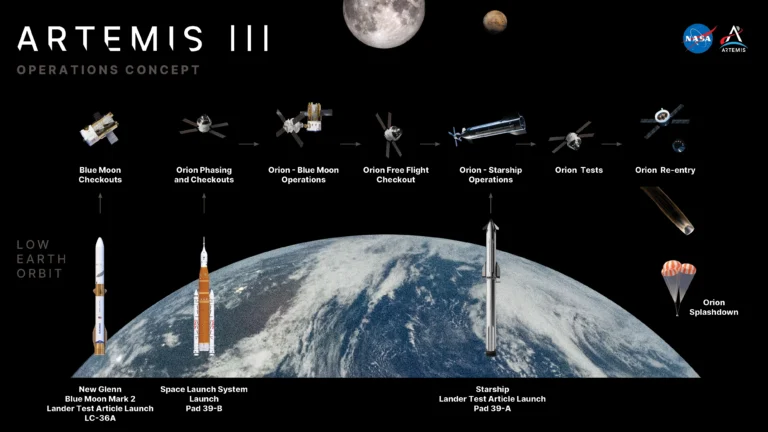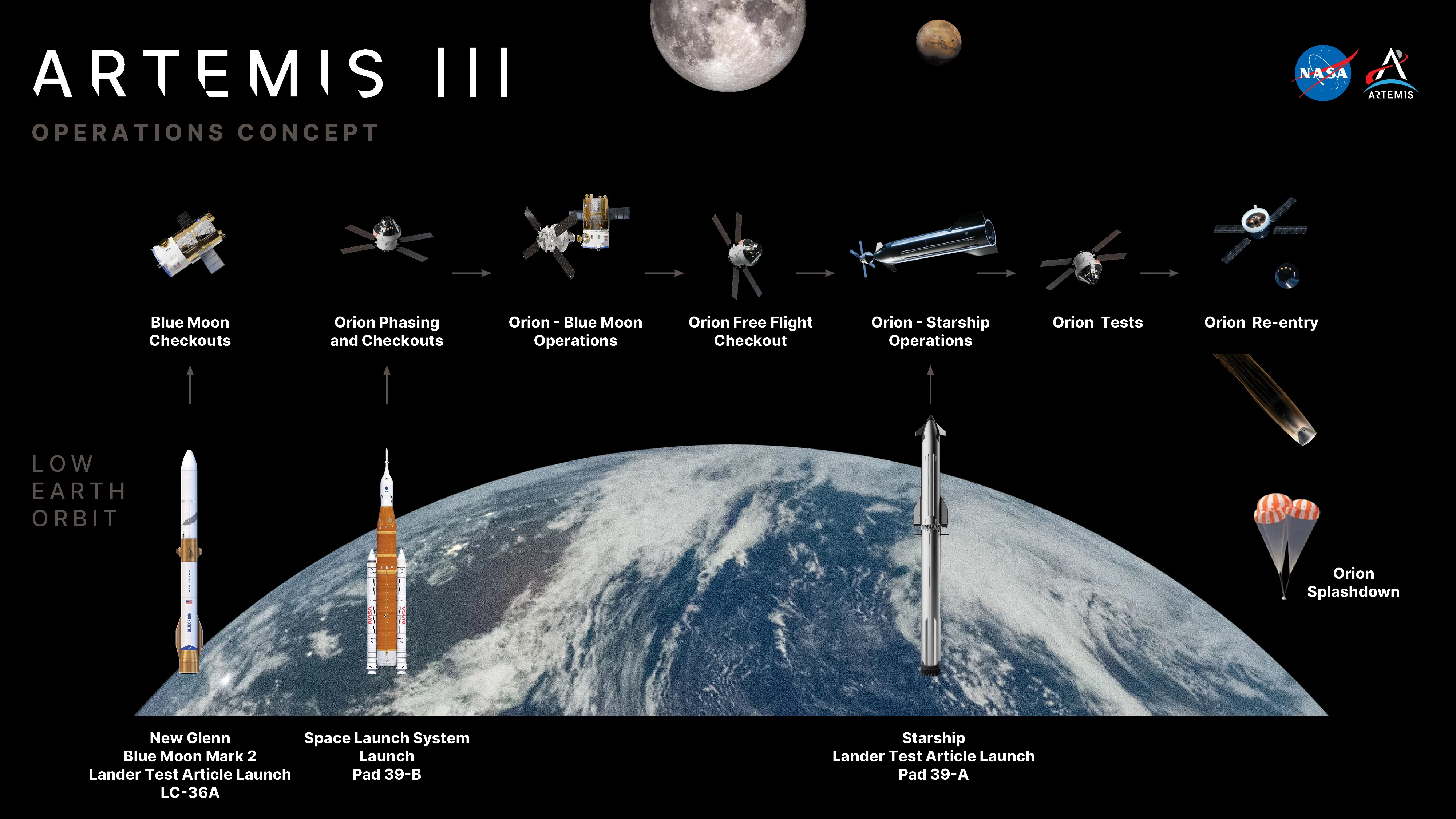
Orion is the spacecraft carrying and sustaining the crew on Artemis missions to the Moon and returning them safely to Earth. Orion launches on NASA’s heavy-lift rocket, the SLS (Space Launch System). Source: https://www.nasa.gov/humans-in-space/orion-spacecraft/orion-overview/
DeepSeek research response:
Citations
Artemis III — NASA official program page (resolution source)
Date: Accessed Nov. 23, 2026; page undated
Description: NASA’s official Artemis program page, listed as the resolution source.
Summary: NASA states that Artemis III will launch in 2027 as a demonstration mission in low Earth orbit with NASA astronauts Randy Bresnik, Frank Rubio, Andre Douglas, and ESA astronaut Luca Parmitano. The crew will test rendezvous and docking between Orion and test versions of commercial human landing systems from Blue Origin and SpaceX. The page lists Artemis IV as NASA’s first crewed Moon landing in 2028, gives no more specific Artemis III launch date than 2027, and does not yet report a completed Artemis III mission.
“NASA’s Artemis III Mission to Test Future Moon Lander Operations” — NASA
Date: Oct. 23, 2026
Description: Detailed NASA mission-profile article describing the Artemis III flight sequence and objectives.
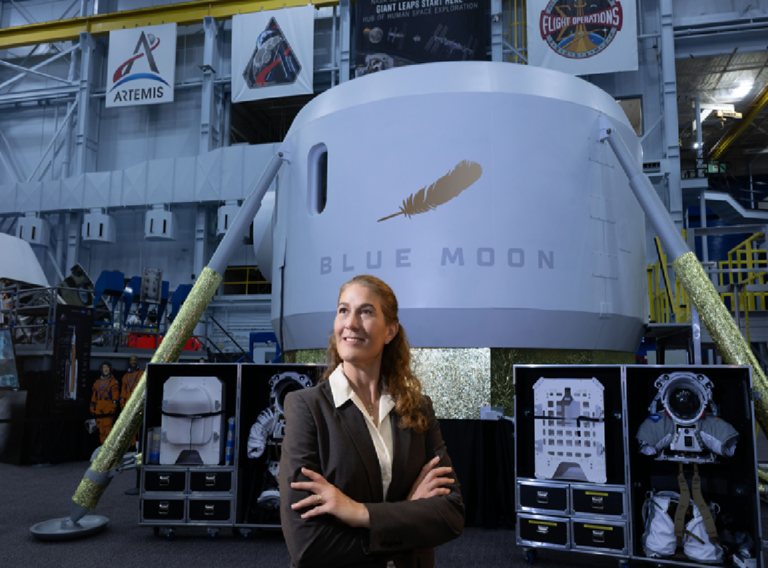
Summary: NASA says Artemis III will launch in 2027 for a planned 14-day flight involving three spacecraft and three heavy-lift rockets. Blue Origin’s Blue Moon Mark 2 test article launches first and can remain on orbit up to 30 days; Orion/SLS follows days later, and SpaceX’s Starship V3 test article launches later for a second docking. Orion will dock with Blue Moon for about two days with crew entering the lander, then dock with Starship for up to two hours without crew entering.
“Artemis III SLS Core Stage Joins Boosters at Kennedy” — NASA Science
Date: Oct. 28, 2026
Description: NASA image/article update on SLS stacking at Kennedy Space Center.
Summary: NASA reported that the Artemis III SLS core stage was integrated alongside the twin solid rocket boosters at Kennedy Space Center on Oct. 28, 2026. The milestone moves the Artemis III rocket into final integrated testing and stacking. Orion mate, rollout, and wet dress rehearsal remain ahead before launch.
“Blue Origin pushes launch to January 2027 as it races to rebuild damaged launch pad” — CNBC
Date: Nov. 4, 2026
Description: CNBC report on Blue Origin’s New Glenn return-to-flight delay.
Summary: Blue Origin CEO Dave Limp told employees that New Glenn’s return to flight has slipped from late 2026 to January 2027 because reconstruction of the Cape Canaveral pad damaged in the May 2026 explosion took longer than planned, worsened by summer weather. The May hot-fire explosion badly damaged Launch Complex 36 and destroyed the vehicle and transporter-erector; Blue Origin has since reworked its pad operations. New Glenn’s return is essential to Artemis III because a Blue Moon MK2 test article is supposed to launch on New Glenn for the mission.
Anthropic Binary response:
Looking at this question, I need to assess the probability that NASA successfully completes the redesigned Artemis III LEO demonstration mission (crewed Orion/SLS launch + rendezvous/docking with one or both commercial landers) by December 31, 2027.
Key considerations:
Mission complexity is extremely high: This requires three separate launch vehicles (SLS, New Glenn, Starship) from three different organizations, two brand-new docking systems never flown before, and successful rendezvous/docking operations — an unprecedented orbital choreography.
Positive signals:
- Artemis II succeeded in April 2026, de-risking the core SLS/Orion crewed transportation system
- SLS core stage/booster stacking for Artemis III completed Oct 2026
- Orion crew/service module integration completed July 2026
- Starship Flight 15 achieved partial success (ship recovery) in Nov 2026
- Blue Moon MK2 test article reportedly “nearly ready”
- The “one or both landers” language provides some flexibility for partial success
Negative signals:
- New Glenn suffered a major pad explosion (May 2026), pushing return-to-flight to January 2027 — this is the pacing item for the entire mission
- Starship booster catch still failing as of mid-November 2026; Florida launch infrastructure for Starship V3 untested
- New Orion docking system is unflown, first-flight hardware for two very different docking geometries
- OIG (NASA Office of Inspector General) explicitly flagged “limited schedule margin,” unresolved integration/crew-safety risks for both providers
- No firm launch date exists — only “2027” or “mid/summer 2027” targets
- Orion’s new LEO operating environment (thermal, debris) introduces unresolved risk assessments (debris study not due until Jan 2027)
- Artemis program has a strong historical pattern of schedule slips (every prior Artemis mission has slipped from its original target)
- The mission was already redesigned once in 2026 due to schedule pressure — indicating fragility
- A 14-day mission needs to launch by ~mid-December 2027 to complete within the window — very little margin if slips occur
Assessment: This is a highly complex, unprecedented mission dependent on multiple independent programs (NASA/SLS, Blue Origin, SpaceX) each having to execute flawlessly in sequence within a compressed timeframe. Given NASA’s/Artemis’s consistent historical pattern of schedule slippage, the recency of major setbacks (New Glenn explosion), and the genuinely novel docking operations required, there is substantial risk of either outright mission failure or (more likely) a slip past the Dec 31, 2027 deadline rather than a 2027 failure per se.
Weighing the real hardware progress against the compounding risks of three-vehicle choreography and historical slip patterns, I estimate a moderate-low probability of full success within the window.
Data sufficiency: Sufficient
Probability: 30%
=== Forecast Result ===
=== Reasoning ===
The mission has been simplified from a lunar landing to a LEO rendezvous/docking demonstration, and NASA’s SLS/Orion hardware is visibly progressing: booster stacking is complete, the core stage joined the boosters in October 2026, Orion is integrated, and Artemis II successfully flew in April 2026. This materially raises the odds relative to the original Artemis III landing plan.
However, completion by end-2027 is still demanding. The mission requires a crewed SLS/Orion launch plus at least one commercial-lander test article in orbit, with substantial new docking, thermal, debris, and integration work still open. Blue Origin’s New Glenn return-to-flight slipped to January 2027 after a pad explosion, and SpaceX still needs to field the V3 docking test article and fly from Florida. NASA’s own OIG warns that the schedule has little margin.
Weighing the positive hardware progress and the “one or both” lander flexibility against NASA’s poor historical record on ambitious new mission schedules, the most likely outcome remains a slip or incomplete demonstration by the deadline, but a 2027 success is plausible. I place the probability somewhat below 50%, with significant uncertainty.
Data sufficiency: Sufficient
Probability: 42%
End
About The Author