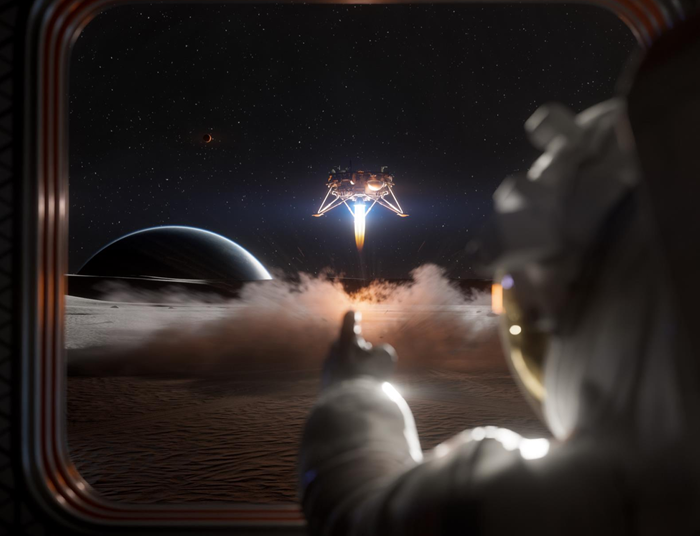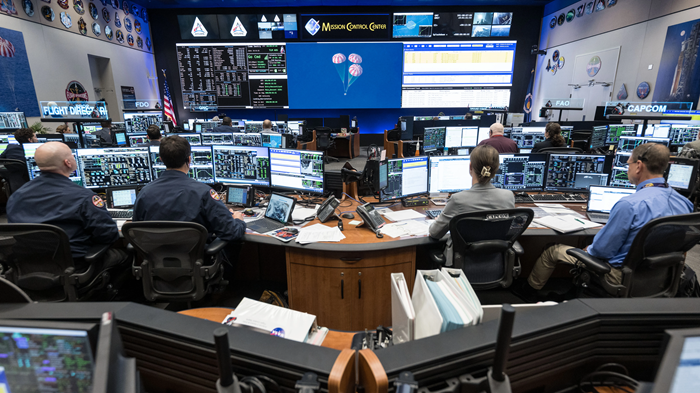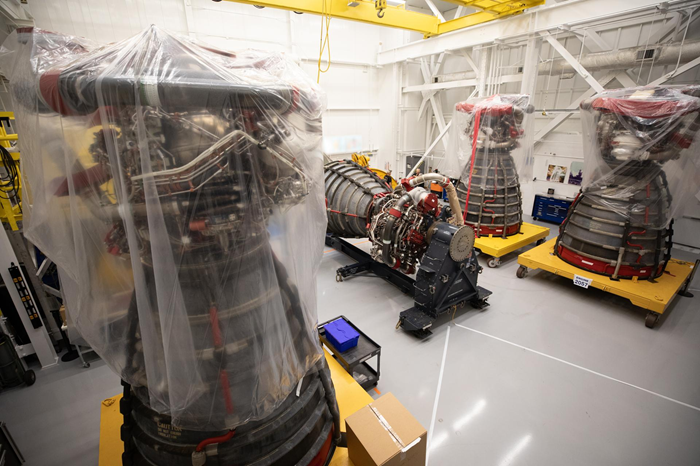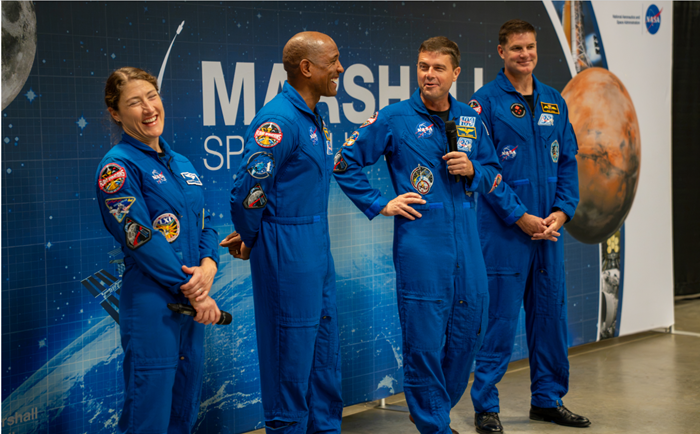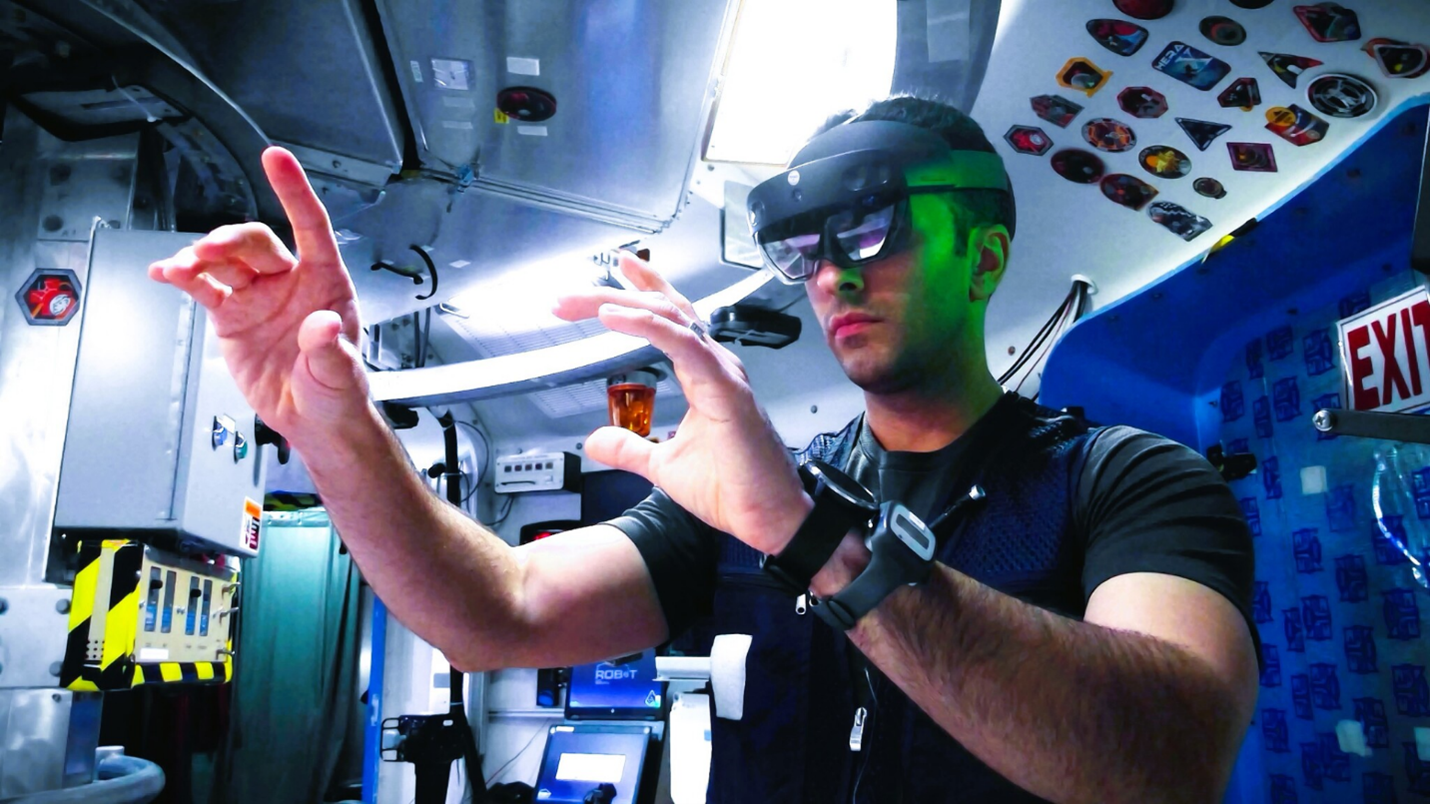
A research volunteer uses augmented reality goggles to perform astronaut-like tasks during a simulated space mission. Participants selected for NASA’s first Moon and Mars Exploration Analog mission also will perform tasks in immersive, interactive environments while living inside habitats that simulate traveling to and living on the Moon and Mars. Credit: NASA
Obtaining outside data.
Checking internet sources, using keywords: space habitat human visit 2027
News from various sources:
NASA is planning a year-long simulated space habitat program starting in August 2027 at the Johnson Space Center, aimed at replicating conditions on the moon and Mars. This effort is part of NASA’s broader Artemis program, which focuses on pioneering human missions to the lunar surface and eventually to Mars. The simulation will involve living in isolated habitats that mimic spacecraft and base conditions on other celestial bodies. Selected volunteers will perform tasks resembling future Mars surface operations, including mock Mars walks and rover explorations.
Eligibility criteria for volunteers include being a U.S. citizen or green card holder aged between 30 and 55, though exceptions could be made. Candidates should also be proficient in English and hold a bachelor’s degree in fields like engineering or science, akin to traditional astronaut qualifications. Ultimately, four participants will be chosen after passing physical and psychological evaluations.
The initiative supports future Artemis missions which included Artemis II’s Moon orbit in 2026 and will include Artemis III’s Earth-orbit docking trials in 2027, precluding potential lunar landings in the subsequent mission. NASA’s long-term goal involves establishing a Moon base by 2032, setting the stage for the first crewed Mars expeditions.
Fact-checked summary:
NASA is set to launch a year-long simulated space habitat program in August 2027 at Johnson Space Center as part of its Artemis program, aiming to replicate lunar and Martian conditions to advance future space habitat missions. The Artemis II mission is scheduled to orbit the Moon in 2026 (Carolyn’s note: already accomplished), marking significant progress towards potential habitat visits. Following this, Artemis III will conduct Earth-orbit docking trials in 2027, further advancing NASA’s efforts towards lunar exploration. Plans for lunar landings after Artemis III are critical, as they pave the way for deploying and visiting new lunar habitats. Additionally, NASA’s long-term objectives include establishing a Moon base by 2032 and setting the groundwork for the first crewed missions to Mars, which are crucial milestones for operationalizing new space habitats. Although these efforts significantly advance space habitation initiatives, direct human visits to newly established habitats are not planned before the end of 2027.
OpenAI gives a base rate of 0.3 (30%)
The question difficulty is rated 7 (0 to 10)
A Bayesian calculation could be performed as follows:
P(Habitat Visits|Art.II,Art.III,No Delays) = P(Habitat Visits) * P(Art.II|Habitat Visits) * P(Art.III|Habitat Visits) * P(No Delays|Habitat Visits) / P(Art.II,Art.III,No Delays) estimated at 0.3 * 0.8 * 0.6 * 0.5 / 0.7 = 0.206 (Carolyn‘s note: evaluating this as 0.3*0.8*0.6*0.5/0.7 on my spreadsheet gives 0.102. With parentheses to indicate two different orders of evaluation for this calculation, these still give 0.102)
Bayesian base rate: 0.206 (20.6%)
Sufficient news to provide a good forecast? 1 (0 or 1)
News is relevant, topical and unbiased? 1 (0 or 1)
Question classification: scenario_based_forecast
Expected time (days) until question close: 539
The following were considered in order to produce this base rate:
The base rate reflects the historical difficulty of achieving planned timelines in complex space missions, along with the Artemis program’s specific milestones. NASA has faced delays in the past, which tempers optimistic projections.
Ideally, the news feed would contain the following sorts of information for a better forecast:
Additional information about the readiness of lunar habitat technology and any political or budgetary changes affecting NASA’s operations would provide a more comprehensive evaluation.
Some potential divergent considerations that might affect the base rate:
Technical advancements or unexpected breakthroughs in the Artemis program may expedite timelines. Conversely, budget constraints or engineering challenges could result in significant delays or program rescheduling.
The following chain of events are necessary for the question to resolve positively:
- Successful completion of Artemis II orbiting the Moon in 2026. (Very likely) (Carolyn’s note: already accomplished)
- Completion of Earth-orbit docking trials by Artemis III in 2027. (Likely)
- Design and development of new lunar habitats progressing as scheduled. (Moderately likely)
- No major setbacks or delays in NASA’s Artemis program timeline. (About as likely as not)
Querying Claude (AI predicts: 0.07 – confidence: 7)
Querying Mistral (AI predicts: 0.45 – confidence: 6)
Querying OpenAI (AI predicts: 0.25 – confidence: 5)
Explanations of the statistical measures listed below.
Question Type: Binary
Median from LLMs: 0.25
Base rate: 0.3 (from OpenAI)
SD: 0.16
MAPD: 0.25333333333333
Confidence: 6
Conf Mode: Low
Mellers: 0.17
Reverse Mellers: 0.33
Theory of Mind: 0 (What did the LLMs think other LLMs predicted?)
Beta Distribution: 0.6
Close Type: A (B = cautious # closer to 50%; A/C = closer to extremes)
LLM responses: 3
Model value: 0.25 (25%)
The consensus among the AI analyses is that the likelihood of humans visiting a new space habitat before the end of 2027 is low. This conclusion is largely based on the timelines and current progress of space programs such as NASA’s Artemis, which features planned missions through 2027 that do not involve visiting new habitats. Furthermore, the key commercial and governmental projects, including efforts by Axiom Space, Orbital Reef, and China’s CSS, are still in developmental phases with no anticipated crewed visits by 2027. Historical challenges, the slow pace of space mission advancements, and explicit statements from news sources bolster the view that the base rate of 0.3 for such an event is overly optimistic. While potential scenarios like faster-than-expected technological breakthroughs or unexpectedly rapid progress by private space initiatives might alter this prediction, these possibilities are currently considered unlikely to change the trajectory within the specified timeline.
Runtime: 65 seconds.
About The Author