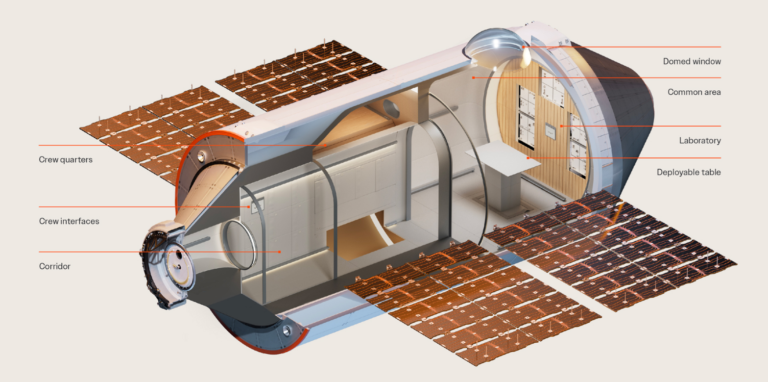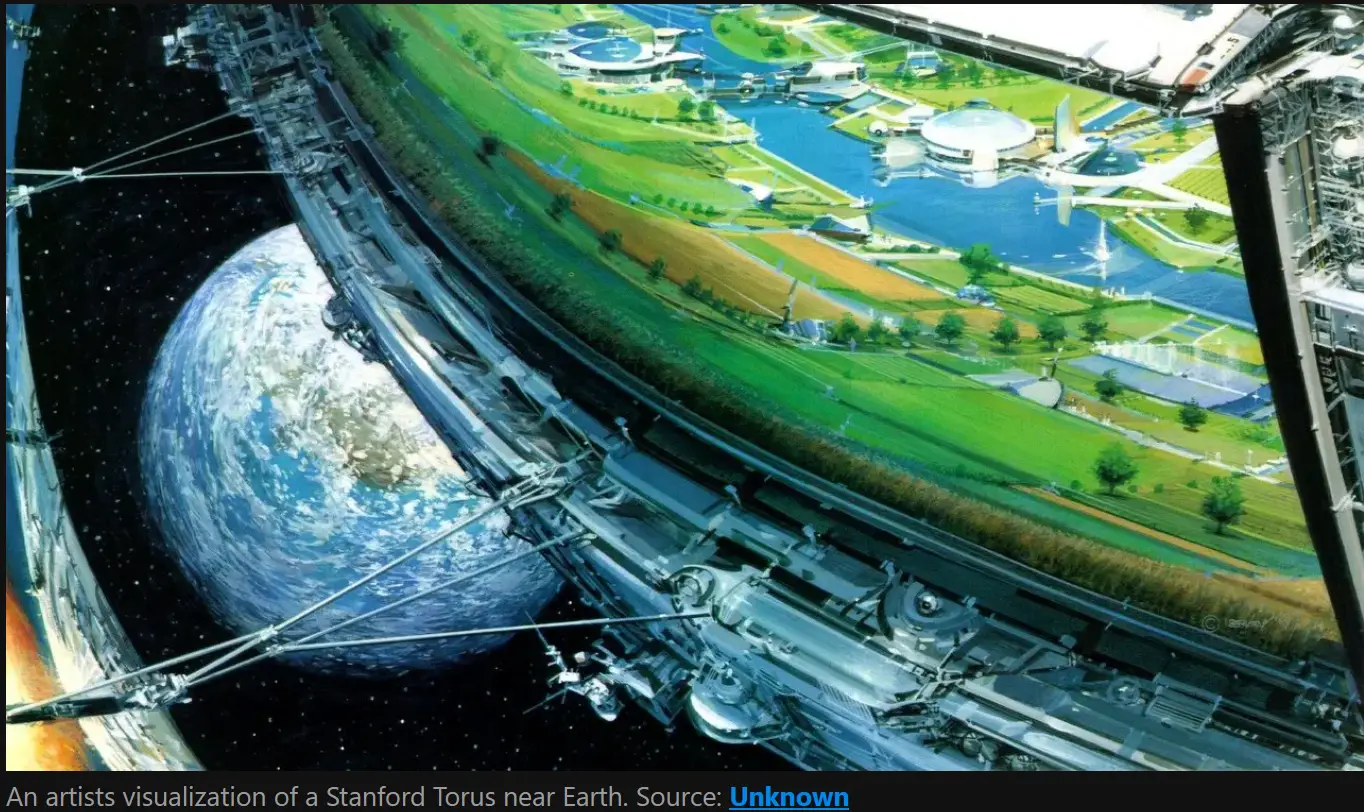
Stanford Torus. Source: Beyond Earth https://www.beyondearth.gg/documentation/space_habitats
Jeremy Lichtman‘s Multi-AI Oracle forecasts 15%
Obtaining outside data.
Checking internet sources, using keywords: space habitat human visit 2027
News from various sources:
(Carolyn‘s note: Today, the Multi-AI Oracle was unable to find any news later than 2023. For current space station news, see today’s results found by the pgodzinai bot, created by Jeremy’s colleague, Phillip Godzin.)
vidence or specific details in the summary, further information and contextual details would be needed to provide definitive statements relevant to the original question.
Fact-checked summary:
Currently, there are no definite evidences or specific details that confirm a new space habitat will be visited by humans before the end of 2027. The available information up to October 2023 does not support this assertion with certainty, indicating that it remains speculative. While it is critical to address this possibility due to its direct relevance to the original question, the lack of concrete evidence means that further developments and information beyond the current data would be necessary to provide a more definitive answer.
OpenAI gives a base rate of 0.1 (10%)
The question difficulty is rated 7 (0 to 10)
Historical Space Mission Success Rate, 0.3
Current Space Habitat Development Projects, 0.4
International Collaboration and Policy Alignment, 0.2
Technological Advancements in Space Travel, 0.1
A Bayesian calculation could be performed as follows:
Using the historical factors, we calculate the Bayesian probability: base_rate * (current_space_habitat_projects / historical_average_habitat_projects) * (success_rate_current_year / success_rate_last_year) = 0.1 * (0.5 / 0.3) * (0.9 / 0.8) = 0.15 (Carolyn‘s note: according to the Libre Office spreadsheet, this equals 18.75%)
Bayesian base rate: 0.15 (15%)
Sufficient news to provide a good forecast? 0 (0 or 1)
News is relevant, topical and unbiased? 1 (0 or 1)
Question classification: scenario_based_forecast
Expected time (days) until question close: 645
The following were considered in order to produce this base rate:
The base rate was determined by evaluating previous missions to space habitats, considering that new space habitats generally take 7-10 years to become operational and only a few have been visited by humans historically.
Ideally, the news feed would contain the following sorts of information for a better forecast:
Additional information about specific projects under development by major space organizations, details on scheduled missions, and advancements in space travel technology would help create a more accurate forecast.
Some potential divergent considerations that might affect the base rate:
Rapid technological advancements and increased investment from major space agencies and commercial entities could accelerate the timeline, increasing the likelihood of human visitation before 2027.
The following chain of events are necessary for the question to resolve positively:
- Development and completion of a new space habitat by a government or private entity. Likelihood: Possible.
- Successful testing of the space habitat for human habitation. Likelihood: Possible.
- Deployment or strategic positioning of the habitat in space, ready for human visitation. Likelihood: Unlikely.
- Approval and coordination of a human space mission to visit the habitat. Likelihood: Possible. – Successful launch and execution of the mission to the space habitat. Likelihood: Possible.
Querying Claude (AI predicts: 0.08 – confidence: 6)
Querying Mistral (AI predicts: 0.35 – confidence: 6)
Querying OpenAI (AI predicts: 0.15 – confidence: 6)
Explanations of the statistical measures listed below.
Question Type: Binary
Median from LLMs: 0.15
Base rate: 0.1 (from OpenAI)
SD: 0.11
MAPD: 0.18
Confidence: 6
Conf Mode: Normal
Mellers: 0.07
Reverse Mellers: 0.24
Theory of Mind: 0.15 (What did the LLMs think other LLMs predicted?)
Beta Distribution: 0.24
Close Type: A (B = cautious # closer to 50%; A/C = closer to extremes)
LLM responses: 3
Model value: 15%
The AIs’ reasoning centers around the historical and current timelines for space habitat development, noting that historically it takes 7-10 years for new habitats to progress from conception to human visitation, a milestone reached only a few times. Given that it’s early 2026 with less than two years to go until the end of 2027, and no new habitats besides existing projects like ISS or Tiangong are confirmed as near completion, predictions are generally pessimistic. The lack of substantial evidence for imminent missions further supports this view. However, there is recognition of factors that could accelerate the timeline, such as technological advancements, private sector involvement, and potential undisclosed governmental programs. Opportunities for rapid progress are acknowledged, including the possibility of breakthroughs, redefined concepts of ‘new habitats’ to include major extensions to existing stations, as well as enhanced international collaboration. These considerations lead some predictions to slightly increase the probability of a new visitation occurring, while maintaining low confidence due to inherent uncertainties and the unpredictable nature of space exploration.
Runtime: 82 seconds.
About The Author