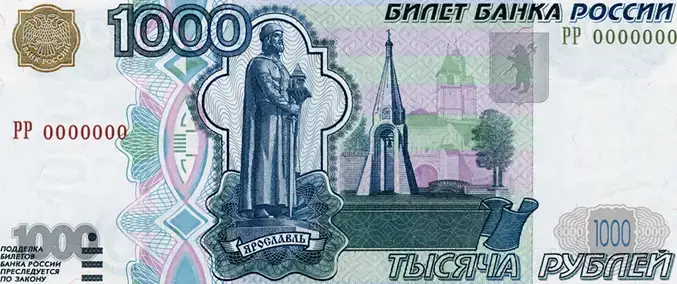
A Russian Bank Note
Jeremy Lichtman‘s Multi-AI Oracle predicts 75%
Obtaining outside data.
Checking internet sources, using keywords: Russia interest rate 2026
News from various sources:
OpenAI gives a base rate of 0.5 (50%)
The question difficulty is rated 7 (0 to 10)
Historical weighted factors include:
Frequency of interest rate changes by Russian Central Bank per year, 0.4
Impact of global economic conditions on Russia’s monetary policy, 0.3
Historical inflation trends in Russia, 0.2
Political stability in Russia affecting economic policies, 0.1
A Bayesian calculation could be performed as follows:
Using a baseline probability of 0.5 based on historical factors. Adjust by considering new economic forecasts and global economic conditions as per available news and trends. For example, if new forecasts indicate economic downturns or instability, increase the likelihood by 10%. Thus, adjust the probability to 0.55 with provided historical and recent economic indicators.
Bayesian base rate: 0.55 (55%)
Sufficient news to provide a good forecast? 0 (0 or 1)
News is relevant, topical and unbiased? 0 (0 or 1)
Question classification: scenario_based_forecast
Expected time (days) until question close: 326
The following were considered in order to produce this base rate:
The base rate is set at 0.5 (50%) considering the usual frequency and rationale for interest rate changes by the Russian Central Bank, which historically reacts to both domestic economic conditions and global financial trends.
Ideally, the news feed would contain the following sorts of information for a better forecast:
Obtaining current and reliable economic forecasts or policy guidance from Russian financial analysts or institutions would improve forecast accuracy. Additionally, understanding any recent statements from the Russian Central Bank officials could provide insight.
Some potential divergent considerations that might affect the base rate:
Potential geopolitical tensions, unexpected shifts in commodity prices significantly impacting the Russian economy, or changes in the global economic landscape could alter the likelihood of an interest rate change.
The following chain of events are necessary for the question to resolve positively:
-The Russian Central Bank decides to change the key interest rate of 16% before the end of 2026. Possible – Economic conditions in Russia significantly change, prompting a policy response. Moderately likely – Global economic factors influence Russia to adjust its interest rate policy. Possible
Querying Claude (AI predicts: 0.92 – confidence: 7)
Querying Mistral (AI predicts: 0.65 – confidence: 6)
Querying OpenAI (AI predicts: 0.75 – confidence: 7)
Question Type: Binary
Median from LLMs: 0.75
Base rate: 0.5 (from OpenAI)
SD: 0.11
MAPD: 0.18
Confidence: 7
Conf Mode: Low
Mellers: 0.83
Reverse Mellers: 0.67
Theory of Mind: 0.6 (What did the LLMs think other LLMs predicted?)
Beta Distribution: 0.01
Close Type: C (B = cautious # closer to 50%; A/C = closer to extremes)
LLM responses: 3
Model value: 75%
The AI models emphasize that the Russian Central Bank is likely to adjust interest rates before the end of 2026 due to historical trends and current economic conditions. Historically, the bank has been proactive in its monetary policy, adjusting rates multiple times per year in response to inflation, currency stability, and geopolitical factors. With the current key interest rate at a high 16%, indicative of economic stress, and with 10.7 months left in 2026, there is ample opportunity for economic changes that necessitate rate adjustments. Key influences include inflationary pressures, ruble stability, oil price fluctuations, and geopolitical tensions related to the ongoing conflict and sanctions. However, predictions could be thwarted if Russia’s economic situation stabilizes unexpectedly, if global economic conditions shift drastically, or if political pressures or leadership changes alter the Central Bank’s decision-making. Furthermore, the lack of specific 2026 forecasts adds uncertainty, suggesting reliance on broader economic trends rather than immediate signals.
Runtime: 78 seconds.
About The Author