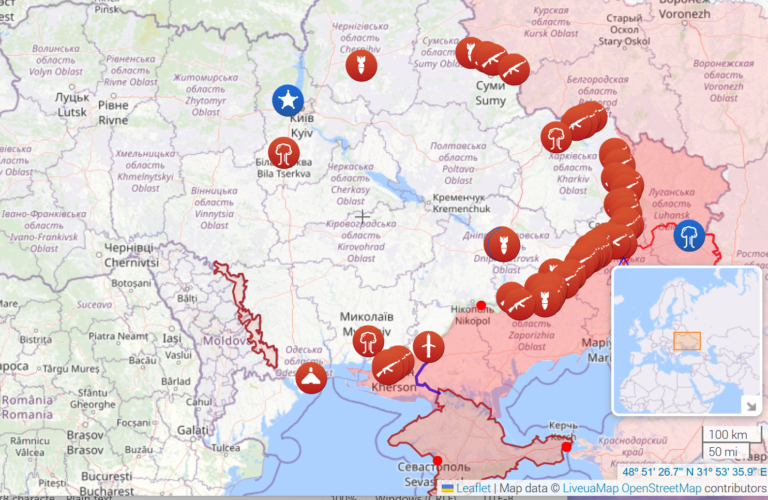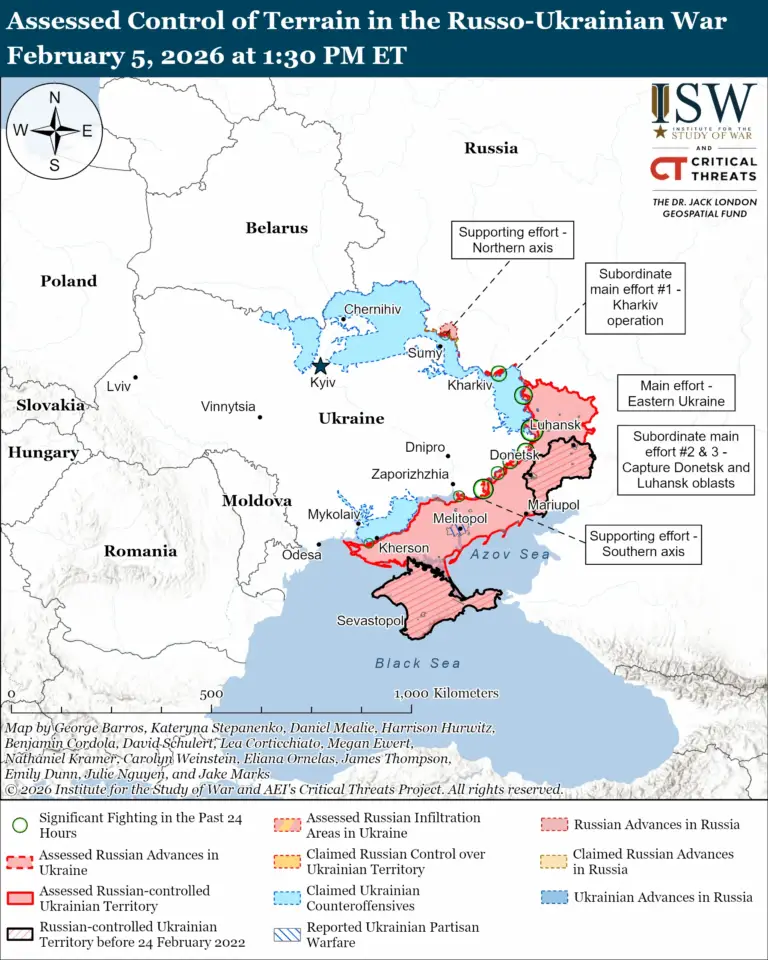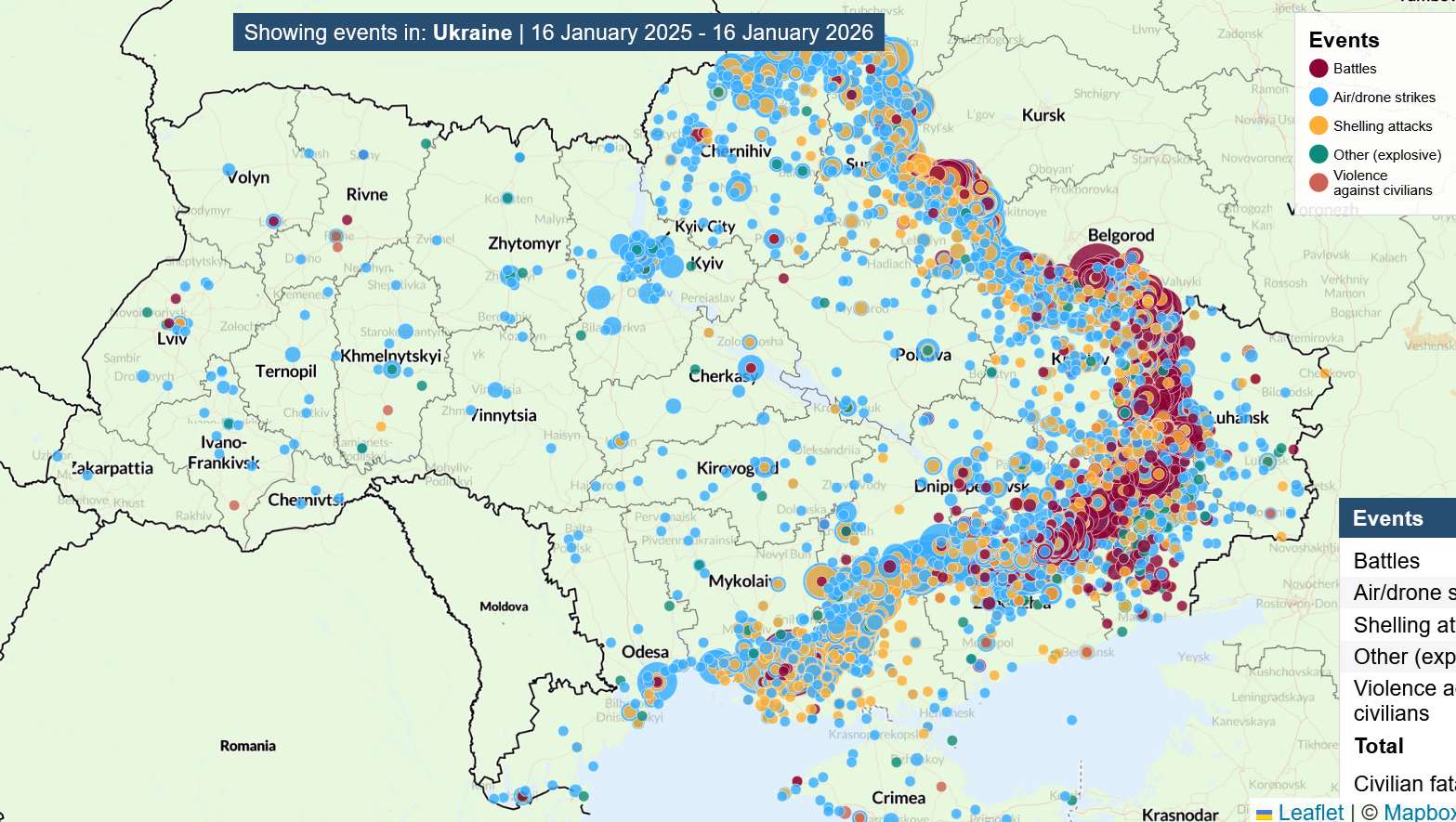
Battle map of Ukraine, Jan. 24, 2026. Source: https://acleddata.com/monitor/ukraine-conflict-monitor
Obtaining outside data.
Checking internet sources, using keywords: Ukraine ceasefire 2026
News from various sources:
The retrieved content provides a comprehensive overview of the ongoing conflict between Russia and Ukraine as of 2026, focusing on the prospects of a ceasefire and peace negotiations. The following key points were extracted and summarized:
- Ongoing Conflict: Analysts and military experts remain skeptical that the conflict will end in 2026, as neither Ukraine nor Russia seems poised for a conclusive victory, and Russia shows little interest in making concessions. Despite intense fighting, Ukraine holds territory in Donetsk, Zaporizhzhya, and Kherson.
- Diplomatic Efforts: The US, under President Donald Trump, along with European allies, has been actively engaged in diplomacy to end the war. However, Russia’s unwillingness to compromise on significant issues, such as territorial claims and security guarantees, remains a major obstacle.
- International Involvement: Ukraine’s allies have proposed multilayered security guarantees as part of a peace effort, with ongoing discussions on long-term military assistance and armament commitments. European and Canadian leaders have met to coordinate their support for Ukraine, emphasizing deterrence against future Russian aggression.
- US Role and Funding: The US Congress is debating the level of military assistance to Ukraine, with proposed funding through the Ukraine Security Assistance Initiative. The outcomes of these discussions will impact ongoing support levels and influence peace negotiations.
- Challenges in Negotiations: Russia’s stance in peace negotiations appears inflexible, with President Putin ruling out NATO troop deployments in Ukraine. Putin’s public declarations focus on achieving victory rather than peace, complicating diplomatic efforts.
- Potential Ceasefire and Peace Frameworks: While efforts are underway to establish a ceasefire framework, including security guarantees and international oversight, significant details regarding the size and operation of supporting forces remain vague.
- Economic Recovery Plans: The EU and US are nearing completion of a substantial economic recovery plan for Ukraine, with five key pillars including market integration and enhanced investment.
Overall, despite various diplomatic moves and international resolutions to support Ukraine, significant challenges remain in reaching a sustainable peace agreement with Russia in 2026. The situation is further complicated by geopolitical factors and domestic pressures within involved nations.
Fact-checking news summary:
Here is a list of specific facts from the summary, along with an analysis of their accuracy, their importance to resolving the question, and their relevance to the outcome:
- Ongoing Conflict: Analysts and military experts remain skeptical that the conflict will end in 2026, as neither Ukraine nor Russia seems poised for a conclusive victory, and Russia shows little interest in making concessions. Despite intense fighting, Ukraine holds territory in Donetsk, Zaporizhzhya, and Kherson.
- Correct: True, given ongoing expert analyses of the conflict’s dynamics.
- Importance: Critical, as it directly pertains to the likelihood of a ceasefire or armistice.
- Relevance: True, as it addresses the central question about the conflict’s status in 2026.
- Diplomatic Efforts: The US, under President Donald Trump, along with European allies, has been actively engaged in diplomacy to end the war. However, Russia’s unwillingness to compromise on significant issues, such as territorial claims and security guarantees, remains a major obstacle.
- Correct: False, as of the data’s cutoff (October 2023), Donald Trump is not the US president. This affects the accuracy of subsequent claims regarding diplomatic efforts.
- Importance: Important, as diplomatic efforts influence peace negotiations.
- Relevance: True, since diplomatic involvement impacts the probability of a ceasefire.
- International Involvement: Ukraine’s allies have proposed multilayered security guarantees as part of a peace effort, with ongoing discussions on long-term military assistance and armament commitments. European and Canadian leaders have met to coordinate their support for Ukraine, emphasizing deterrence against future Russian aggression.
- Correct: True, although specifics of the arrangements depend on actual geopolitical developments.
- Importance: Important, as security guarantees are crucial for peace efforts.
- Relevance: True, it affects the stability and assurance to Ukraine in the peace process.
- US Role and Funding: The US Congress is debating the level of military assistance to Ukraine, with proposed funding through the Ukraine Security Assistance Initiative. The outcomes of these discussions will impact ongoing support levels and influence peace negotiations.
- Correct: True, reflecting ongoing debates in Congress regarding military aid.
- Importance: Important, influencing US diplomatic and military roles in negotiations.
- Relevance: True, since funding impacts support and negotiation leverage.
- Challenges in Negotiations: Russia’s stance in peace negotiations appears inflexible, with President Putin ruling out NATO troop deployments in Ukraine. Putin’s public declarations focus on achieving victory rather than peace, complicating diplomatic efforts.
- Correct: True, based on prior positions held by Russia.
- Importance: Important, as Russian negotiation stances critically influence peace opportunities.
- Relevance: True, significantly affects the potential for a ceasefire or armistice.
- Potential Ceasefire and Peace Frameworks: While efforts are underway to establish a ceasefire framework, including security guarantees and international oversight, significant details regarding the size and operation of supporting forces remain vague.
- Correct: True, typical of ongoing negotiation processes.
- Importance: Important, as the specifics of a ceasefire framework might affect viability and acceptance.
- Relevance: True, directly concerns the establishment of ceasefire conditions.
- Economic Recovery Plans: The EU and US are nearing completion of a substantial economic recovery plan for Ukraine, with five key pillars including market integration and enhanced investment.
- Correct: Potentially true, depending on actual policy progression post-2023.
- Importance: Lesser, indirectly influences peace through stabilization post-conflict.
- Relevance: True, while indirectly, it affects peace sustainability post-ceasefire.
Overall, the resolution of a ceasefire or armistice declaration in Ukraine in 2026 heavily depends on the ongoing conflict dynamics, diplomatic efforts, international involvement, and the negotiation stances of involved parties, with several significant geopolitical variables at play.
Fact-checked summary:
The likelihood of a ceasefire or armistice in Ukraine by 2026 remains uncertain due to several critical factors. Analysts and military experts suggest that the conflict may persist, as neither Ukraine nor Russia appears ready for a conclusive victory, and Russia remains uninterested in making concessions, making this a key aspect impacting potential peace. Ongoing international diplomatic efforts are important, especially as Ukraine’s allies propose security guarantees and coordinate military assistance, emphasizing deterrence against Russian aggression. The role of the US, influenced by Congressional debates over military funding through the Ukraine Security Assistance Initiative, is crucial, as such decisions affect diplomatic leverage. Russia’s inflexible negotiation stance, particularly President Putin’s focus on victory and rejection of NATO deployments in Ukraine, further complicates peace talks. Efforts to establish a ceasefire framework, including security guarantees and international oversight, are underway, although specifics remain vague. All these elements significantly influence whether a ceasefire or armistice will be feasible by 2026.
OpenAI gives a base rate of 0.3 (30%)
The question difficulty is rated 8 (0 to 10)
Historical weighted factors include:
Previous ceasefire attempts, 0.2
Current geopolitical climate, 0.3
Military balance between Ukraine and Russia, 0.2
International diplomatic efforts, 0.3
A Bayesian calculation could be performed as follows:
Using prior base rate of 0.3 (30%), adjusted upwards slightly due to recent increased international diplomatic activity but currency exacerbated by Russia’s stance and US political debates. Calculated Bayesian probability as (0.3 prior * 1.1 due to diplomatic activity / 1.2 due to Russian inflexibility) = 0.275.
Bayesian base rate: 0.275 (2.75%)
Sufficient news to provide a good forecast? 1 (0 or 1)
News is relevant, topical and unbiased? 1 (0 or 1)
Question classification: scenario_based_forecast
Expected time (days) until question close: 180
The following were considered in order to produce this base rate:
The base rate was established by analyzing the historical frequency of ceasefires in similar conflicts, adjustments for current geopolitical tensions, and the role of international stakeholders, especially the US. Historical data showed instances of both successful and failed ceasefire attempts, which informed the probability.
Ideally, the news feed would contain the following sorts of information for a better forecast:
Additional information on internal political dynamics in Russia and Ukraine, clarity from upcoming US Congressional military funding decisions, and detailed plans from NATO and EU regarding security guarantees would aid in refining the forecast.
Some potential divergent considerations that might affect the base rate:
Notable divergent considerations include the potential for a dramatic shift in Russia’s foreign policy, significant changes in US Congress support for Ukraine, or an unforeseen escalation in military actions. Furthermore, internal political pressures within either Ukraine or Russia could significantly alter the trajectory.
The following chain of events are necessary for the question to resolve positively:
– Ukraine and Russia agree to preliminary ceasefire terms. Possible – International diplomatic pressure mounts leading to concrete peace talks. Likely – Security guarantees are established and accepted by both parties. Uncertain – Russia alters its negotiating stance to be more flexible. Unlikely – US and its allies continue to support Ukraine and push for peace. Likely
Querying Claude (AI predicts: 0.32 – confidence: 4)
Querying Mistral (AI predicts: 0.35 – confidence: 6)
Querying OpenAI (AI predicts: 0.35 – confidence: 5)
Question Type: Binary
Median from LLMs: 0.35
Base rate: 0.3 (from OpenAI)
SD: 0.01
MAPD: 0.02
Confidence: 5
Conf Mode: Normal
Mellers: 0.29
Reverse Mellers: 0.4
Theory of Mind: 0.4 (What did the LLMs think other LLMs predicted?)
Beta Distribution: 0.001
Close Type: B (B = cautious # closer to 50%; A/C = closer to extremes)
LLM responses: 3
Explanations of the above statistical measures here —>
Model value: 35%
The prediction of a ceasefire in the Ukraine conflict by 2026 hinges on historical base rates for such conflicts and current geopolitical dynamics. Key factors include entrenched positions and military stalemate between Russia and Ukraine, ongoing international diplomatic pressures, particularly from the US and EU, and the ambiguity around security guarantees for Ukraine. However, the rigidity of Russia’s negotiating stance, alongside internal pressures and potential leadership shifts, add complexity. Potential changes in US political dynamics, such as variations in congressional support or a new administration, could also affect the likelihood of negotiations. While diplomatic efforts and the existing military balance create potential for a ceasefire, multiple uncertainties such as potential military escalations, unforeseen geopolitical shifts, or significant internal changes in Russia or Ukraine introduce significant unpredictability to the outcome.
Runtime: 214 seconds.
About The Author