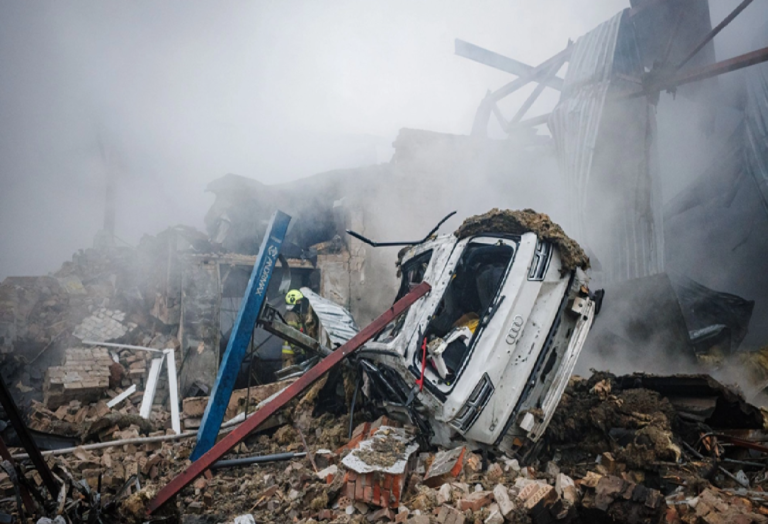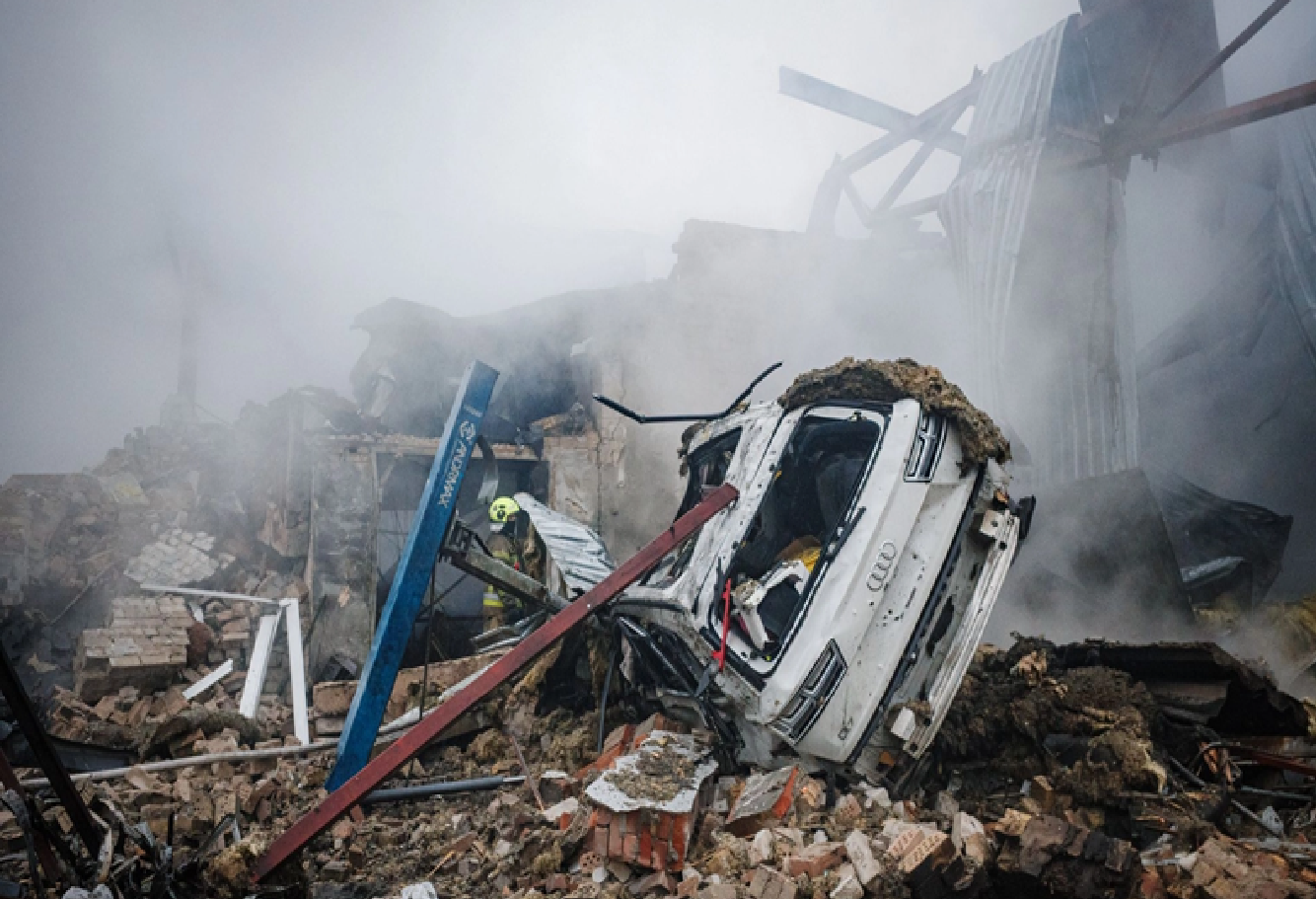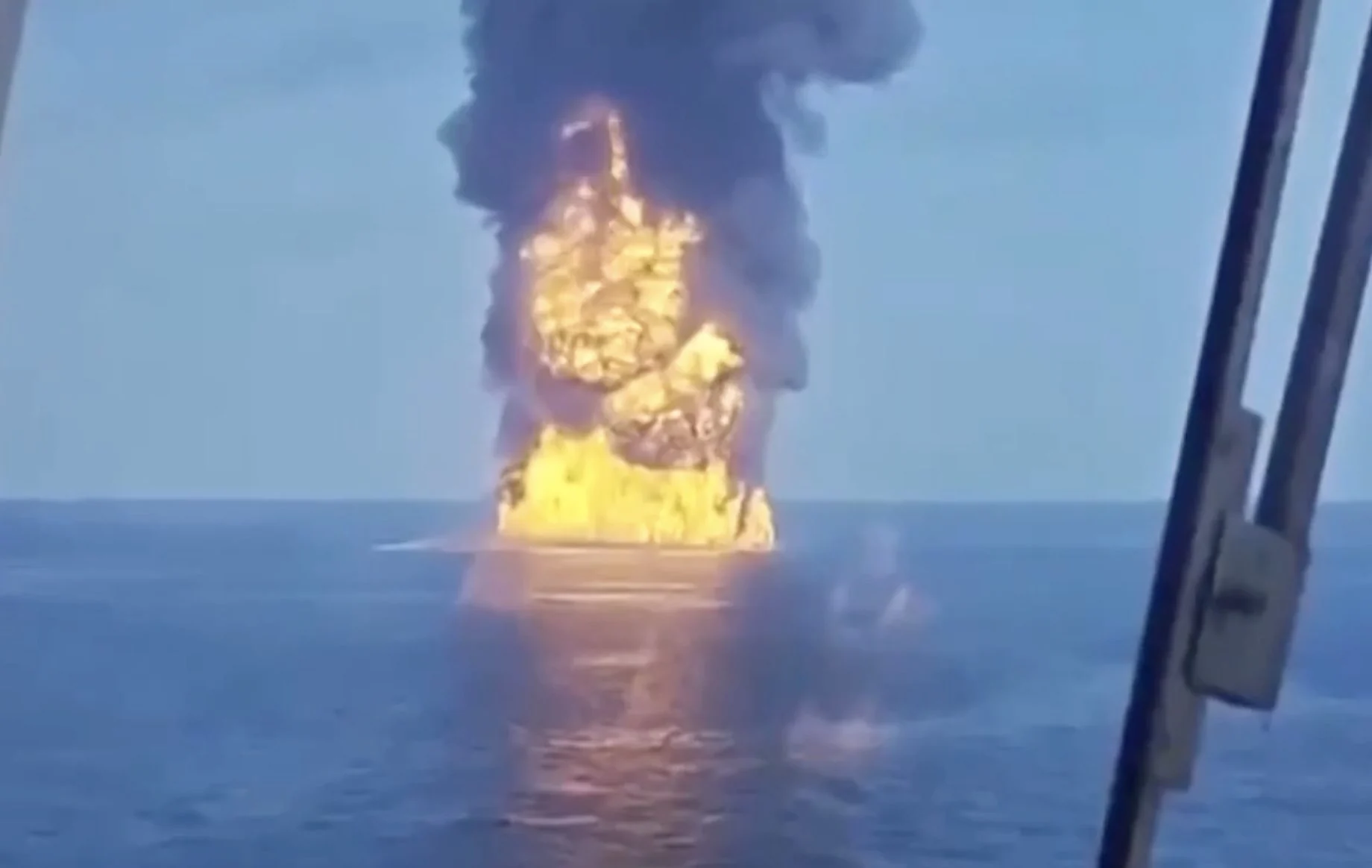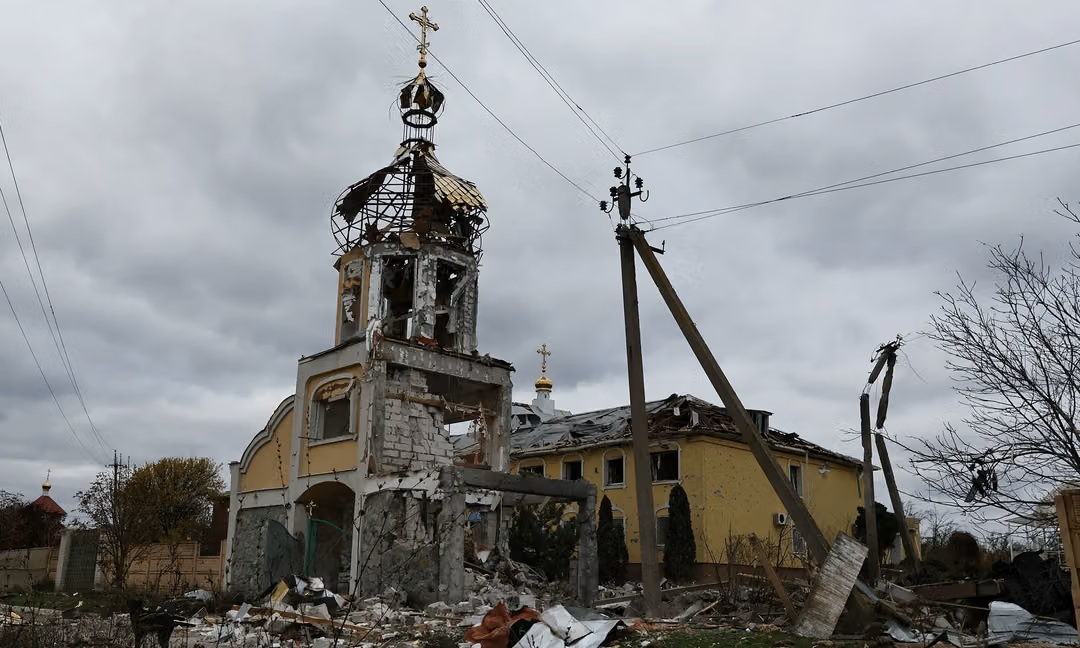
Photo: A church damaged on Monday by a Russian airstrike in the frontline town of Komyshuvakha, Zaporizhzhia Region, Ukraine, November 5, 2026. Source: Andriy Andriyenko/Press Service of the 65th Separate Mechanized Brigade of the Ukrainian Armed Forces/Handout
DeepSeek research response:
10 citations
1. “Russia and Ukraine agree to ceasefire, plan November peace talks: What we know so far”
The News International, citing Reuters — published Oct. 24, 2026
Description: Report on the US-brokered localized ceasefire in Oleshky and preparations for later trilateral talks.
Summary: The report says Russia and Ukraine both confirmed a localized ceasefire in Russian-occupied Oleshky, brokered with US First Lady Melania Trump’s involvement, to allow demining, aid deliveries, and civilian evacuation. It states the temporary halt was scheduled to take effect at 4 a.m. local time on Oct. 27, 2026. This is the most directly resolution-relevant item because the question’s fine print says a temporary or single-region ceasefire counts.
2. “Ukraine Responds to Putin’s ‘Humanitarian Mission’ Proposal in Kostiantynivka. What Could Russia Be Planning?”
UNITED24 Media — published Nov. 11, 2026
Description: Confirms the Oleshky ceasefire was implemented and records Kyiv’s suspicions about a similar Kostiantynivka pause.
Summary: The article says the Oleshky ceasefire lasted from Oct. 27 to Nov. 1 and allowed hundreds of civilians to leave. Ukrainian authorities later reported that Russian forces used the pause to rotate personnel, move weapons and supplies, and restore positions. It also records Kyiv’s warning that a similar Kostiantynivka pause could be used militarily.
3. “Ukraine wants to put ceasefire issue on agenda for new round of talks with Russia”
VOV, citing Reuters — published Nov. 13, 2026
Description: Zelensky’s latest comments after meeting US envoys in Dublin and before a new round with European participation.
Summary: Zelensky welcomed European participation in the next round and said Kyiv wants de-escalation measures and “forms of ceasefire” on the agenda. He spoke after meeting US envoys Steve Witkoff and Jared Kushner in Dublin, following the Nov. 10–11 Abu Dhabi talks. The report indicates diplomacy is active but no broader ceasefire has been announced.
4. “Putin remains inflexible on demands to end war”
RTP — published Nov. 11, 2026, reporting from the Nov. 12 Moscow meeting
Description: Account of Putin’s meeting with Witkoff and Kushner and his latest territorial and security demands.
Summary: Putin reiterated maximalist territorial demands, rejected demilitarized “grey zones” and any foreign troop deployment in Ukraine, and proposed only a five-day humanitarian truce in Kostiantynivka. Zelensky said there could be a “window of opportunity” for a ceasefire before 2027. The report says Russia occupies just over 19% of Ukrainian territory.
5. “Russian Offensive Campaign Assessment, November 12, 2026”
Institute for the Study of War — published Nov. 12, 2026
Description: Daily battlefield and negotiation assessment from a leading Western think tank.
Summary: ISW assesses that Putin remains unwilling to compromise on territorial demands, rejects a demilitarized zone and meaningful Western security guarantees, and reasserted 2021 NATO demands in the latest talks. It says a Kostiantynivka ceasefire would likely be used to accumulate Russian forces and is far harder to implement than Oleshky because forces are intermingled. It also reports neither side advanced on Nov. 12, while Russia launched 123 drones overnight and 124 during the day.
6. “Zelenskiy Says Ukrainian Battlefield Successes Strengthen Kyiv’s Position in Talks”
U.S. News & World Report / Reuters — published Nov. 9, 2026
Description: Pre-talks assessment of the front line and Kyiv’s negotiating leverage.
Summary: Zelensky said Ukrainian battlefield successes and heavy Russian losses were strengthening Kyiv’s negotiating position on the eve of the Abu Dhabi talks. Reuters describes the 1,200-km front as fairly static for months and Russian advances in Donetsk as slowed, while Russia holds about 20% of Ukrainian territory. The report captures Kyiv’s view that attrition and long-range strikes improve its leverage.
7. “The Situation at the Front and the Strikes on Energy Infrastructure — What Might Kyiv and Moscow Agree on in Abu Dhabi?”
INSS — published Nov. 9, 2026
Description: Israeli think-tank analysis of battlefield trends, fiscal pressure, and feasible interim deals.
Summary: INSS says Russia lost more territory than it captured in September and October, though it still advances in some areas, and that Moscow demands land its army has not taken. It notes Ukraine’s central bank forecasts a 0.4% contraction in 2026, while Russia’s projected federal deficit is nearly double the original target and oil/gas revenue fell about 14% in January–October. It identifies a mutual pause in energy-infrastructure strikes as the most feasible near-term deal.
8. “Russian federal budget deficit 5.234 trillion rubles or 2.3% of GDP in 10M — MinFin”
Interfax — published Nov. 10, 2026
Description: Official Russian Finance Ministry data for January–October 2026.
Summary: Russia’s federal budget deficit reached 5.234 trillion rubles, or 2.3% of GDP, in January–October 2026. Oil and gas revenues fell 14.1% year-on-year to 6.442 trillion rubles, while total spending rose 13.4% to 38.4 trillion rubles. The report gives the latest official fiscal data at a time when military spending is pressuring the budget.
9. “Not quite mercenaries: How Russia lures thousands of foreigners to fight in its war on Ukraine”
Atlantic Council — published Nov. 5, 2026
Description: Analysis of Russia’s foreign-fighter recruitment system and its expansion.
Summary: The Atlantic Council says Ukrainian authorities count more than 45,000 foreign nationals from 151 countries recruited into Russia’s armed forces since February 2022. It documents recruitment through social media, deceptive job offers, debt, and coercion, with the drive expanding into Peru, Indonesia, the Philippines, and Southeast Asia. This supports the view that Russia is offsetting manpower losses abroad, but the article does not show that the model is near collapse.
10. “Russia x Ukraine ceasefire b 2026 — Final Polymarket Odds”
Polymarket Analytics — live page accessed Nov. 13, 2026; market resolves Dec. 31, 2026
Description: Prediction-market pricing for a general Russia–Ukraine ceasefire by the end of 2026.
Summary: The page shows “No” at 74% and “Yes” at 26%, with $15 million cumulative volume, for a general Russia–Ukraine ceasefire by Dec. 31, 2026. Its rules require a publicly announced, mutually agreed general pause and exclude humanitarian pauses, local truces, energy-only deals, and Black Sea arrangements. Because this question’s fine print expressly counts temporary or single-region ceasefires, the 26% price is not a direct match for the stated resolution criteria.
Resolution-relevant finding: the Oleshky ceasefire may already satisfy the literal criteria
The single most important development is not the current Abu Dhabi/Moscow diplomacy. It is the Oleshky localized ceasefire, which was announced in late October 2026, took effect on Oct. 27, and lasted through Nov. 1.
Under the question’s stated criteria, a ceasefire does not need to be nationwide. The fine print explicitly says: “A ceasefire is temporary or might only cover one region of the front.” Oleshky fits that description closely:
- It was a localized ceasefire in Russian-occupied Oleshky, in the Kherson region.
- Both Russia and Ukraine said they had agreed to it, according to Reuters reporting carried by The News International.
- It was temporary, scheduled to begin Oct. 27 and lasting several days.
- It was officially announced and reported by major outlets, including Reuters and Ukrainian media.
- It was implemented: UNITED24 reports that it lasted from Oct. 27 to Nov. 1 and allowed hundreds of civilians to leave.
So, if the resolver applies the fine print literally, the Oleshky agreement is a strong candidate for an already-triggered “Yes.” The main residual ambiguity is semantic: whether the resolver treats Oleshky as a genuine “ceasefire” or merely a “humanitarian pause/evacuation corridor.” Contemporaneous reporting called it a “localized ceasefire,” and both governments confirmed it, which weighs toward counting it. But a resolver insisting on a national-level declaration could still say no.
=== Forecast Result ===
=== Reasoning ===
Looking at this question, I need to carefully parse the temporal constraint: despite the resolution criteria saying “at any point in 2026,” the explicit instruction states “the event must happen after today [Nov 13, 2026] and before the resolution date [Dec 31, 2026].” This means the already-completed Oleshky ceasefire (Oct 27-Nov 1) and any already-announced “energy ceasefire” from earlier in November cannot be counted as satisfying this question — a new qualifying ceasefire/armistice declaration must occur in this ~7-week window.
Key considerations:
- Low bar for resolution: The background explicitly states “A ceasefire is temporary or might only cover one region of the front” — this is a much lower bar than a comprehensive nationwide armistice. This is critical given recent precedent (Oleshky) for exactly this kind of declaration occurring roughly monthly.
- Active diplomatic momentum: Abu Dhabi talks, Dublin meetings, prisoner exchange agreement in principle, and Putin’s proposed 5-day Kostiantynivka truce all suggest continued negotiation activity likely to produce further localized agreements.
- Countervailing evidence: Russia (via Lavrov) has explicitly rejected a standalone ceasefire absent a comprehensive settlement; core territorial/security disputes remain unresolved; Ukraine is wary of Kostiantynivka being used for Russian military repositioning (as allegedly happened with Oleshky); the stricter Polymarket “general ceasefire” market prices only 26% by year-end (though that market excludes local/humanitarian pauses, making it not directly comparable).
- Base rate of recent pattern: Given that a regional ceasefire (Oleshky) occurred in roughly the prior month, and multiple additional local ceasefire proposals (Kostiantynivka, energy infrastructure, Black Sea shipping) are actively being discussed, the “rate” of such declarations suggests a reasonable chance another qualifying one materializes in the next 7 weeks — though not with certainty, as negotiations remain fragile and prone to collapse or delay.
Key assumption risks:
- If the resolver requires a genuinely significant, mutually-agreed ceasefire (not just a 5-day evacuation pause), probability drops ~15-20 points lower.
- If diplomatic talks stall entirely (as they did for 9 months before Abu Dhabi), probability of a new declaration drops significantly.
- Holiday season (Dec) could either accelerate symbolic agreements or stall talks.
Weighing the broad definitional criteria against the genuine uncertainty of whether a new formal declaration (not just continued talks) occurs in this specific window, and considering historical overconfidence calibration, I’ll land moderately above the stricter market pricing but below highly confident territory.
Data sufficiency: Sufficient
Probability: 52%
End
About The Author