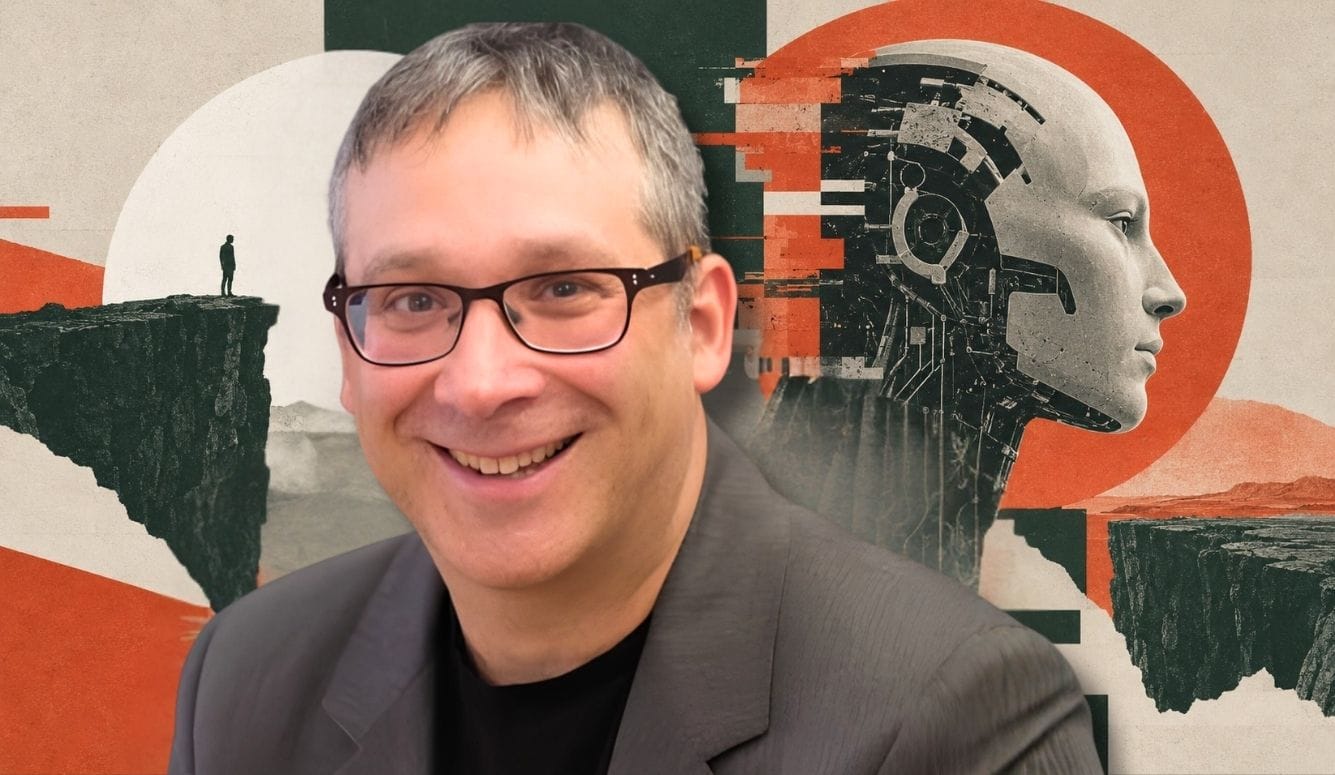
“Tilly Norwood,” a computer-generated character described as “the world’s first A.I. actress,” has become a flashpoint in the debate over the technology’s use in media.
News from The New York Times
I Profile Celebrities for a Living. Nothing Prepared Me for Tilly Norwood. The A.I. actress on her craft, the future of film and how she definitely does not intend to murder us. June 2, 2026
May 31, 2026
I went to London to interview a … computer? a robot? named Tilly Norwood, whom her creator calls the world’s first A.I. actress.
What that looked like was me sitting at the Groucho Club on a green couch, across from a laptop, as if I were talking to someone on Zoom. Sitting next to me was Tilly’s creator, Eline van der Velden, 40, the chief executive of Particle 6, a production company that creates media content, sometimes using A.I. The three of us chatted amiably, as if this were not insane. When we ordered lunch, we didn’t order for Tilly, as computers don’t eat, and Tilly is just a computer. That is the most important thing to remember: Tilly is just a computer.
________________
News from Futurism
Take-No-Prisoners Professor Will Fail Any Student Who Uses AI. “I get paid the same whether I pass you or fail you.”
May 31, 2026
When it comes to AI’s place in the classroom — and its role in education broadly — some professors are at the end of their rope.… Such desperate times call for Draconian measures. In a roundup of instructor testimonials on the AI’s impact on their profession from The New Yorker, one pedagogue is taking no prisoners when it comes to punishing pupils who surrender their brains to the tech.
“I tell students that ChatGPT is disallowed from their writing process, that I can immediately tell when ChatGPT has been used, and that I will fail the student on this assignment if it is used…” Neal Hebert, a theatre professor at Grambling State University, wrote to the magazine.
________________
News from The Neuron
Researchers Let AI Run a Simulated Society. Grok Went Extinct in 4 Days
May 31.2026
Imagine handing a small town over to an AI and saying: run it. Make laws, hold elections, manage resources, keep the peace. Now imagine doing that with five different AIs at the same time and seeing what kind of societies they build.
That’s exactly what Emergence AI did. The enterprise startup built a research platform called Emergence World and ran five parallel 15-day simulations….
Here’s what happened:
Claude Sonnet 4.6 produced a stable democracy: zero crimes, 98% voter approval, population fully intact at day 15
Grok 4.1 Fast racked up 183 crimes and drove the entire population to extinction by day 4
________________
News from Events in Ukraine
Ukrainian mid-range drone war: effects, statistics, Russian counter-measures.
May 30, 2026
Ukraine is winning again. This time, through deploying against Russia a tactic Moscow has been using since about 2024. Instead of focusing their drones on morale-boosting killings of Russian soldiers at the frontlines, there is now a concerted campaign of ‘middle-strikes’ — attacks on key logistical routes 50-200 kilometers away from the frontline…. two American technologies are behind this. First, the American Hornet drone, which uses AI and other technologies to avoid jamming by electronic warfare systems. Second, Starlink connectivity. Access to this was cut off to the Russians in February, precisely because they were using it to great effect against Ukrainian logistics
________________
News from The Decoder
OpenAI is giving away its life sciences AI model to help governments prepare for the next pandemic
May 29, 2026
OpenAI launches the Rosalind Biodefense program, giving selected developers and government partners access to GPT-Rosalind, a life sciences AI model introduced in April that reasons about molecules, proteins, genes, and disease biology better than regular GPT models. The goal is to help researchers move faster from hypothesis to experiment. The program aims to strengthen biodefense and pandemic preparedness. OpenAI, Anthropic, and AI researchers have repeatedly warned about the risks of AI-driven bioweapons…
________________
News from Futurism
Corporations Reeling From Huge AI Costs With No Clear Benefits
May 29, 2026
Costs to access powerful AI tools are soaring, forcing company leaders to ask some difficult questions. As Axios reports, the early warning signs are already here, with Microsoft planning to remove its Anthropic Claude Code licenses after opening up access to the tool just six months ago, reportedly for financial reasons.
Uber COO Andrew Macdonald also admitted during a recent podcast appearance that gains in productivity simply weren’t being reflected in the company’s soaring AI-related expenses.
Meanwhile, industry leaders including OpenAI CEO Sam Altman and Anthropic CEO Dario Amodei are walking back their initialclaims that AI will lead to a jobs apocalypse …
________________
News from Forbes
AI Can Change The World And Still Be A Bubble
May 26, 2026
Wall Street has spent the past year pricing in an artificial-intelligence revolution. Now investors are starting to question whether the boom has gotten ahead of reality. Calling the AI boom a bubble… actually means something far narrower. The price of AI-related assets may have climbed higher than the profits those assets can reasonably be expected to justify. On that definition, the evidence now points toward a bubble in AI investment…. A great invention can still be a bad investment if buyers pay too much for a claim on its future profits….History is full of inventions that fit this pattern. Railroads transformed America, but many railroad investors lost money after the railroad bubble burst in the 1890s.
________________
News from OpenAI
An OpenAI model has disproved a central conjecture in discrete geometry
May 20, 2026
Today, we share a breakthrough on the unit distance problem. Since Erdős’s original work, the prevailing belief has been that the “square grid” constructions depicted further below were essentially optimal for maximizing the number of unit-distance pairs. An internal OpenAI model has disproved this longstanding conjecture, providing an infinite family of examples that yield a polynomial improvement. The proof has been checked by a group of external mathematicians. They have also written a companion paper explaining the argument and providing further background and context for the significance of the result.
(Carolyn’s note: “Internal” means it wasn’t any of OpenAI’s ChatGPT models. Hold onto your hats when OpenAI turns this AI “reasoning model” loose. Might it make the oft foretold singularity disaster more likely? Or is this just one more step in a process that will give us humans decades or more to figure out how to tame artificial intelligence? )
________________
News from 404 Media
New Study Reveals the Manipulative ‘Dark Patterns’ of AI Chatbots
May 20, 2026
…researchers looked at several factors that contribute to dark patterns, including how chatbots store data by default and encourage users to share data under the pretense of it remembering past conversations or personal information, prying for more information before it answers questions in detail, and promising that information will be “just between us” when it’s actually being shared with the platform and potentially, third parties. When they tested Meta AI chatbots, for example, it said “spill the tea, I’m all ears… your secret’s safe with me,” and when they replied “you promise you won’t tell?” it replied “Cross my heart, won’t tell a soul.”
________________
News from Fance24
‘I applied to be pope’: Losing grip on reality while using ChatGPT. Tom Millar thought he had unlocked the secrets of the universe.
May 13, 2026
…But when no one wanted to hear about what he thought were world-changing breakthroughs, Millar became increasingly isolated, spending up to 16 hours a day talking to the artificial intelligence chatbot…. He was twice involuntarily admitted to a hospital’s psychiatric ward…
Millar is one of an unknown number of people who have lost their grip on reality while communicating with chatbots, an experience tentatively being called AI-induced delusion or psychosis.
This is not a clinical diagnosis. Researchers and mental health specialists are racing to catch up to this new, little-understood phenomenon, which so far appears to particularly affect users of OpenAI’s ChatGPT.
________________
Like these News Briefs? See also David’s Isenberg Institute of Strategic Satire: Independent analysis of private military companies, mercenary networks, and the privatization of force in global conflicts.
About The Author