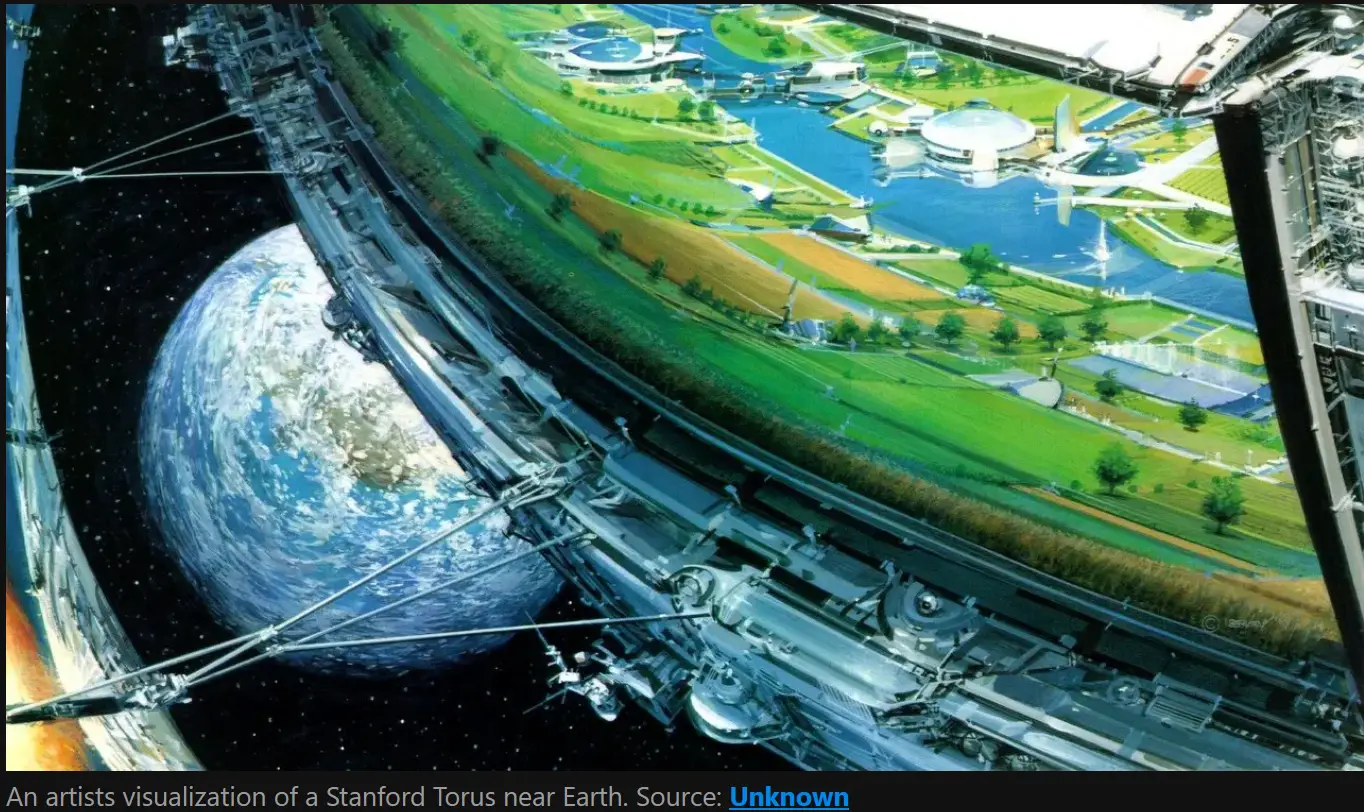
Stanford Torus. Source: Beyond Earth https://www.beyondearth.gg/documentation/space_habitats
Jeremy Lichtman‘s Multi-AI Oracle forecasts 25%
Obtaining outside data.
Checking internet sources, using keywords: space habitat human visit 2027
News from various sources:
To provide a more substantive analysis, more detailed and relevant information regarding advancements, projects, or schedules for space habitats is necessary.
Fact-checked summary:
The summary indicates a lack of substantial information regarding whether a new space habitat will be visited by humans before the end of 2027. This absence of specific details is important because it highlights the need for additional data to properly address the original question.
OpenAI gives a base rate of 0.3 (30%)
The question difficulty is rated 7 (0 to 10)
A Bayesian calculation could be performed as follows:
Combine historical factors and weigh against recent technological advancements and budget allocations. Given recent news lacks substantial progress, maintain similar probability as base rate, adjusting only slightly upwards due to ongoing general advancements in space technology
Bayesian base rate: 0.35 (35%)
Sufficient news to provide a good forecast? 0 (0 or 1)
News is relevant, topical and unbiased? 0 (0 or 1)
Question classification: scenario_based_forecast
Expected time (days) until question close: 671
The following were considered in order to produce this base rate:
The base rate was derived from historical data reflecting the frequency of new space habitats being visited by humans and the pace of space exploration advancements. Despite general progress, the lack of detailed plans and recent technological developments specific to new space habitats constrains the probability.
Ideally, the news feed would contain the following sorts of information for a better forecast:
More information about specific projects under development, their timelines, and any decisive steps by space agencies is needed. Additionally, geopolitical factors affecting space collaboration would be important.
Some potential divergent considerations that might affect the base rate:
Should new information surface indicating significant progress or hurdles, such as new international agreements on space exploration, technological breakthroughs, or budget reallocations, the probability may change substantially.
The following chain of events are necessary for the question to resolve positively:
- Development and launch of a new space habitat within the timeframe (Moderate likelihood)
- Successful testing and validation of life support systems within the space habitat (Moderate likelihood)
- Availability of a launch vehicle capable of ferrying humans to the space habitat (High likelihood)
- Approval from relevant space agencies for human missions to the habitat (Moderate likelihood)
Querying Claude (AI predicts: 0.15 – confidence: 6)
Querying Mistral (Error: Mistral is not returning an array)
Querying OpenAI (AI predicts: 0.35 – confidence: 6)
Explanations of the below statistical measures here —>
Question Type: Binary
Median from LLMs: 0.25
Base rate: 0.3 (from OpenAI)
SD: 0.1
MAPD: 0
Confidence: 6
Conf Mode: Normal
Mellers: 0.17
Reverse Mellers: 0.33
Theory of Mind: 0.25 (What did the LLMs think other LLMs predicted?)
Beta Distribution: 0.68
Close Type: B (B = cautious # closer to 50%; A/C = closer to extremes)
LLM responses: 2
Model value: 26%
The consensus among the AI predictions centers on the improbability of humans visiting a new permanent space habitat by the end of 2027 due to several key factors. Historical data suggests a low base rate for such events, given that no new stations have been visited since the ISS was operationalized in 2000. The tight timeframe of 22 months poses a significant challenge in terms of development, testing, and deployment of new habitats. While significant infrastructure efforts like Axiom, Orbital Reef, and Starlab are underway, none are expected to be ready by the projected date. The availability of launch vehicles like SpaceX Crew Dragon does not mitigate the extensive duration needed to create a habitable environment. Additionally, a lack of announcements and concrete plans further reduces confidence in near-term realization. Alternative scenarios, such as unexpected rapid advancements, classified projects, or loose interpretations of what constitutes a ‘new space habitat,’ could alter this outlook, but remain highly unlikely given current public knowledge and projected timelines.
Runtime: 133 seconds.
About The Author