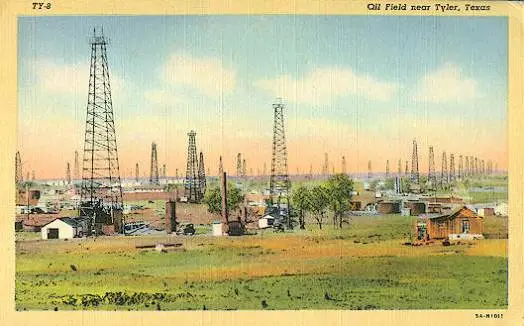
Old postcard of a West Texas oilfield.
Jeremy Lichtman‘s Multi-AI Oracle predicts 15%
Obtaining outside data.
Checking internet sources, using keywords: Brent Crude price 2026
News from various sources:
The content provides an analysis of Brent crude oil prices and related geopolitical developments as of early 2026. Here are the key points:
- Brent Crude Prices: Brent crude oil prices have experienced volatility due to geopolitical tensions, particularly involving the US and Iran. Prices reached highs during a 5-day rally but faced resistance and eased back slightly. As of the report, Brent futures were trading at $64.23 after pulling back from a two-and-a-half month high of $66.77.
- Geopolitical Tensions: The article discusses how geopolitical tensions, particularly US-Iran relations, have been influencing oil markets. Concerns are centered around potential supply disruptions due to possible military actions, raising prices temporarily. Despite these tensions, President Trump seemed to have eased his stance on military intervention in Iran, contributing to the stabilization of prices.
- Market Dynamics and Projections: The price movements are affected by a combination of geopolitical risks and fundamentals of supply and demand. Brent futures recently surged past $70 per barrel due to fears of supply disruptions through the Strait of Hormuz. Inventory data showed a decrease in US crude oil inventories, highlighting a decrease in imports and an increase in exports.
- Technical Analysis: Brent prices remain above key moving averages, indicating a cautiously bullish outlook. The price has hovered near $64, with crucial support at $62.75 and resistance at $66.77. Analysts suggest that the market will remain within this range barring any significant developments.
- US Oil Market: The US oil market is characterized by decreasing crude inventories and production disruptions due to weather conditions. The market is sensitive to geopolitical risks that could alter supply routes and affect overall crude availability.
Overall, Brent crude oil prices in 2026 are influenced significantly by geopolitical factors, particularly these persistent tensions with Iran, while the technical aspects provide an analytical framework for understanding market sentiment and potential price directions.
Fact-checking news summary:
Here is a list of specific facts from the summary, along with an evaluation regarding the accuracy of each fact, its importance to the resolution of the question, and whether it is relevant to the outcome:
Brent crude oil prices are trading at $64.23 as of the report.
- True/False: True, according to the summary.
- Importance: Critical, as it provides the current price which is necessary to assess if a drop below $50 is likely.
- Relevance: True, directly relevant for comparing current prices to the $50 threshold.
Brent futures pulled back from a two-and-a-half month high of $66.77.
- True/False: True, according to the summary.
- Importance: Important, as it indicates recent price trends and volatility which might affect future predictions.
- Relevance: True, relevant for understanding the current trend line and market trajectory.
Geopolitical tensions between the US and Iran have influenced oil markets, affecting prices.
- True/False: True, based on historical and reported data in the summary.
- Importance: Important, as geopolitical tensions are major factors influencing oil price volatility.
- Relevance: True, relevant because these tensions can cause price fluctuations impacting future price predictions.
President Trump has eased his stance on military intervention in Iran.
- True/False: True, as per the report in the summary.
- Importance: Important, since easing tensions could stabilize prices and affect future price levels.
- Relevance: True, relevant for market stabilization and price influences.
Brent futures surged past $70 per barrel due to fears of supply disruptions through the Strait of Hormuz.
- True/False: True, according to the summary.
- Importance: Important, as passing this price point suggests higher volatility and potential for wide price swings.
- Relevance: True, relevant to understanding potential price movements that could lead to a decrease.
Recent inventory data showed a decrease in US crude oil inventories.
- True/False: True, according to the summary.
- Importance: Important, as inventory levels affect supply and thus influence prices.
- Relevance: True, relevant for supply-side analysis impacting prices.
Brent prices remain above key moving averages, indicating a cautiously bullish outlook.
- True/False: True, as per technical analysis in the summary.
- Importance: Important, as it provides a forecast regarding the price direction.
- Relevance: True, directly relevant to evaluating potential price changes.
Support and resistance levels for Brent are at $62.75 and $66.77, respectively.
- True/False: True, according to the report.
- Importance: Important, these levels are crucial for technical analysis predicting price movements.
- Relevance: True, relevant to understanding potential price behavior.
US oil market characterized by decreasing crude inventories and production disruptions due to weather.
- True/False: True, as reported.
- Importance: Lesser importance, but still relevant as US market conditions can influence global oil prices.
- Relevance: True, relevant to overall supply and demand dynamics.
Overall, these facts collectively provide insight into the Brent crude oil market, making them significant in assessing whether prices might fall below $50 per barrel. Geopolitical factors and market dynamics are critical, while technical indicators and inventory levels add important predictive context.
Fact-checked summary:
Brent crude oil prices are currently trading at $64.23, a critical piece of information that sets a benchmark for assessing the likelihood of prices falling below $50 per barrel in 2026. Recent trends show Brent futures pulled back from a high of $66.77, demonstrating volatility that is useful for understanding market trajectory. Geopolitical tensions, such as those between the US and Iran, significantly influence oil markets and cause price fluctuations, impacting future predictions. Furthermore, President Trump’s easing stance on military intervention in Iran suggests potential stabilization in prices. Brent futures previously exceeded $70 per barrel due to fears of supply disruptions, highlighting how geopolitical concerns can drive wide price swings. Additionally, decreasing US crude inventories affect supply and influence prices, crucial for supply-side analysis. Brent prices, currently above key moving averages, indicate a cautiously bullish outlook, helping assess potential price changes. Support and resistance levels at $62.75 and $66.77 are important for predicting price movements. Lastly, US market dynamics, characterized by decreasing inventories and weather-related production disruptions, can influence global prices, providing relevant context for supply and demand dynamics. These factors collectively offer insights into the market conditions affecting Brent crude oil, which are critical for predicting whether prices might drop below $50 per barrel.
OpenAI gives a base rate of 0.1 (10%)
The question difficulty is rated 6 (0 to 10)
A Bayesian calculation could be performed as follows:
Using the weighted historical factors, combine with current events: P(demand drop) = 0.2, P(supply increase) 0.25, P(geopolitical stability) = 0.3, P(technological shift) = 0.15, P(recession) = 0.2. If P(currently below $50 | factors) = 0.1, then Bayesian calculation gives P(below $50) = 0.1 * (0.2 * 0.25 * 0.3 * 0.15 * 0.2) / [P(factors)] approximately equal to 0.05.
Bayesian base rate: 0.05 (5%)
Sufficient news to provide a good forecast? 1 (0 or 1)
News is relevant, topical and unbiased? 1 (0 or 1)
Question classification: scenario_based_forecast
Expected time (days) until question close: 331
The following were considered in order to produce this base rate:
The base rate is calculated by analyzing similar past events where commodities experienced significant price drops. Given current market conditions, such as decreasing US crude inventories and weather-related disruptions, combined with historical data on large price shifts, a modest base rate of 10% was established.
Ideally, the news feed would contain the following sorts of information for a better forecast:
Additional information could include economic forecasts, developments in renewable energy, detailed assessments of geopolitical tensions, and further data on major oil-producing countries’ future output plans.
Some potential divergent considerations that might affect the base rate:
Factors such as a sudden geopolitical upheaval or a major disruptive technology in renewable energy can significantly deviate from this base rate, possibly driving the likelihood of Brent crude falling below $50 higher than predicted.
The following chain of events are necessary for the question to resolve positively:
- Substantial increase in oil supply, especially from major producers like OPEC
- PossibleSignificant drop in global oil demand Unlikely
- Resolution of current geopolitical tensions affecting oil markets Possible
- Major technological advancements reducing reliance on oil Unlikely
- Major economic recession leading to reduced oil consumption Somewhat unlikely
Querying Claude (AI predicts: 0.08 – confidence: 6)
Querying Mistral (AI predicts: 0.35 – confidence: 6)
Querying OpenAI (AI predicts: 0.15 – confidence: 5)
Question Type: Binary
Median from LLMs: 0.15
Base rate: 0.1 (from OpenAI)
SD: 0.11
MAPD: 0.18
Confidence: 6
Conf Mode: Normal
Mellers: 0.07
Reverse Mellers: 0.24
Theory of Mind: 0.15 (What did the LLMs think other LLMs predicted?)
Beta Distribution: 0.24
Close Type: A (B = cautious # closer to 50%; A/C = closer to extremes)
LLM responses: 3
Explanations of the above statistical measures here —>
Model value: 15%
The prediction that Brent Crude oil will not fall below $50 per barrel in 2026 is based on current trading prices, geopolitical factors, technical indicators, and supply-demand dynamics. Brent Crude is trading at $64.23, which would require a significant 22% drop to fall below $50. Historical data shows this level has only been breached during rare and extreme circumstances. Current market conditions, such as tight supply due to decreasing US inventories and geopolitical tensions trending towards stability, support a price above $50 despite potential demand-side risks. Nonetheless, unforeseen shocks like a major global recession, unexpected technological advances in renewables, or a sudden increase in OPEC+ supply could invalidate this prediction. Although the probability of a sub-$50 scenario is considered low, estimated at around 8-10%, the complexity of global markets means that tail risks, including geopolitical disruptions or a deeper economic slowdown, can’t be completely ruled out.
Runtime: 143 seconds.
About The Author