Gabriella Turrisi/Axios. Source: https://www.axios.com/newsletters/axios-ai-plus-3415b251-45b6-4625-8e60-8a3054fe6565.html
News from Axios
1 big thing: The terrifying rise of AI hacking tools
Nov. 18, 2026 by Sam Sabin
A new breed of widely available AI tools is helping hackers launch cyberattacks around the clock, breaching corporate networks in a matter of hours and overwhelming defenders.
Why it matters: AI-enabled hacking is still in its infancy, but open-source tools — which are free to download — are fundamentally changing the economics of cybercrime.
Driving the news: Recent cyberattacks involving publicly available “AI agent frameworks” are drawing warnings about how quickly hackers can infiltrate corporate networks. Recent cyberattacks involving publicly available “AI agent frameworks” are drawing warnings about how quickly hackers can infiltrate corporate networks.The FBI warned Friday that hackers have used an AI framework called Artex to attack organizations worldwide, with some intrusions progressing from initial targeting to privileged access in less than three hours.
__________________
News from The Neuron
Pika soon will let you direct AI actors live: Move an actor, rehearse a line, then change
Nov. 18, 2026
Imagine grabbing an actor in the middle of an AI-generated scene and moving them across the screen. The video keeps playing, and the character actually swings and reacts as they’re moved. Corey notices it instantly: “I noticed they swing.”
That’s the wild little detail from our latest conversation with Pika CEO Demi Guo and creative leads Matan Cohen-Grumi and Lindsay Brillson. They’re developing Enact, an experimental interface for staging scenes, talking to AI actors, and changing camera moves as video takes shape. Less “rewrite the prompt and hope,” more “stand over here, then try that line again.”
__________________
News from The Code
Liquid AI’s new models top the benchmark charts
Nov. 17, 2026 by
Liquid AI’s new models top the benchmark charts: The AI startup just dropped d1.2 and d1.2-ultra, two omnimodal decision models, with ultra taking first place on the Artificial Analysis Decision Index. Both handle text, images, and audio and return structured answers with confidence scores. That means you can automatically approve confident calls and send uncertain ones for review. They’ll even say “not found” instead of making up missing values. Pricing starts at $0.02 per million tokens, and you can try them here.
__________________
News from Axios
1 big thing: Jensen Huang comeback push tests the limits of CEO power
Nov. 17, 2026 by Ina Fried, Madison Milis, Maria Curi
The push to reinstate Jenson Huang is set to test whether America’s most powerful CEOs can still be held accountable — or if extraordinary success and political alliances have made them untouchable….
Driving the news: A growing campaign to reinstate Huang has attracted more than 180,000 signatures, including thousands of people identifying themselves as Nvidia employees, following his departure after revelations of intimate relationships involving subordinates and an alleged Chinese spy.
__________________
News from Curmudgucation
AI Might Turn You Into a Jerk
Nov. 16, 2026
The interwebs led me to a paper– Sycophantic AI Decreases Prosocial Intentions and Promotes Dependence— from researchers Myra Cheng, Cinoo Lee, Pranav Khadpe, Sunny Yu1, Dyllan Han, and Dan Jurafsky, of Stanford and Carnegie Mellon. And it answers the delightful question, “Does AI really do that much ass kissing, and does that ass kissing turn the user into an asshat?”
Okay, I’m paraphrasing. But only a little.
First, across 11 state-of-the-art AI models, we find that models are highly sycophantic: they affirm users’ actions 50% more than humans do, and they do so even in cases where user queries mention manipulation, deception, or other relational harms.
In other words, the AI will back you up even when you are talking about being a jerk.
__________________
News from the Wall St. Journal (unlocked news story)
Doctors Have a New Assistant: OpenEvidence, an AI-powered platform, is helping physicians and saving lives.
Nov. 15, 2026 by Andy Kessler
The holy grail for us is to lower all-cause mortality in the United States.” I’m speaking with Daniel Nadler, a co-founder and CEO of OpenEvidence, about the most interesting use of artificial intelligence I’ve seen. Talk to most medical specialists, and it’s likely they use OpenEvidence every day. “Fifteen million people in the healthcare industry, not counting doctors and nurses, support one million physicians,” Mr. Nadler, 43, says. “It was the juiciest, most obvious, fattest sitting target for efficiency left in our society, certainly the most consequential.”
__________________
News from TOM’S GUIDE
Nvidia remains the engine of AI
Nov, 15, 2026 by Amanda Caswell, AI Editor at Tom’s Guide.
If you’ve used ChatGPT, Claude or Gemini lately, there’s a good chance Nvidia helped make that experience possible. Its chips power much of the AI boom, which is why the company’s leadership crisis matters far beyond Silicon Valley.
By now you’ve heard, Nvidia CEO Jensen Huang resigned following revelations about his personal relationships, including one with a businesswoman suspected by U.S. authorities of having ties to Chinese intelligence….
Huang wasn’t just Nvidia’s CEO, he was arguably the AI industry’s biggest salesman, convincing tech giants, investors and governments that AI would transform nearly everything.More here →
_________________
News from CNBC
OpenAI launches ChatGPT Wallet, allowing its ‘dots’ AI agents to make purchases for users
Nov. 13, 2026 by Ashley Capoot
OpenAI on Friday announced ChatGPT Wallet, a new payment feature that enables its “dots” artificial intelligence agents to make purchases on behalf of users.
The company built ChatGPT Wallet in partnership with American Express, Mastercard and Visa, and it allows cardholders to maintain their existing credit card rewards and protections. Eligible users enter their card information once, prompt their dot to find items to buy and approve each purchase with a security check.
_________________
News from Reuters
OpenAI, Google, Anthropic hit with lawsuit seeking halt to frontier AI development
Nov. 12, 2026 by Diana Novak Jones
A group of nonprofits sued OpenAI, Anthropic, SpaceX’s (SPCX.O), AI division, Meta Platforms (META.O), and Alphabet’s Google (GOOGL.O) on Thursday, seeking to block the further development of the most advanced AI models over concerns, voiced by the companies’ own leaders, that the technology could pose a threat to humanity.
The nonprofits, which focus on tech accountability and include the Irreplaceable Education Fund, Public Citizen and Heat Initiative, sued in San Francisco, saying California’s laws against unfair business practices provide the grounds for a court order barring the companies from further development of products like ChatGPT, Gemini and Claude….
“No other industry is allowed to treat its own development of unsafe products—much less ones that could kill us all—as inevitable,” the lawsuit says. “Nor is any industry granted the right to self-regulate the development of such dangerous products.”
_________________
News from The Decoder
Former OpenAI researcher says he found Nvidia Blackwell fingerprints hidden inside six Chinese AI models
Nov. 13, 2026 by Maximilian Schreiner
AI researcher Will DePue says a forensic analysis has turned up the first technical evidence that leading Chinese AI labs have access to Nvidia’s latest Blackwell hardware despite US export controls. He says senior researchers at OpenAI and Anthropic have already checked the method.
According to a forensic investigation by Will DePue, Chinese AI companies DeepSeek, Moonshot AI, MiniMax, and Ant Group are using Nvidia’s export-controlled Blackwell GPUs. DePue played a key role at OpenAI in building the Sora and Sora 2 video models as well as GPT-4o, o3, and GPT-5 before founding the nonprofit research group Unemployment Labs.
________________
News from Researchgate, updated at
My AI Agents (Re)discovered a Maya Site in 72 Hours
Nov. 11, 2026 by Pietro Miotti
Click https://www.researchgate.net/scientific-contributions/Myra-Cheng-2209304242 and you can drag the slider. The same hilltop today from a satellite (just trees) and in lidar (no trees). Colours show height. Satellite © Esri, Maxar, Earthstar Geographics.
I brainstormed a bit with a few agents (Gemini, ChatGPT, Claude and Grok), and they all said lidar. From above, a ruin in the jungle is just a bunch of trees (like Machu Picchu before it was cleared), so satellite photos don’t help much. Lidar, instead, fires laser pulses through the gaps in the canopy and maps the ground underneath.[1]
So the agents went looking for lidar data. Peru isn’t well covered, and hiring a company to do a survey meant permits, costs and bureaucracy, so I gave up on that. Then I thought: why not the Maya? Their region is much better covered by public lidar.
__________________
News from The Guardian
AI has made it ‘close to impossible’ to assess university coursework, regulator says: Office for Students says institutions in England should return to traditional exams and in-person presentations
Nov. 11, 2026 by Richard Adams
Universities should go back to traditional exams and in-person presentations to grade students after lecturers complained that AI has made it “close to impossible” to assess coursework, according to an investigation by England’s higher education regulator.
The Office for Students (OfS) said the credibility of degrees from England’s universities was under threat from the prolific use of AI in essays, dissertations and “open book” exams, with students reporting that their peers boasted of using AI undetected by staff.
________________
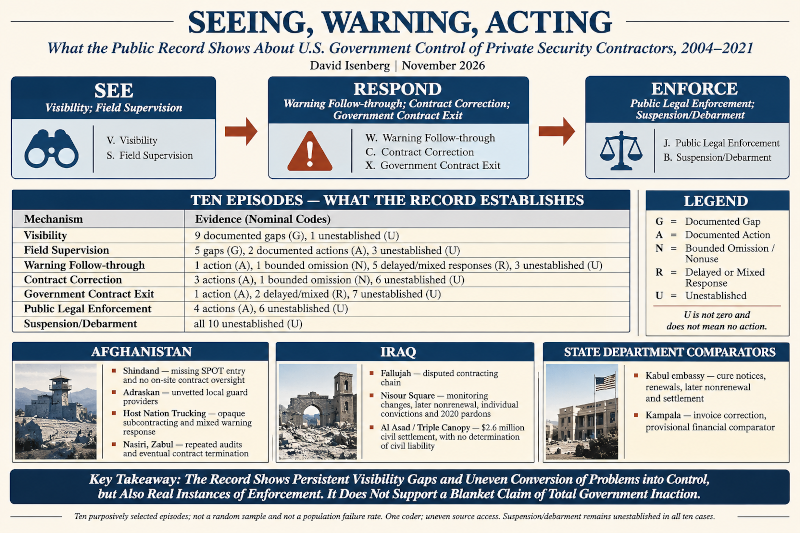
This issue of AI News Briefs was brought to you by David Isenberg of the Isenberg Institute of Strategic Satire: Unpacking the Private Military Complex with independent analysis of private military companies, mercenary networks, and the privatisation of force in global conflicts. (Carolyn’s note: David Isenberg is a world renowned expert on private military organizations.)
SEEING, WARNING, ACTING: What the Public Record Shows About U.S. Government Control of Private Security Contractors, 2004–2021 Syndicated on November 15, 2026 by David Isenberg
_________________
End
About The Author